It was based on Article 6, paragraph 5 of the UNESCO Statute, which obliges the Director-General to avoid actions that could harm his status as an international official.
However, it is unclear on what grounds M. Zacharova equated the UNESCO Director-General’s visit to Kyiv with a violation of the organization’s statute.
The mentioned Article VI, paragraph 5 does not state a prohibition on visiting one country or another, but rather the obligation of UNESCO leadership and staff to remain independent from national governments:
“The duties of the Director-General and staff are exclusively international in nature. In performing their duties, they must not seek or accept instructions from any government or other authority not belonging to the Organization. They must refrain from any actions that could harm their status as international officials.
Each Member State of the Organization undertakes to respect the international nature of the duties of the Director-General and staff and not to seek to influence them in the performance of their duties,” reads Article VI, paragraph 5 of the United Nations Educational, Scientific and Cultural Organization (UNESCO) Constitution.

Visiting war-torn countries is not prohibited
In other words, this provision of the UNESCO Constitution establishes the independence of the organization’s Director-General and staff from individual state governments – they cannot accept their instructions or succumb to political influence.
However, it does not contain any prohibition on visiting a country affected by war or meeting with its authorities. On the contrary, the protection of cultural heritage during conflicts is one of UNESCO’s most important functions.
The UNESCO Constitution Article I, paragraph 2(c) assigns the organization the duty to care for the preservation and protection of the world’s books, works of art, and monuments of history and science.

Obligation to document damage
Under war conditions, it is necessary to assess the condition of objects, document the damage caused, and coordinate their protection measures. UNESCO leaders and experts have repeatedly traveled to conflict zones in Iraq, Syria, Libya, Yemen, and Mali, where they assessed destruction and helped organize technical and financial assistance.
The necessity for UNESCO to provide such assistance, including the involvement of experts to assess the condition of cultural assets, is directly stipulated in Article 23 of the 1954 Hague Convention.
It states that States Parties to the Convention may request technical assistance from UNESCO, and the organization itself, without exceeding its program and available resources, may also offer its proposals.
Since the Director-General is the chief administrative officer of UNESCO and responsible for implementing the organization’s mandate, as provided in Article VI of the UNESCO Constitution, he may visit conflict-affected countries upon invitation or consent of the host country to assess on-site the damage to cultural heritage and the possible need for assistance.
M. Zacharova also accused UNESCO of applying “double standards” and allegedly supporting one side of the war. However, such an argument is misleading.
Article 100 of the UN Charter and Article VI of the UNESCO Constitution establish that officials of international organizations must be independent from the authorities of individual states – they cannot accept government instructions or act in their interests.
However, impartiality does not mean that UNESCO must equally assess the aggressor and the attacked state or ignore decisions adopted by the UN.
The UN General Assembly resolution ES-11/1 “Aggression against Ukraine” of March 2, 2022 clearly identifies Russia’s actions as aggression against Ukraine. Therefore, UNESCO, by documenting damage to cultural heritage and providing assistance to Ukraine, does not violate the principle of impartiality – it is fulfilling its mandate and relying on the legal assessment established by the UN.
Even more manipulations
M. Zacharova also tried in her statement to link the UNESCO leader’s visit with broader propaganda narratives about Ukraine.
She claimed that the country’s children’s education had turned into a “neo-Nazi drill,” and called the visit to Kyiv Pechersk Lavra a staged spectacle. She also accused the Ukrainian authorities of damaging a UNESCO World Heritage site and said that the organization’s Director-General ignored these circumstances.
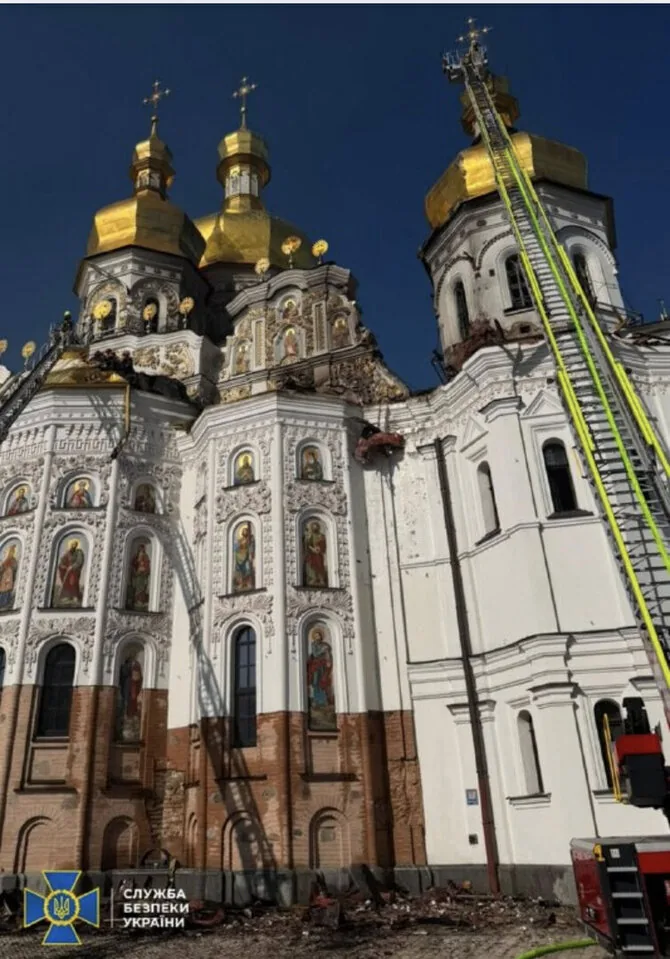
Moreover, M. Zacharova disputed the information provided by Ukraine about the damage to the Assumption Cathedral in June 2026: based on the Russian Ministry of Defense’s version, she claimed that the Lavra complex was allegedly hit by a US-made Patriot air defense missile.
She, in turn, called UNESCO’s reports on the incident politically biased and claimed that such assessments allegedly exceeded the organization’s mandate.
15min verdict: false. M. Zacharova’s claim that the UNESCO Director-General’s visit to Kyiv contradicted the organization’s statute and violated the principle of impartiality is unfounded.
The mentioned Article VI, paragraph 5 of the UNESCO Constitution prohibits the Director-General and staff from accepting instructions from national governments or acting in their interests, but it does not prohibit visiting war-affected countries.
On the contrary, the protection of cultural heritage, damage assessment, and coordination of assistance are direct parts of UNESCO’s mandate. The visit to Ukraine, including the visit to the war-damaged Kyiv Pechersk Lavra, did not contradict this mandate.
Publication prepared by 15min in cooperation with Meta, aiming to stop the spread of misleading news on social media. More about the program and its rules – here.
Read more In the early morning – Lunar eclipse: where is the best place to watch?