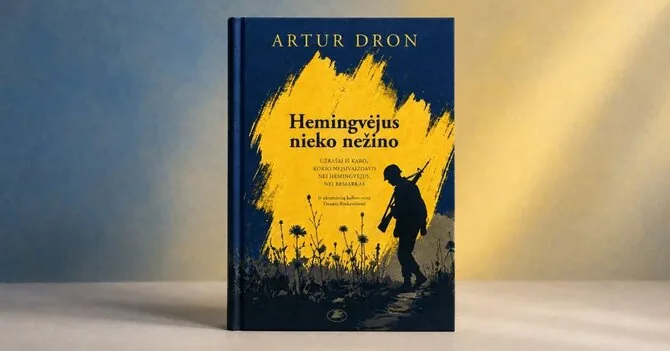
In this work, a 25-year-old writer records the extreme human experiences, revealing how this war is different from the one depicted in the works of 20th-century literary classics. It is a fight where there is no room left for romanticizing or humanizing the enemy. In a poetic narrative imbued with cruelty and beauty, death, suffering, and faith become the cornerstones of a new reality.
Read more Third checkpoint test: Lithuania – University of Michigan
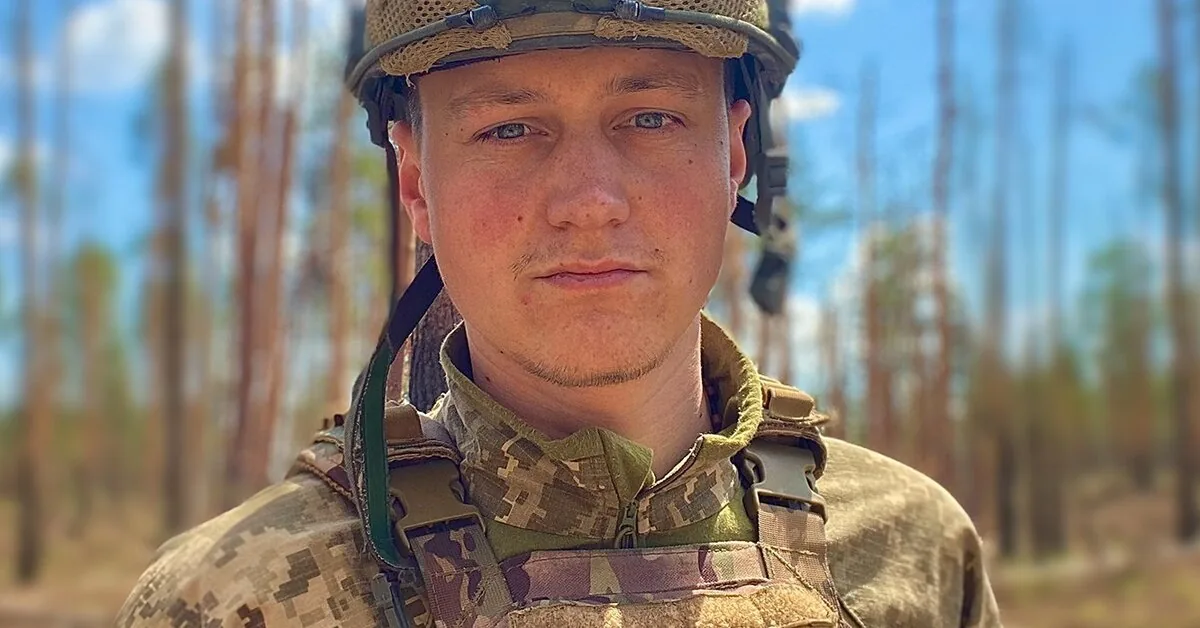
A. Dronis is a poet, author of the books “Dormitory No. 6” and “Here We Were,” an infantryman in the Armed Forces of Ukraine, who voluntarily joined the 125th Territorial Defense Brigade of Ukraine just a few days after the Russian invasion, choosing the call sign Dovydas and serving until he was seriously wounded. Initially, he carried out combat missions in the Kharkiv direction, and later his brigade was transferred to the Zaporizhzhia front.
This year, A. Dronis’s book of poems “Here We Were” was published in Lithuanian (publisher “Baziliskas”).
“Hemingway Knows Nothing” is the author’s debut prose and memoir book, written while recovering from a serious injury. This book was published by the Lithuanian Writers’ Union Publishing House (translated from Ukrainian by Donata Rinkevičienė, cover artist Milena Liutkutė-Grigaitienė). All profits from the sales of this book will be donated to “Blue Yellow” – an organization supporting Ukrainian soldiers.
We offer readers an excerpt from this book.
Hemingway Knows Nothing
Hemingway stayed with me in Donbas until about the end of October. When we first hid from shelling in a house in Torske, he was still with me. One Mykola – that saint – looked at us from a large church calendar on the wall, and another Mykola, the deputy commander of the battalion, unbuckled his helmet strap and lit a cigarette. We talked with his son Tura about books; I told him about Hemingway’s novel “Islands in the Stream,” about fathers and sons during World War II.
I started 2022 with Hemingway, but back then I knew nothing. When I got a rifle in March of the same year, I named it Ernest. When in September Hemingway’s literary executor Michael Katakis mentioned me at the “Book Forum,” I wrote him a reply letter. Later, in October, sitting with my comrades in a trench in the Donetsk region, I told them how young and poor Hem believed he would change literature.
No, my decision to go to war had nothing to do with love for Ernest Hemingway. No, I was not looking for the romance of war. And certainly not, I was not seeking heroism.
Yes, Hemingway was important throughout my youth. Yes, after going to war, I still admired him. And definitely yes, until then I only understood war from Hemingway’s books.
Soon my comrades already knew who Michael Katakis was and what the restaurant “La Closerie des Lilas” was (A Paris restaurant on Boulevard Montparnasse, popular among artists and creators in the early 19th century. It was frequented by James Joyce, Pablo Picasso, Émile Zola, F. Scott Fitzgerald, Ezra Pound, Gertrude Stein, and Ernest Hemingway, who mentioned this place in his works. Author’s note), where he would treat us all.
“Will he seriously buy us drinks?” asked Kieša.
“Man, anyone will buy us drinks,” I replied. “We’ll say that while we were starving in the trenches under shelling, the only thing that saved us was the thought of Michael Katakis treating us to drinks. Basically, it was only this thought that kept us alive…”
War had already made us cynics. And a bit witty.
And then it left us without Ernest Hemingway.
I long believed in Hemingway’s words, but I got a completely different war than he saw. In 2022 it became clear that Ernest Hemingway would not tell me the most important thing about what has been happening to us since 2014.
I first read his “The Sun Also Rises” at sixteen, and for many years it became my favorite book. I went crazy over the Hemingway series published by “Vydavnyctvo Staroho Leva,” awaited new editions, and wrote to the publisher on Messenger about how beautifully designed their books were. When I came there for an internship, my first text was a review of “Islands in the Stream.” When I started working in the public relations department, I contributed to the promotional campaign for the last book in the series, “The Snows of Kilimanjaro.” When I started writing myself, Ernest Hemingway was my constant example. And when I got my war, I lost Ernest Hemingway forever.
No, I don’t think Hemingway unrealistically describes war. No, I don’t think he lacks personal experience. And I certainly don’t think I am superior to him.
Yes, our shared youth ended. Yes, we said goodbye and went our separate ways. And definitely yes, that is the best decision for both of us.
Hemingway knows nothing about the Russia-Ukraine war. That’s all.
I long believed in Hemingway’s words, but I got a completely different war than he saw. In 2022 it became clear that Ernest Hemingway would not tell me the most important thing about what has been happening to us since 2014.

We talked a lot about this with French journalist David Di Nota, whom I met in Lviv on February 25. I was recovering from an injury, and he was gathering material about Ukrainian soldier-writers.
“But you two are so similar,” says David. “You both went to the front so young. And what you say about the sincerity of writing, he said that himself!”
“Some people in Ukraine say about my peers: ‘They are just kids, what do they understand? They went to the front because they wanted to be heroes,’” I answered the journalist. “That’s what they have in mind about Hemingway. The First World War took place across the ocean and posed no threat to the writer or his family. Nineteen-year-old Ernest went to the front to become a hero, to embark on an adventure.”
But we had to grow up and understand that the front came to us. That this war is happening here and threatens everything and everyone we love. Yes, Hemingway and I went to war. But the difference is that I would never have wanted to be in a war.
The young Hemingway participated in the war because he wanted to. And it was a foreign war that did not threaten his nation. But young Ukrainians fight because they must. This is a war for our survival.
The young Hemingway participated in the war because he wanted to. And it was a foreign war that did not threaten his nation. But young Ukrainians fight because they must. This is a war for our survival, from which fleeing or surrendering would mean the death of the entire nation.
Yes, David and Dovydas quickly agreed. We sat each on our own chair in a café, and on the third was placed a drone that the journalist was delivering to writer and soldier Yaryna Chornohuz. The Frenchman has been in Ukraine more than once and, besides journalistic work, volunteers.
“Do you know what Hemingway’s worst novel is?” asks David. “For Whom the Bell Tolls.” It was supposed to be full of courage and heroism, feats and war stories. I liked this book in my youth. But now I visit Ukraine, talk to soldiers. And when I talk about this novel somewhere, I say: ‘People in war don’t talk like that!’ You Ukrainians revealed this to me. I saw the people of war, and they are nothing like Hemingway described. In this respect, he really knows nothing. ‘For Whom the Bell Tolls’ is his weakest novel.”
“He told about the war most distant from him,” I agree. “And Hemingway’s best book is ‘The Sun Also Rises.’ It has no descriptions of battle actions, only young people who love and argue with each other. In this novel, he best revealed war because he wrote not about it, but about the people touched by it.”
Talking with David, I remembered a conversation with Giles Sutherland. I needed a counterbalance to my previous experience, and I got it. The French journalist is really very conscious, his approach very mature.
“I have my own opinion about the concept of Europe,” says David. “I think Europe is like a spirit. It constantly travels. Once Europe was based in France. Later there was a period when the largest part of Europe was concentrated in Belgium.”
But now Europe is undoubtedly in Ukraine. You all show us what it means to be Europeans. What it means to defend your right to freedom. To defend both yourself and everyone else. I keep coming to you because that’s how I return to the real Europe.”
I talked with the journalist for three hours. About Ukrainian writers at war. About young people at war. About faith in war and loyalty to values. And later we returned once again to the old friend.
“You still look very much like him,” repeats David, which I no longer want to hear. “Just as hot-headed. You also speak passionately about literature and the need for new writing. You are similar, no matter how much you deny it, how much you contradict it.”
“Maybe that’s why I contradict. When I say he knows nothing, I admit that I myself know little. It’s just that we don’t need him. In Ukraine, people often ask when ‘our Hemingway’ will appear. But he won’t appear because he knows nothing about us. Hem condemns war but seeks it. And we need our own voice.”
At home, some condemn David for buying drones for Ukrainians. But David, like us, is a European. A true, understanding European.
“They say I finance massacres this way. But this is our main task – to destroy the Russians who brought the war.”
We leave the café, David carries a bag with the drone. A few days later he writes to me that he successfully delivered it. And leaves for London. And returns here, to Europe. I often remember our conversation as I remember Hemingway himself – with gratitude. And here everything is intertwined. And the sun sets like this. And the sun rises like this.