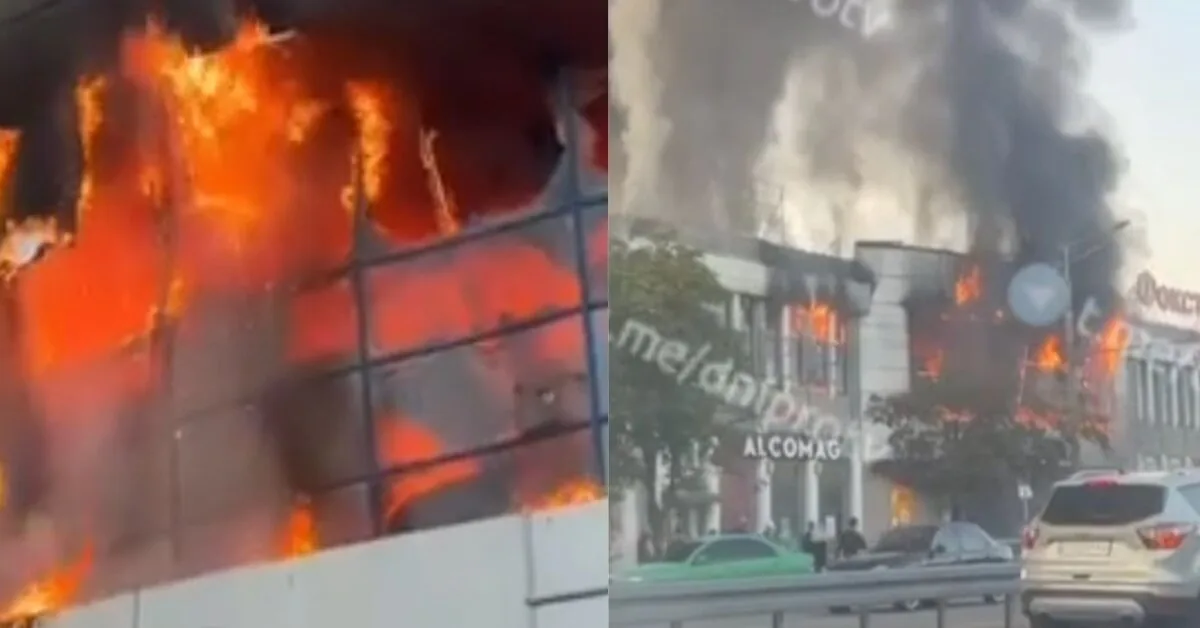
Oil refineries and tanker terminals are located very close by, making the region an increasingly frequent target of Ukrainian attacks in Russia.
Ukrainian military officials emphasize that they strike only Russian military and energy infrastructure. According to them, drones that fall in civilian areas are intercepted by air defense systems or electronic warfare measures before reaching their targets, the article explains.
Due to drones buzzing overhead and oil spilled in the sea, the number of tourists has decreased by 10.8% compared to last year, Dmitry Bogdanov, chairman of the Association of Hotel Owners in Southern Russia “AMOS,” told journalists.
It seems that the potential threat has also deterred the most famous vacationer in the region – the Kremlin’s host Vladimir Putin, who has an official residence in Sochi and luxurious mansions built for his personal use near Gelendzhik.
As noted by the Financial Times, Putin visited Sochi 24 times in 2021, the last year before launching a large-scale invasion of Ukraine. However, in 2024 and 2025, he visited only twice, according to data from the Kremlin’s official news website. The last time he appeared in Sochi was in October last year, and since then he has mostly spent time in Moscow and Saint Petersburg, as well as another residence near Lake Valdai in northern Russia.
Next month, State Duma elections will be held in Russia. In turn, Putin has intensified trips around the regions, but most of them have been spent east of the Urals. In other words, beyond the range of Ukrainian drones.
However, ordinary Russians continue to flock massively to the sea. Beaches and seaside cafes on the Black Sea coast remain crowded as before. The Financial Times noted that this indicates that daily life and war are increasingly intertwined in Russia.
Sirens wail several times a day
As told by a manager from Voronezh who came to Sochi in June with his preschool-aged daughter, he was concerned about polluted water and drone attacks, so he avoided the sea and instead swam in the hotel pool.
The trip, he said, was far from ideal, but Alexey had little choice: his employer is now classified as part of the military-industrial complex, and like an increasing number of Russians, he is forbidden to leave the country.
The captain of a tourist boat in Arkhipo-Osipovka, in an interview with the Financial Times, noted that until the fatal incident on the beach this month, “sirens almost never went off”; now they wail “several times a day.”
On the beach, vacationers mostly appear calm during danger signals – few seek shelter, the AP agency reports.
Read more Horoscope for August 21: This could be THE day for 3 zodiac signs
The owner of a guesthouse in Kabardinka, another Black Sea resort in Krasnodar Krai, said that this summer’s bookings allegedly remain at last year’s level, and some people “didn’t even ask how things were.” Even after the strike on the Arkhipo-Osipovka beach, she said, visits were canceled only twice.
More than half of Russians have never been abroad
Recent surveys show that more than 65% of Russia’s 146 million population have never been abroad, and 30% have never left their native region.
After Russia began its invasion in 2022, many Western countries stopped issuing tourist visas to Russians, airlines suspended flights, and even international payments using Russian cards became impossible.
Fewer and fewer alternatives remain
Now more than 80% of Russian travel consists of domestic tourism, according to Ostrovok – one of Russia’s main holiday booking operators. Krasnodar Krai accounts for 11% of all bookings. However, this coastal stretch has also become a magnet for Ukrainian drones.
Novorossiysk is the most important oil export port and the final stop of the Caspian Sea consortium pipeline, through which 80% of Kazakhstan’s exported oil passes.
Nearby Tuapse has one of Russia’s largest oil refineries, most of whose capacity Ukraine “shut down” last spring. The strikes also caused two major oil spills, with patches visible in the sea even in satellite images.
Beaches in Anapa – a Soviet-era resort with summer camps lined up along its shallow coast – were closed after an oil tanker sank in the Sea of Azov in 2024.
Volunteers helped clean the coast, which was reopened only in June after authorities brought in hundreds of thousands of tons of new sand. However, environmentalists fear that there may still be fuel oil underneath.
Spills and drone attacks have not only caused fear but also dealt a blow to local tourism. Some hotels recorded a 20% drop in bookings, and tickets to Sochi – the main airport serving Russia’s Black Sea resorts – bookings, according to a person with access to the largest Russian holiday booking platform data, fell by 40% compared to last year.
In turn, in occupied Crimea, due to constant Ukrainian shelling, fuel, water, and electricity are rationed under emergency rules. Journalists emphasized that Russians seeking seaside vacations have fewer and fewer alternatives.