







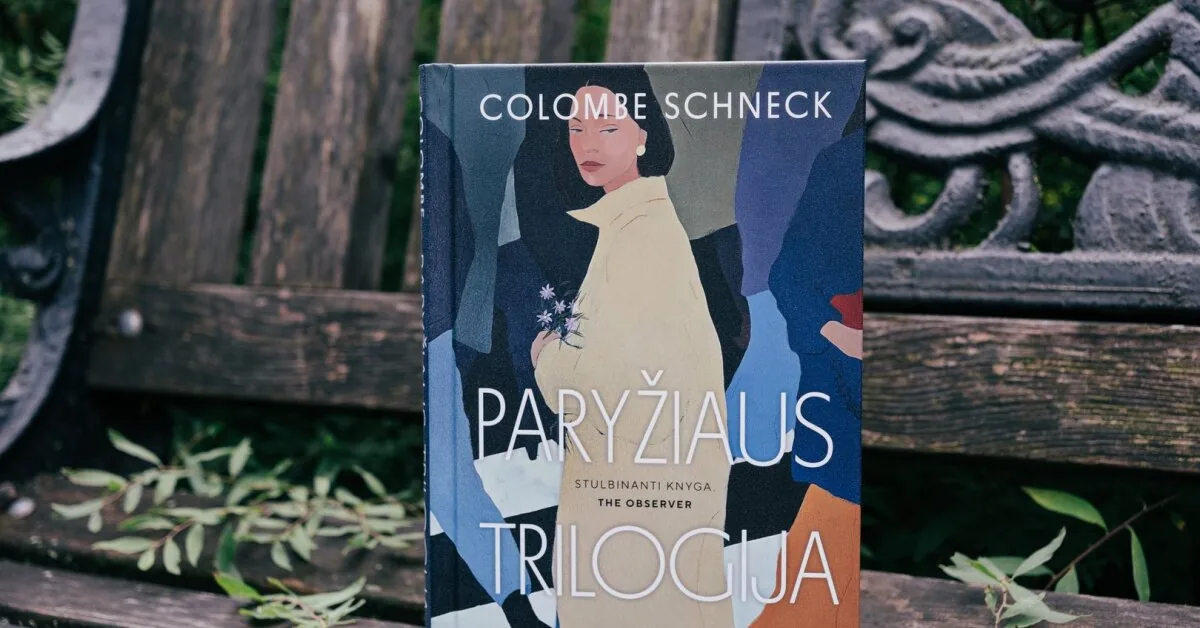
In the internationally acclaimed novel trilogy, C.Schneck reveals a personal world where inner struggles clash with societal expectations and become universal experiences. Through deeply personal experiences, the author speaks about what is familiar to many: moments when the body betrays, when one has to face painful loss, and when one finally learns to trust their body again – to accept oneself and move forward.
Read more TEA: war in the Middle East has significantly increased electric vehicle sales
Roots of the Lithuanian writer
For Lithuanian readers, the “Paris Trilogy” may be close not only because of universal themes. The book’s author – French journalist, director, and writer C.Schneck – has Lithuanian roots. Her grandmother Ginda was born and raised in Kaunas, but after marriage moved to Paris. The grandmother’s family remaining in Lithuania was imprisoned in various ghettos during World War II, and only a few of the writer’s relatives survived.
C.Schneck’s mother asked her to name her daughter Salomé in memory of their relatives. “Salomé was my mother’s cousin who died at just nine years old in Auschwitz. My daughter shares her name and light hair,” the author says.
Painful experiences of women hold an important place in C.Schneck’s work, but the author avoids moralizing or offering a single correct answer. She has written a dozen books, for which she has received the country’s most important awards – from the French Academy, the French Writers’ Union, and Madame Figaro prizes, and has also been shortlisted for the Renaudot and Femina prizes. Translated into more than ten languages, the “Paris Trilogy” brought the author international recognition.
Journey: reconciliation with one’s body
The “Paris Trilogy” consists of three parts – like different stages of the author’s life, combined into one book. C.Schneck tells about French society at the end of the 20th century, dominated by distinct social roles and high expectations. It is a story about a woman experiencing great love, a painful scar left by abortion, strong friendship, unexpected divorce, and personal growth. Although each part of the trilogy tells about different life experiences, they are all united by the effort to find oneself and remain in a society constantly trying to draw boundaries on what a person should be.
C.Schneck continues the tradition of painful and candid stories about women’s experiences. She speaks openly about the body, loss, self-confidence, and trust in others. The author was inspired to take this step by the Nobel Prize in Literature laureate Annie Ernaux, well known in Lithuania, who openly and boldly discusses complex women’s decisions in her work, such as abortion and its consequences for a woman’s life. The first part of the “Paris Trilogy” is dedicated to her.
Three life breaks
In the first part of the “Paris Trilogy,” “Seventeen,” C.Schneck tells about a teenager who feels free, unrestrained, and capable of conquering the world. At seventeen, the girl unexpectedly becomes pregnant, forcing her to enter the adult world early. Her body becomes a great challenge – it seems to betray her, take away freedom, and painfully limit movements and choices.
Read more Vaidas Baumila arriving at the night VIP party is unrecognizable: changes one after another
In the second part, “Friendship,” the narrator painfully experiences the loss of her closest friend. It is a story about an inspiring, pure, and enchanting friendship between two women that began in childhood. According to C.Schneck, such a bond allows one to be oneself – such friendship has no rules or expectations about who you should be. That is why the loss of a friend is especially painful, and the second part of the “Paris Trilogy” is marked by mourning and the attempt to reconcile with loss, heal, and let go.
In the third part, “Swimming,” the narrator discovers a love for swimming. It becomes a kind of meditation that helps protect against the relentless flow of thoughts, guilt, or feelings of inadequacy. In this story, the body gradually becomes an ally of the mind and thoughts. The author has repeatedly said that she aims to write as one swims – without movements that waste energy unnecessarily, without extra commas or words that add nothing to the text.
Behind the elegant Paris facade
C.Schneck’s personal experiences become a means to talk about universal things – money, privileges, and how social origin shapes a person and their choices. The author often describes French high society and the environment in which she grew up, openly speaking about financial security, unspoken but strict rules, and the pressure to follow them.
The writer talks about the lives of several generations of women. “Each generation fights its own battles. My grandmother fought for the right to study and choose a husband. My mother fought for equal pay with men and the opportunity to hold certain positions. At seventeen, I thought everything was fine, that we had achieved equality between women and men, and only much later did I realize that we had actually achieved almost nothing. Women in our society are still perceived as fragile, delicate, kind, and obedient personalities destined to bear children. And that should be enough for them,” says the author C.Schneck.
Thus, the “Paris Trilogy” not only speaks openly and sensitively about the most intimate human experiences but also reveals society’s pains, expectations, and everyday life.
Read more Not only private jets: revealed when the royal family flies economy class