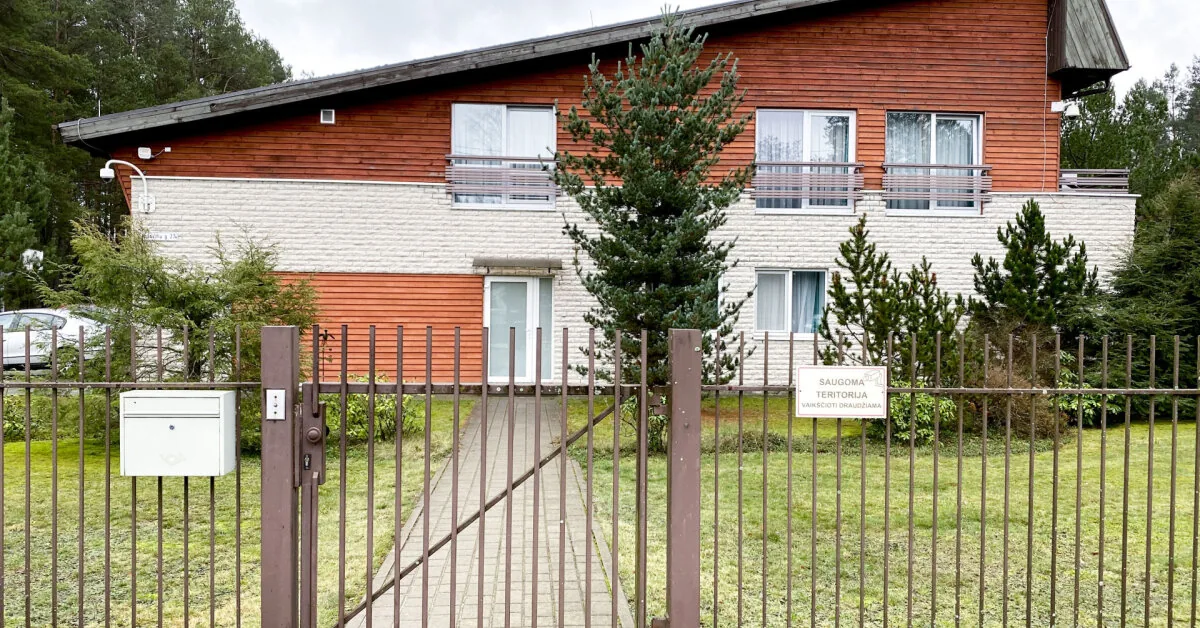
The ruling party believes that answers to these questions were provided by previous parliamentary and law enforcement investigations, and moreover, too much time has passed since the alleged CIA prison operated near Vilnius in Antaviliai.
Read more A fire broke out at a biofuel site in Kupiškis district, arson suspected
The opposition, in turn, is convinced that such an investigation is necessary, and a clear answer as to whether such a detention facility existed in Lithuania is a matter of national honor.
Says questions have been answered
Orinta Leiputė, elder of the largest ruling Lithuanian Social Democratic Party (LSDP) faction, does not believe that such an investigation is needed.
“I doubt whether an additional parliamentary investigation will be necessary. However, if the need arises, we will discuss it in the faction,” the MP told BNS.
“I think the questions were answered a little earlier, and now this return…” she added.
O. Leiputė stated that she was referring to the investigation conducted by the Seimas National Security and Defence Committee (NSGK) in 2009.
The first report about a possible CIA detention center operating in Lithuania was made in 2009 by the US television channel “ABC News”. It announced that eight terrorism suspects were imprisoned near Vilnius in 2004-2005.
The NSGK, which conducted a parliamentary investigation in the same year, did not determine whether detained persons were brought to Lithuania, but concluded that conditions for transfer existed.
During the parliamentary investigation, two objects were identified in Vilnius and near the capital in Antaviliai, where premises for holding suspects could have been set up. Several flights linked to the CIA to Vilnius and Palanga, which took place in 2003-2006, were also identified.
Prosecutors had also launched their own investigation into the matter, but terminated it in 2011 after not receiving data that the building in Antaviliai “would be related to the detention of persons,” and that “the factual data obtained during the pre-trial investigation and all related witnesses questioned substantiate a different purpose and use of the building.” It was also not established that terrorism suspects were illegally imprisoned there.
In 2015, the pre-trial investigation was resumed, merging it with the investigation into illegal human trafficking across the state border, taking into account the US Senate Committee report declassified in 2014.
“Political archaeology”
Agnė Širinskienė, elder of the “Vardan Lietuvos” Democratic Union faction, stated that the democrats had not discussed among themselves whether such an investigation was needed, but in her opinion, it would not bring any benefit.
“In my opinion, this political archaeology in this case is unlikely to add anything, because those political investigations have been done before,” A. Širinskienė told BNS.
According to the politician, the fact that cases are being brought against Lithuania before the ECHR regarding the alleged CIA prison is not new, and she speculated that there might be more cases in the future.
BNS wrote that at the beginning of July, the Strasbourg court awarded Saudi Arabian citizen Abd Al Rahim Hussein Al-Nashiri 30,000 euros for illegal detention two decades ago in a secret American prison in Lithuania and obliged the Lithuanian authorities to contact Washington to seek assurance that the terrorism suspect would not be sentenced to death.
This was the third similar ECHR decision in applicants’ cases against Lithuania.
A. Širinskienė sees no new circumstances that would require members of the Seimas “to sit down and dig something up.”
“The more time passes, the more people’s memories fade, and the less opportunity there is to get acquainted with documents, because simply some of them are already being destroyed according to the Archives Law. I see no added value for the state if we start investigating something else, when, apparently, the ECHR has already investigated quite clearly in three or several cases,” the democrat said.
“Court decisions are a fact, and I don’t know who else could deny those court decisions. It is unlikely that there is (…) a higher instance than the ECHR in Europe. In the European Union, there is the Court of Justice, but such matters are certainly not its specificity,” she stated.
Read more A helpless few-week-old fell into the hands of caregivers: Sofia’s story moves Lithuania
Meanwhile, Aušrinė Norkienė, vice-chairwoman of the Lithuanian Farmers and Greens Union (LVŽS), stated that she does not have a clear opinion on the resumption of the investigation, but questions arise about its necessity, as the alleged prison in Lithuania operated more than 20 years ago.
“I have no opinion, in fact, we should probably discuss in the faction what the opinion would be, discuss, evaluate those circumstances, when it was, if it was. But events 20 years ago, all statutes of limitations, I really can’t imagine what to investigate then, it’s complicated. (…) 20 years is really a very long gap,” A. Norkienė told BNS.
Opposition – for the investigation
Laurynas Kasčiūnas, chairman of the Homeland Union-Lithuanian Christian Democrats (TS-LKD), believes that a new investigation into the CIA prison is necessary.
“I think that especially the aspect in the US Senate report, that cash was circulating and it was possibly unaccounted for and allocated to certain people who could have made decisions here in Lithuania. This aspect is very important and needs to be clarified. I agree with those who say that this is a matter of our self-respect,” L. Kasčiūnas told BNS.
“A parliamentary investigation can always be done, but the question is how effective it will be. (…) Then, 20 years ago, the geopolitical situation was one way, now it is different, in other words, I think that precisely the issue of circulating money still needs to be clarified,” he added.
Remigijus Žemaitaitis, leader of “Nemuno aušra,” told BNS that both he and the faction in the Seimas would support the resumption of the investigation, claiming that he would like to participate in the investigation commission and name “the names and surnames of those who contributed to the prison’s operation at that time.”
“Unequivocally (I support it – BNS), because it (the prison – BNS) existed, I know it, I was doing that job at the time, and it existed, and denying it is a shame for Lithuania, a shame for politicians who cannot say that it existed under (Valdas – BNS) Adamkus, under Mečys Laurinkus and others,” he said.
“These are double standards, when state leaders say and cannot admit that it existed, when all the documents are on the table and they cannot name the individuals who are doing this, it is a shame for the state,” explained the “aušriečiai” leader.
This week, Viktorija Čmilytė-Nielsen, chairwoman of the opposition Liberal Movement, also spoke about the need for a new parliamentary investigation.
According to her, by ECHR decision, the state pays compensation to persons accused in the CIA prison in Lithuania, while state leaders claim that no such prison existed in the country.
“A parliamentary investigation is one of the possible formats, now there is more basis for it, because after so many years and with new information emerging, it might be easier to find the truth,” the MP told Žinių radijas.
“It is a matter of honor to answer the questions. Otherwise, this story will not end, it will continue, there may be more fines in the future. And the statement by the highest politicians that we are paying for nothing, for a building, or that further investigation is not needed, does not dispel the shadow,” the liberal stated.
According to her, there is currently more data about CIA detention centers than in 2009, when the Seimas National Security and Defence Committee conducted a parliamentary investigation.
As BNS wrote, Lithuania provided explanations in ECHR cases that the premises in Antaviliai, near Vilnius, operated not as a prison, but as an intelligence support center. The country claimed that the suspicious planes transported not people, but communication equipment to Lithuania.
Meanwhile, a report published by the United States Senate in 2014 on CIA torture of suspected terrorists in secret detention centers mentions a center called “Violet,” which operated in 2005-2006. Specific states and officials are classified in the document, but human rights defenders believe that this center operated in Lithuania, in Antaviliai, near Vilnius.
President Gitanas Nausėda stated in an interview with BNS last week that he trusts the assessment of Lithuanian institutions that there was no American prison in the country where terrorism suspects were held.
The Lithuanian president also said he did not believe that this story should be re-examined. According to the head of state, the situation has already been assessed, “investigations have been carried out which concluded that no such prison existed.”
Read more Jermain Defoe stayed only 116 days at his first coaching career stop