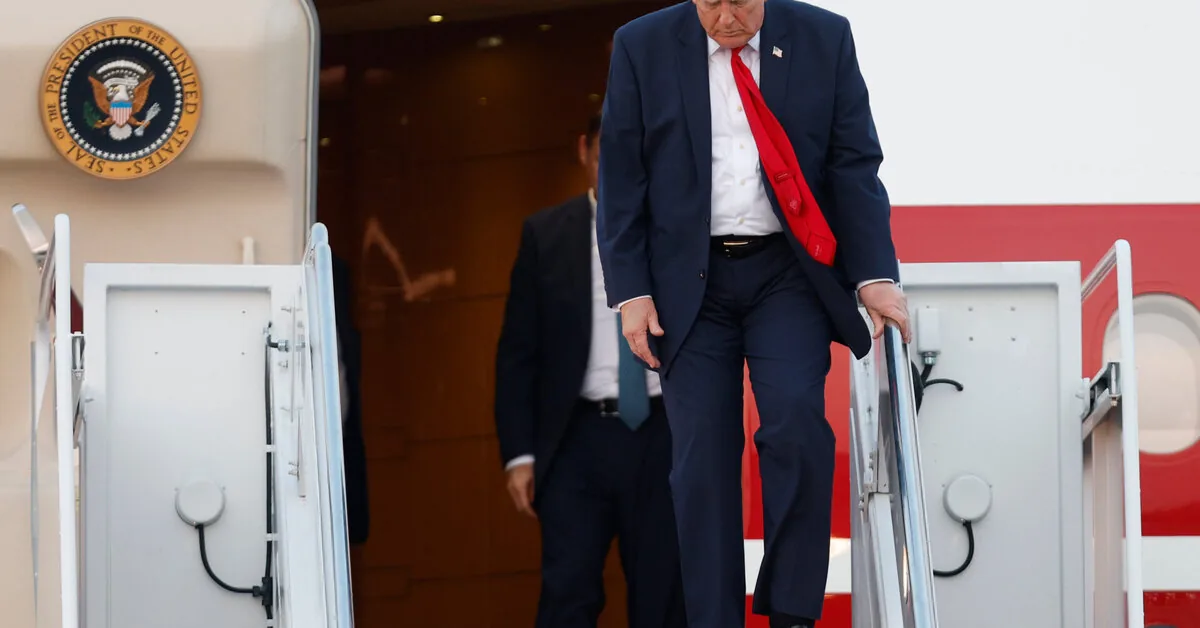
This was an unusually aggressive attempt to reveal confidential sources of journalists who wrote about Qatar’s presidential plane gifted to D. Trump.
Read more Analysts revealed how many billions Hungary’s OTP Bank will pay for Luminor
The Republican president’s administration’s efforts to forcibly ascertain the identity of sources through additional subpoenas indicate increasingly strained relations between the executive branch and the media. A memo submitted by NYT over the weekend states that these measures were broader than previously thought and covered a period exceeding the scope of the articles in question.
“Two requests demand data from January 1, 2026, which is significantly earlier than the events that are allegedly the basis of the department’s investigation,” the publication’s lawyers wrote in a letter.
“Such a period clearly indicates that the department is using this investigation not to focus on alleged concerns regarding the articles of July 8 and 9, but to broadly gather information about journalists’ connections with sources,” the lawyers asserted.
Government claims journalists are not targets
These requests for phone data supplement the grand jury subpoenas served on three journalists on July 10, which sought to compel them to reveal the identity of their sources. NYT separately challenged these grand jury subpoenas, and U.S. District Judge Arunas Subramanian is expected to hear arguments on Thursday. The judge also halted the execution of the phone data requests pending a decision on the newspaper’s motion to quash them.
The newspaper’s lawyers noted that some of the phone data requests were issued on the same day as the grand jury subpoenas, another on July 14, and yet another on July 16, after the Times had already filed a motion to quash the grand jury subpoenas.
Arguing why the phone data requests should be dismissed, the Times stated that the government acted in bad faith and ignored its own protocols, failing to warn journalists about the data being collected and demanding information “without conducting any serious investigation.”
The newspaper’s lawyers stated that the additional requests “raise doubts about the accuracy” of the testimony given last week by Jay Clayton, the U.S. Attorney in Manhattan, where the grand jury subpoenas were issued. During his confirmation hearings for the position of D. Trump’s administration’s Director of National Intelligence, J. Clayton said that “we followed protocols” and that the government took “the least intrusive actions possible.”
The Department of Justice justified the grand jury subpoenas by stating that “journalists are not targets; the targets are those who leak classified information.”
Additional requests included a demand for phone data of one journalist’s mother and two journalists’ spouses. The document notes that the aforementioned mother is a mental health professional with confidential client relationships, and one of the spouses is a senior counsel at a law firm.
“The disclosure of additional requests for confidential journalists’ information raises significant concern and reveals another example of a troubling pattern of behavior, detailed in the motion to quash the requests,” wrote the news organization’s lawyers.
Read more BNS Sprintas: Tuesday’s events briefly
“These actions demonstrate an abuse of the grand jury process, continued bad-faith attacks on journalists, violations of the department’s internal rules, and disrespect for the laws of this district, which aim to protect important First Amendment interests,” the document states.
In a response released Tuesday morning, the Department of Justice stated that it followed its rules when issuing the requests and took investigative steps before seeking them. The department claimed it had the right to delay the disclosure of the requests but chose to notify the journalists’ lawyers to give them an opportunity to challenge them.
“Any requests for a phone number not used by one of the applicants were obtained due to information in a law enforcement database indicating that the phone number is linked to the applicant,” the department’s lawyers stated.
“If the government determines that these phone numbers were not used by the applicants, the government will no longer pursue the relevant request(s),” they asserted.
Part of a legal dispute
Grand jury subpoenas served on journalists at their homes marked a dramatic escalation in the D. Trump administration’s fight against information leaks.
Free press advocates condemned this as a government attempt to intimidate media organizations. This occurred after the FBI earlier this year raided the home of a Washington Post journalist and confiscated her electronic devices.
The new plane, a gift from Qatar, for the modernization of which the D. Trump administration spent 400 million dollars (about 350 million euros), recently entered service. However, earlier this month, D. Trump departed from the NATO summit in Turkey on an older “Air Force One” model.
NYT, citing anonymous sources, reported that this decision was made at the insistence of the Secret Service, as the new plane lacked some advanced security features, including missile defense. On social media, D. Trump denied the security issues.
Since returning to power last year, the D. Trump administration has repeatedly clashed with the media – from newspapers to television networks and “Voice of America.” Methods include lawsuits, administrative actions, and public threats.
The First Amendment of the U.S. Constitution guarantees the press the ability to operate without government restrictions.
Read more Microsoft and Mistral signed a multi-billion dollar agreement for AI infrastructure in Europe