The legal dispute was resolved by the script: at the beginning of the third season, the black fake Ferrari was demonstratively blown up, and the factory officially donated two new Ferrari Testarossas to the series. At the request of producer Michael Mann, they were painted dazzling white to reflect the city’s neon lighting in night scenes. From that moment, the white Ferrari shaped the entire pop culture aesthetic of the 1980s.
Read more In Poland, train drivers held a protest after a fatal accident
Choosing cars for films can provoke fans’ anger. In the 1995 James Bond film GoldenEye, the producers put Pierce Brosnan behind the wheel of a German BMW Z3. Bond was perceived as a symbol of British culture, elegance, and aristocracy. When the studio signed a three-film deal with the German BMW corporation, fans took it as a personal insult. The producers were accused of “selling out” in letters, and agent 007 was said to have “lost his British soul.”
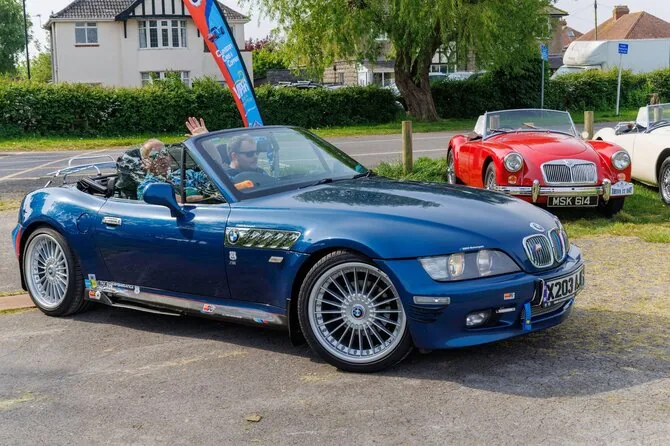
The anger repeated in the film Tomorrow Never Dies, when Bond was put into a boring BMW 750iL sedan. Bond brought even greater “shame” upon himself in Casino Royale, when the famous MI6 spy in the Bahamas switched to a simple family Ford Mondeo.
The Lithuanian capital has long earned the title of a film chameleon. Famous series such as HBO’s Chernobyl, Sisi, and Catherine the Great were filmed here. Few consider how much effort is required for a retro car flashing for a second or a sidewalk curb that does not match the era. Masterpieces born behind the scenes require not only historical accuracy. A complex, precise logistical mechanism and a large technical support team are needed.
The car’s task is to tell a story without words. It reveals the character’s status, financial situation, personality, and emotion. Creative decisions related to vehicle selection are made by the filmmakers themselves and the project’s art department. They decide which specific model, color, and even wear level the character’s car will have to match historical truth.
As Milda Leiputė, producer at the film production company Nordic Productions, explains, private Lithuanian collectors are a great help to filmmakers during shoots. Thanks to their enthusiasm and love for technology, many cars from different periods and models can be found in the country. However, the shortage of technology from certain eras is very noticeable.

“The situation has always been more complicated with historical military equipment. Its quantity in Lithuania and the possibilities to use it in filming were quite limited even before the large-scale war in Ukraine, so searching for and bringing military equipment from other countries often becomes a significant logistical and financial challenge,” shares the interlocutor.
If the required car is not found in Lithuania, producers have several options: bring the car from abroad by reserving it for filming days or adapt the available cars to the film’s needs.
“For example, a simple Alfa Romeo can be turned into a certain period’s Italian police car for filming. On the movie screen, the most important thing is that the car looks convincing in the specific story and era,” reveals the Nordic Productions producer.
Vilnius Film Office head Jūratė Pazikaitė emphasizes: the biggest challenges arise when it is necessary to recreate not just individual historical elements but the entire city environment. In historical series and films, not only the main cars visible in the frame are important but also background vehicles. They fill the streets and create the atmosphere of the corresponding era. To convey the atmosphere described in the script, the city’s infrastructure must be changed.
Read more In autumn, the rules for buying phones on installment change: what you need to know?

“In practice, this can mean temporarily dismantling road signs, masking modern lighting elements, changing modern surfaces, curbs, tiles, benches, street name signs, or hiding other modern city infrastructure details,” emphasizes J. Pazikaitė.
A single mass scene may require a dozen or several dozen historical cars. Decades-old equipment usually does not have the right to participate independently in public traffic, so it is transported to the site on trailers.
Breakdowns a few minutes before the call “Action!” are a common everyday occurrence. “Every minute of downtime on the filming set is very expensive because the entire film crew, equipment, and location are waiting. A small car breakdown can become a very costly problem,” says Milda Leiputė.
But sometimes stories happen on set that surpass any script. Milda Leiputė shared a memorable event that happened while filming a project with the famous Hollywood actor John Malkovich:
“One morning, arriving at the filming location, we saw that one of the most important props of the day – his character’s Moskvich – was floating in the Neris River. It turned out that during the night someone just decided to have fun and pushed the car into the river. Instead of the usual preparation, we started a rescue operation – we had to pull the car out, fix it, and prepare it for filming as quickly as possible. At a time when the entire film crew is waiting and the main scene car is in the river, it was definitely not funny,” shared the producer.
Why do foreign producers increasingly choose the Lithuanian capital when looking for ideal locations for historical films? The head of the Vilnius Film Office insists that the answer lies in the city’s urban architecture.
“Vilnius’s advantage is the architecture of different eras, which allows recreating the environment of different countries and periods. In recent years, Vilnius has become various European cities and backgrounds of different epochs on screen, so international creators often find here what would otherwise have to be sought in several different locations,” says J. Pazikaitė.
However, increasing competition in the global film market and tightening historical accuracy requirements pose new challenges. For Lithuania to maintain its position, beautiful old town walls are not enough. Constant close cooperation between city authorities, collectors, and technical teams capable of creating a miracle in a few hours is needed. This process requires not only money but also community spirit and patience from the city’s residents, whose yards are thundered by last century’s four-wheeled masterpieces at night.
Despite the constant logistical difficulties and equipment whims, producers keep returning to film in Lithuania. Vilnius’s contrasting architecture allows finding in one place what usually has to be sought in several different countries. A car in cinema is not just a silent object. It tells about the character and sometimes becomes a character itself.