







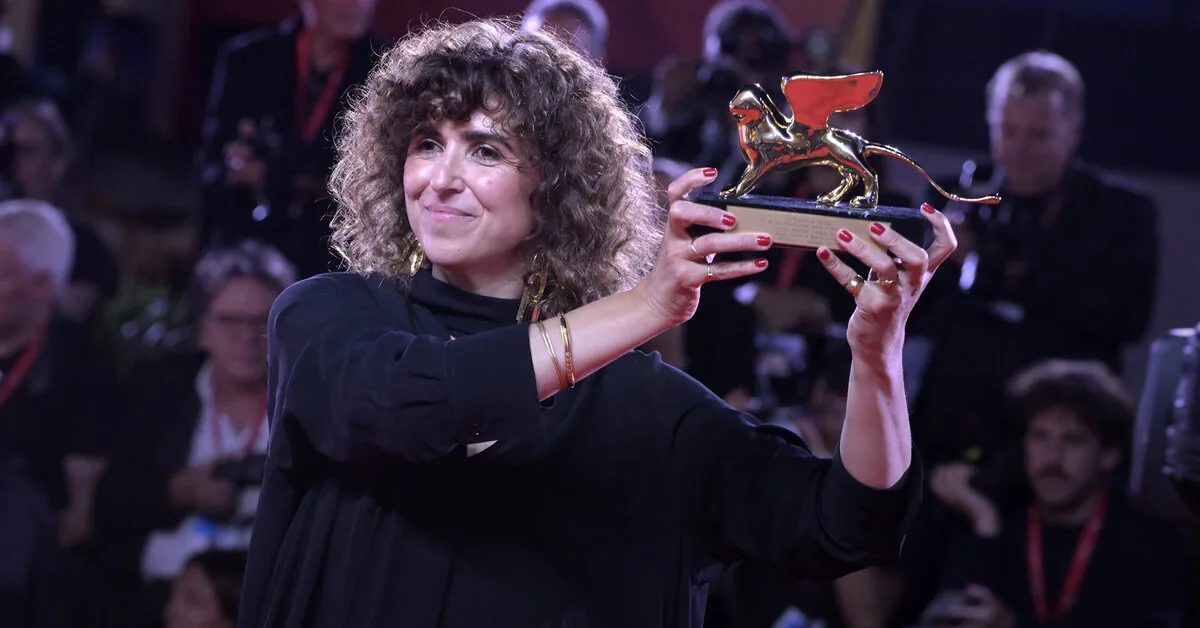
This was the only feature film in the competition directed by a woman.
The film “Woman Unknown” sparked much discussion due to its plot, which is rarely explored on the big screen, and because director May el Toukhy was one of the few female directors at the Venice Film Festival.
Read more From conquest «in three days» to «we will soon achieve victory»: what the Kremlin promises
Besides her, among the 21 films competing for awards at the star-studded Venice closing ceremony, there was only one other woman – Israeli director Rachel Szor, one of the creators of the chilling documentary “NAZA” about the war in Gaza.
“Woman Unknown” tells the story of a woman’s body as a battlefield and a public matter. At the same time, this film reveals the story of women who are invisible, unnoticed, and voiceless,” said M. el Toukhy at the ceremony.
This year’s jury president, American actress and director Maggie Gyllenhaal, raised the issue of the lack of films directed by women on the opening day but did not want to discuss the topic further at the closing press conference.
“I think I’m tired of talking about the same topic over and over again,” she said. “I just want to enjoy a masterfully made film that seemed to me like a laser beam.”
Other winners
Saturday’s awards ceremony concluded a 10-day program that was often dark and turbulent. Festival director Alberto Barbera promised that it would reflect the war-torn and anxious state of the world.
The second place and the “Silver Lion” went to the film “Possible Love” – a sensitive study of relationships created by South Korean auteur Lee Chang-dong. This film was one of the best-rated at the festival.
The Best Director award went to Ilja Khrzhanovsky, born in Russia, for his huge, rebellious, and experimental film project “DAU,” which tells the story of the complex life of Lev Landau, the father of the Soviet nuclear program.
The film, lasting more than three hours, began production two decades ago. It involved 2,000 people, many of whom were actors living for several months in their roles in a fully recreated secret Soviet research institution while I. Khrzhanovsky filmed them.
“Not everyone believed the film would be finished, but I always believed,” he told the audience, dedicating the award to the people of Ukraine “who are fighting for their freedom in this terrible war.”
The Best Actor award went to John Malkovich for his role as a weary CIA agent in the dark comedy “Wild Horse Nine.” It tells the story of how he and a colleague go to Easter Island in Chile to rest just before the 1973 US-backed military coup.
Read more Where trees felled by storms end up: some for biofuel, some also in private yards
The film magazine “Variety” wrote that J. Malkovich “is causing a stir for awards” and predicted a possible first Best Actor Oscar for him at the next awards ceremony.
The Best Actress was chosen as Danish actress Mathilde Arcel. This was her first film role – in “Woman Unknown” she played a bride-to-be feverishly trying to hide the shame of past relationships with a Nazi.
The 30-year-old actress told the news agency AFP in Venice that she does not like fame and recognition, but M. Gyllenhaal predicted even greater success for her.
“I think she will simply blow us away,” M. Gyllenhaal told journalists.
Film about Gaza Strip
“NAZA,” created by Oscar-winning Israeli directors Yuval Abraham and R. Szor, was named by some critics as a contender for the Best Film award after receiving a record 25 minutes of standing ovations following its premiere on Thursday.
Instead, the film won the special jury prize – an award given annually by the jury for an outstanding work.
In their 80-minute film, Y. Abraham and R. Szor spoke with 24 Israeli army or intelligence informants. They revealed how AI-based targeting systems used in the bombing of the Gaza Strip have taken the lives of tens of thousands of civilians.
“Israeli intelligence officers we spoke to said this mass killing is systematic: not accidental but planned, and this murder and policy are based on the complete dehumanization of Palestinians,” Y. Abraham told the audience.
The film magazine “Screen” described the film as shocking, and “The Hollywood Reporter” said it provokes “outrage and, undoubtedly, the deepest disgust with the current Israeli regime.”
The Israeli army criticized the use of anonymous testimonies in the film, stating on Friday that the identities of the informants “cannot be verified.”
Israel denies deliberately targeting civilians.