



Seven years ago, the writer’s prose book “Pakeleivingų stotys” became a real event in our literature – it was much talked about, written about by literary critics, and recognized as the most creative book of 2019. With precise and vivid language in his texts, V. Morkūnas opened up the gloomy and eerie edges of our lives, full of the strangest characters and their stories.
The world of the stories in the book “Parulskio perukas” is no less gloomy. However, as the author himself admits, there are considerably more literary oddities here: a family decides to breed a saint for the breed, a man is met whose chest has a door, chronicles are written by Albertukas – an unclear creature. Something between absurdity and magical realism suddenly flashes with an unexpectedness in a shocking disharmony.
On the occasion of the new book, we sat down with V. Morkūnas to talk about his slow writing, perfectionism and optimism, why he is so drawn to marginal people and abandoned places, about darkness and light, fantastic literature, and the Parulskis.
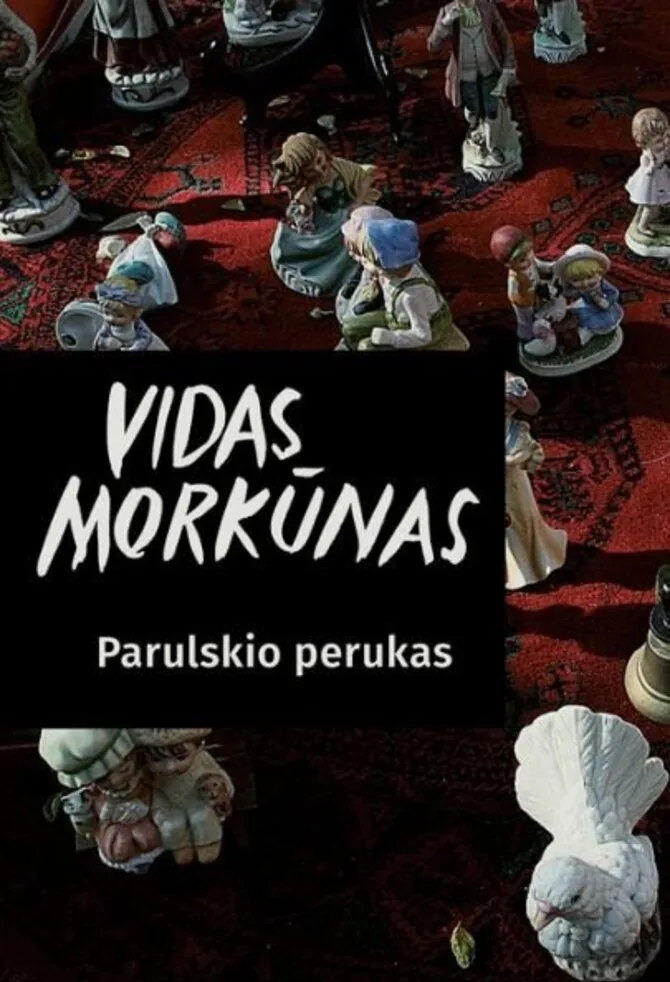
– Vidas, seven years have passed since your last book “Pakeleivingų stotys”. The recently published new book “Parulskio perukas” contains seven short stories, so the statistics are quite simple: it takes you one year to write one text.
– (Laughs) I didn’t notice this coincidence of numbers myself, but it turns out about the same. The reality is that I write very slowly. Of course, it doesn’t take a year to write the first draft. But when all the corrections and putting the text aside to let it settle come in, quite a lot of time accumulates.
– So you write not only slowly and sparingly but also very little?
– There are several texts that didn’t make it into this book – they seemed too weak to me. There is also one longer one that I set aside for the future – it would have seemed like a foreign body in this book. After some time, I will see if it is still alive. It may also happen that later it will seem too bad and become completely unnecessary.
– You are ruthless with your texts.
– Maybe more demanding. Very demanding. I am a perfectionist – if I can’t do some work, not necessarily literary, very well, I better don’t start it at all.
– In one interview, you said that you don’t have a strong need to publish books – it’s enough that you know what you have written yourself.
– I am definitely not against book publishing (laughs). I have a fairly large library of books written by other people at home. I don’t blame other writers for publishing their books. But myself… When I feel that the time has come, then I look if I have something, if the texts have settled and will make a book. I don’t even have any need to count how many books I have published.
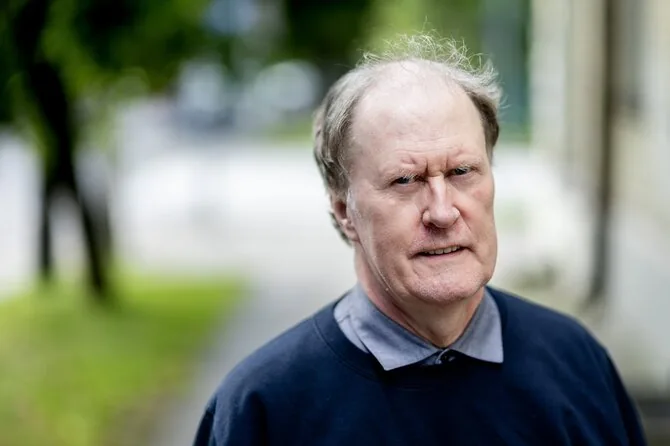
– And I calculated: you debuted twenty-five years ago with the short story collection “Manekeno gimtadienis” and have published five books so far.
– And I think that is quite a normal number. If not too many (laughs).
– Do you also have the attitude or at least a short-term mood that now there is so much information, texts, and books that it’s even worth writing anything?
– No, I don’t think about that. I egocentrically focus on what happens inside me, not outside. I don’t think that if something is missing, I have to write about it, and if something has already been written about, that topic is exhausted and I won’t take it. I don’t write only because I don’t have a good idea. And if a promising thought appears that seems fruitful to me, I don’t worry about who and how much may have already written about it or not.
– What is the short prose genre, sort of mini-stories, close to you? Although, to be fair, compared to the book “Pakeleivingų stotys”, this time, jokingly, one could say you wrote without restraining yourself…
– If I remember correctly, the book “Reportažas iš kiaušinio” has a fourteen-page text – that is my longest short story among all published. And all the others are much shorter. Indeed, in the book “Pakeleivingų stotys” the texts were quite short compared to “Parulskio perukas” – here they are almost like novels (laughs).
I call my texts short stories, although someone might say they are more like novellas. In principle, I don’t deny the term novella, but I don’t use it in the context of my work. Of course, sometimes I have the idea to write in a novella style – introduction, exposition, unexpected ending. But even then I stick to the view that it is a short story – it gives me more freedom.
I egocentrically focus on what happens inside me, not outside. I don’t think that if something is missing, I have to write about it.
Why do I write briefly? Well, if the refined and matured concept of the work is enough with that much text, should I specially write more, try to stretch the work to about twenty pages? When I see that it is enough, it is enough – and I put a period.
– Reading the new book, I thought your texts are very cinematic – you are precise with details, impressions caused by a certain image. How much did your completed film script courses once influence this?
– This style or method of mine did not form because I completed script courses. Saulius Šaltenis accepted me into the studies largely because I was already writing cinematically then. So it comes from earlier, from a certain, maybe even innate way of thinking and seeing.
And I still don’t give it up – why scatter, look for what I haven’t lost. And if someday I start to drift in some other direction, then probably I will drift naturally. At least for now, I feel that this is my space, my element.
– Can you imagine any of your works adapted to the screen?
– There are already some. A few years ago, a student took two of my texts from “Pakeleivingų stotys” and made a several-minute film from them. Interestingly, I recognize one of my works, but not the other (laughs).
In fact, during my studies, there were also adaptations – my texts were taken by directors from neighboring groups purely for practice purposes. But these were not official adaptations, just educational material.
I have offered the texts of “Pakeleivingų stotys” to animators. It seemed to me that some could be made into very interesting animations, of course, not for children.
By the way, I have offered the texts of the book “Pakeleivingų stotys” to animators. It seemed to me that some could be made into very interesting animations, of course, not for children. Unfortunately, I received no response from them – maybe the animators didn’t understand where I saw animation in these texts (laughs).
– It is important for you to tell the stories of “invisible”, “insignificant” people – a village boy, a public toilet cashier, a nameless traveler, a homeless person. Moreover, not only people. Where does this come from? Maybe it is a kind of alternative to the image of a “successful and happy” life saturated in the media and social networks?
– Literarily, those marginal people are more interesting to me than the successful ones. For example, the idea of one of the texts in “Pakeleivingų stotys” was born in just a few seconds among many people passing by on Gediminas Avenue, suddenly seeing one person. And instantly everything fell into place in my head.
I don’t write specifically about such people – they are interesting to me by themselves. And if two people were put in front of me – one from the margins and the other from high society, I wouldn’t know what to write about the latter. I would have to rack my brains and think about what to write about him. No idea, empty…
Of course, it’s not that all marginal people automatically transmit ideas to me. But the probability is definitely higher (laughs). Apparently, there is more inner dramaturgy in that. Or maybe a subconscious desire to resist the cult of happiness.
– In the new book, as in previous works, stories about life without “large-scale adventures, without great joys and misfortunes” dominate. Why?
– I am interested in finding things in a boring, gray life that are really not gray and boring. Often the inhabitants of that gray life themselves do not realize what is happening to them, whether something good or bad. I dig into unnoticed lives of others looking for manifestations of oddities there.
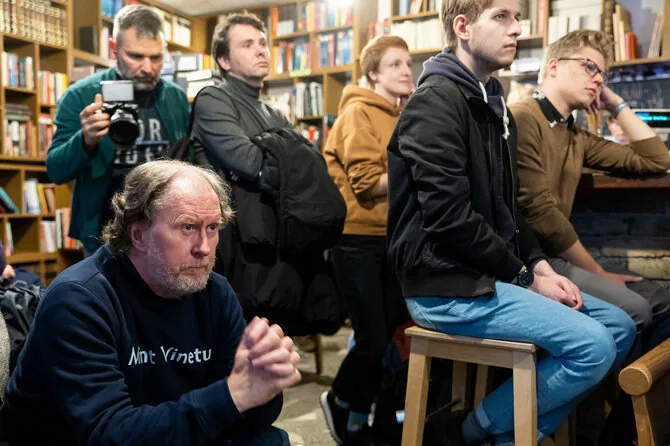
– You have described the characters of previous books as your fellow travelers, whose life paths coincided for a shorter or longer time. Are there any similarities between the characters of “Pakeleivingų stotys” and “Parulskio perukas”?
– Maybe, although the new book has more objectively strange events and lines. For example, doors in the chest don’t happen every day. Or buying a saint for the breed – also an unusual event. Like Albertukas – you can’t understand at all what kind of creature it is.
This book has such literary oddities that were not in “Pakeleivingų stotys” at all. I don’t even know what to classify it as – maybe magical realism, although I’m not sure if it fits the canon. So you could say that there is some continuity from the previous book here, only with added literary strangeness.
Read more Published list of 50 undiscovered European pearls: one of them is also in Lithuania
– Have you yourself answered the question why you are so drawn to all kinds of margins, backwaters, oddities?
– Probably because these topics are fruitful to me literarily. These layers of the world offer me various creative possibilities, stimulate my imagination. And I take advantage of that (laughs).
Apparently, the search mechanism is so deeply rooted in me that when I find myself in an abandoned or dilapidated place, I immediately start looking for literary perspectives.
I don’t specifically look for such places – that would be very artificial. But when I find myself there, I feel how my head starts to work. Of course, maybe it would be better to be able to contemplate any place without literary benefit.
But apparently, the search mechanism is so deeply rooted in me that when I find myself in an abandoned or dilapidated place, I immediately start looking for literary perspectives.
– I’m sure you have heard more than once that your work is dark, gloomy, and pessimistic. Would you agree with that?
– That it is gloomy and pessimistic – yes. And it is completely natural that people think so.
However, I really don’t like it when readers start juggling categories of darkness and light in the context of my work. Then I get the impression that people really don’t know what light is or what darkness is. Having read about a drinking person, they automatically assign it to darkness. But maybe it’s not darkness at all – how would we know…
Neither darkness nor light are so easily recognizable things. After all, rabbits hopping in a sunny meadow are not necessarily light. More precisely, I would say that it is definitely not light, but something else entirely.
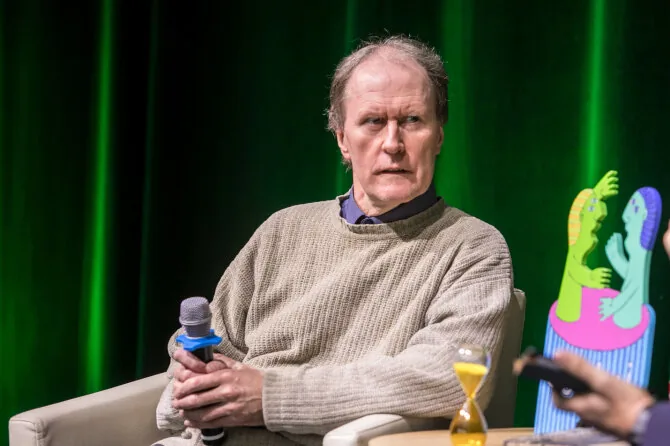
So in my new book, for example, in the story “The Magic Spoon” there is no darkness. There is gloom, yes, but no darkness. True, there is not much light here either, but… All this is a gloomy, unwashed life without any prospects. But that is certainly not necessarily darkness.
– Despite that, something flashes like a meteor here and there. Because of that, I would say your work is quite hopeful.
– Maybe because I am an optimist in life myself. Only the optimistic things don’t write themselves for me. True, I have started one text but still haven’t overcome it. There the life is completely different from what I am used to, a different register. So I am still trying to understand that world myself, but all the variants I have written so far seem banal to me.
I definitely wouldn’t call my texts optimistic, but I agree that there is hope in them.
I definitely wouldn’t call my texts optimistic, but I agree that there is hope in them.
By the way, I read a short and good review by Alfonsas Andriuškevičius about this book of mine. However, I cannot agree with his idea that in “Pakeleivingų stotys” there was a text written specifically to make the reader emotional.
I never aimed to evoke any feelings in readers – I don’t want to make anyone laugh or cry. I write as I see, and people’s reactions are not my business and I am not responsible for them.
– You have quite a few works of classic and contemporary fantastic literature in your translation portfolio. That is a bit surprising because your own texts are quite realistic. True, that realism is always pierced by all kinds of oddities and magical things. Are you a fan of fantastic literature?
– I like fantasy, but definitely not as much as my wife (translator Anita Kapočiūtė, – editor’s note) – she is a huge fan of fantastic literature and has a large library in English.
Those translations just happened: I translated one or two and developed relations with the publishing house “Eridanas”, which at that time published exclusively fantasy. They gave me the opportunity to translate, and so I gradually immersed myself in that world.
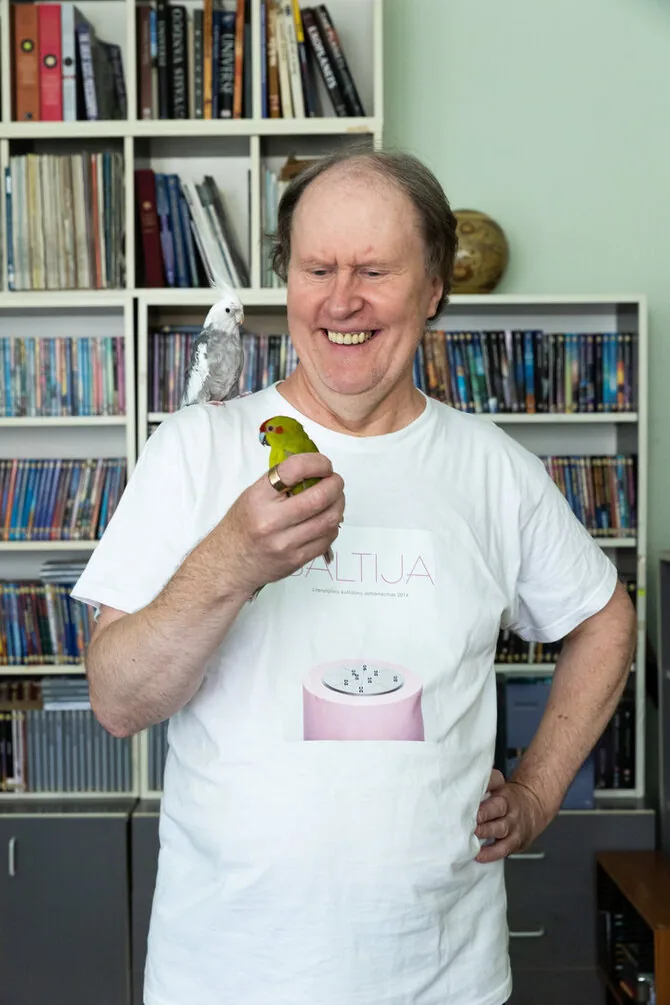
I have been to European fantastic literature fans’ gatherings called “Eurocon” several times (similar global events are called “Worldcon”, and those held in Lithuania – “Lituanicon”, – editor’s note).
At these meetings, I have had extraordinary experiences. For example, at an event in Bulgaria, I sat at a table with the writer Robert Sheckley, whose book “The Three Deaths of Ben Baxter” I read in my youth in the “Brave Roads” series. That made a huge impression on me.
– Do you learn anything in your own work from the books you translate?
– Not really. Translation is work for me, and that’s it – I don’t choose much what to translate. True, there have been books I refused for various reasons. Usually, it happens because of lack of time – if you already have two years of work planned ahead, you can’t really take something extra here and now.
And when I notice some translation influences in my texts – I try to correct it. Of course, it’s worse when you don’t notice anymore (laughs). But I don’t guard myself against translations, I’m not afraid that some author will have too much influence. If circumstances are such that I can translate this or that author, I take it without any fear.
There is really no reference to Parulskio perukas in the book. For me, these words primarily have a sound. It was also necessary that the surname conveyed something.
– And the last question: why did you name the new book “Parulskio perukas”? Honestly, I was looking for some references in the stories and found nothing. Maybe I missed something?
– (Laughs) Just before the book was published, a friend told me that now I will have to answer this question fifty million times.
There really is no reference to Parulskio perukas in the book. For me, these words primarily have a sound. It was also necessary that the surname conveyed something. For example, I knew people with the surname Parukas. Naming the book “Paruko perukas” would sound more sonorous, but it would mean nothing to the reader. So it was necessary not only to have a sound but also a zing.
Of course, all readers now think about Sigitas Parulskis, although there are also Ernestas, Liudas, and probably several less known Parulskis. But honestly, I only asked Sigitas about this title – whether he would object. I assured him that the book is neither satire nor is he mentioned here at all. I got permission. But I didn’t ask other Parulskis for permission, somehow not thinking about it (laughs).
Sometimes the book title comes to me before the whole book. I come up with it, it sticks, and I, if you can say so, remain loyal to it until the end.
Honestly, sometimes the book title comes to me before the whole book. I come up with it, it sticks, and I, if you can say so, remain loyal to it until the end. That happened this time too, although a small doubt briefly flashed when nothing could be changed anymore – I thought that “Parulskio perukas” might sound a bit journalistic. But it lasted only a moment.
– I thought that Sigitas Parulskis, especially his early poetry, is stylistically somewhat close to you. For example, the poem “Subjektyvi kronika”: “The cattle feeder Julius died, the bulls gored, drunk / the animal doesn’t like people who escaped from the pen…” and so on.
Read more In Vilnius, a woman assaulted a minor
– Maybe. But I would consider this similarity more of a magical coincidence.