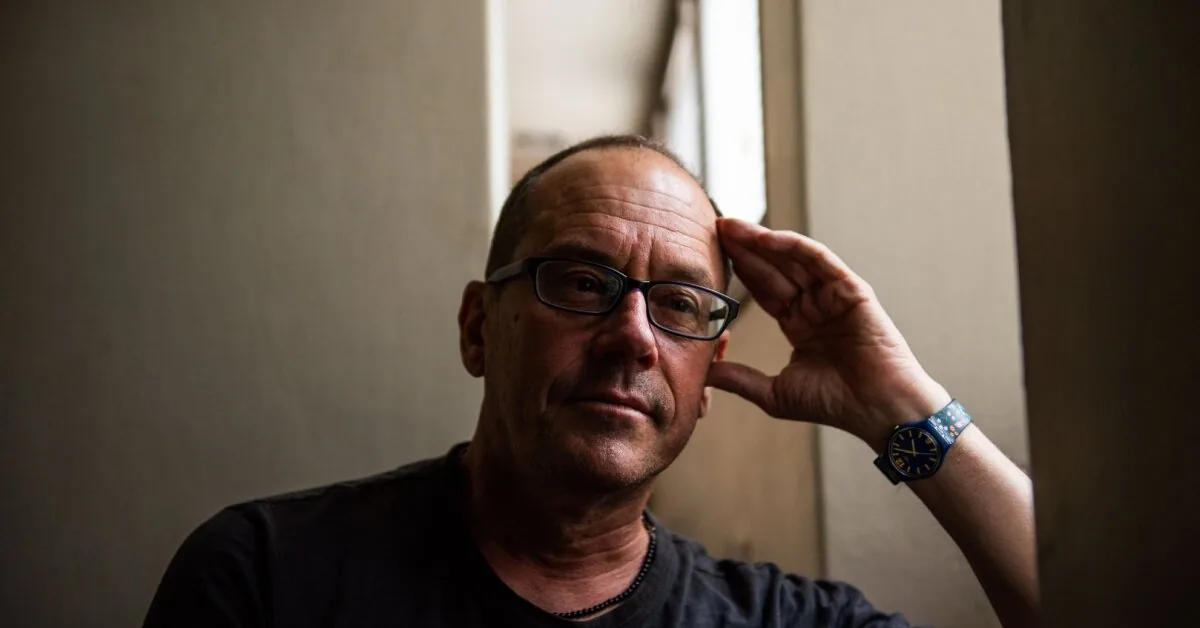
Charl-Pierre Naudé is the author of three poetry collections: Die nomadiese oomblik (The Nomadic Moment, 1995), which won the Ingrid Jonker Prize, In die geheim van die dag (The Secret of the Day, 2004), awarded the M-Net Prize for Poetry, and Al die lieflike dade (All the Lovely Deeds, 2014). He has written a philosophy book as well as a novel in Afrikaans, Die ongelooflike onskuld van Dirkie Verwey, which he translated himself into English (The Equality of Shadows, 2024). A book of his poetry translations has been published in German.
Read more In the land of rain, a decathlete who forgot sunscreen: «I only think about the ice bath»
While awaiting the “Poetic Druskininkai Autumn” festival, taking place from September 23–27 in Druskininkai and Vilnius, we invite you to read an interview with Charl-Pierre Naudé about the limits of language, the never fully comprehensible reality, the myth behind the facts, and the daily life of a poet: driving a car, the wind, and other poetic rituals.
– You are a South African poet writing in Afrikaans and English. How do South Africa’s history, culture, and multilingual environment shape your poetic world? Do you feel a duty to reflect the country’s experiences in your work?
– My work is indeed shaped by all the factors you mentioned. South Africa is the reality I was born into. I did not choose it, but I do not feel resentment. My work in Afrikaans is much more extensive than in English: I was educated in Afrikaans, but my mother was essentially an English speaker, so bilingualism is, in a way, inscribed in my soul as a heritage.
The different South African languages are only partly connected to their specific geographical territories and, although they merge daily, linguistic spheres still function as demographic and cultural wholes – at least in the case of Afrikaans. However, South Africa has only formally recognized the reality of a multilingual state and has not sufficiently resolved how different languages could “agree.” Therefore, they are vulnerable to the global linguistic imperialism of English, characteristic of this period in world history.
Nevertheless, I am grateful for this phenomenon, driven by convenience and necessity, for the gift of a common global language: it now allows me to converse with you. However, since linguistic imperialism is mostly unconscious, its problematic side is greater than we think.
Looking at the themes of my work, such as the multitude of worlds or possible worlds, I realize that the reality of my country has indeed shaped a certain perspective on spiritual life.
Since I also write prose, I was drawn to South African English: a language that easily adapts to accommodate and express what is not “English.” I translated one of my novels (The Equality of Shadows) from Afrikaans into English, and although it tells about local, closed rural Afrikaans communities, it was interesting to experience that I could make characters who do not speak a word of English speak English by flexibly changing their language.
Anyway – first and foremost, I am a poet, so when writing in either language, I pay most attention to the texture of the language. Looking at the themes of my work, such as the multitude of worlds or possible worlds, I realize that the reality of my country has indeed shaped a certain perspective on spiritual life.
I am not particularly interested in political or social themes in their realistic form. I am more interested in how reality affects human imagination in general. Essentially, I am a creator of non-realist literature, although that non-realism is born from realism and ultimately serves the real world. But all realities are forms of shared subjectivity. Final truth cannot be reached through realism.
Do I feel a responsibility to reflect my country’s reality and history? Both yes and no. With age, I understand that the most important responsibility is the responsibility to imagination. We live in a world where social and exact sciences, as well as the need for greater political ethics, constantly try to dictate to writers and poets what they must write about. They want us to confirm the existing reality and established morality, rather than look further – into yet undiscovered territories.
With age, I understand that the most important responsibility is the responsibility to imagination.
Ethics and morality remain very important, but literature’s task is not to serve morality. Its task is to describe experiences that could nourish possible future branches of morality, to question what is given. Literature is not a priori indebted to science, history, politics, or even philosophy. On the contrary – all other fields should thank imagination, and along with it its “first voice,” that is, literature – for endowing human experience with concepts.
As a philosopher, I am a phenomenologist. Reality is real, but if one day as a species we were to disappear (I hope this never happens), our concepts of reality would disappear with us.
From what I say, you probably understand: I am a passionate advocate for the survival of endangered or smaller languages. Every language is a story about a world that exists only once. And by protecting languages now, we might later unlock the most unexpected secrets.
– When writing in different languages, do you become a “different poet”? Does not only the language but also the perception of the world change?
– In a certain sense, moving from one language to another, my view of the world may change in tone or appearance. But essentially, I remain the same poet.
I have translated many of my poems into English, and they changed somewhat depending on the nature of the language. But the “semantic image” remained the same. The sound and music of Afrikaans and English differ. This means that the same experience in another language can be presented in a different sequence. Also, sometimes to achieve a similar “rhythm” of reading experience, one has to choose a different meaning.
Unfortunately, interest in minor literatures, which was characteristic of previous European decades, has significantly faded.
The historical and social “memory” of languages also differs, so one word in one language may have semantic nuances that have no equivalents in another language. In such cases, to preserve meaning, one has to look for a completely different word. But word meanings are not locked in the words themselves – they are determined by their broader contextual reflections. I am close to Jacques Derrida’s concept of language, which precisely expresses this aspect.
However different languages may be, almost all exist intertwined. Rilke wrote many of his poems in French, so at least sometimes his first thoughts had to be “French,” although the poems themselves were ultimately written in German. Goethe studied Latin, not German. Celan also wrote in Romanian. Dante wrote in Florentine/Tuscan – alongside the then imperial Latin language. The same can be said about many African writers, for example, Kenyan writer Ngũgĩ wa Thiong’o, who wrote in Kikuyu, his native language, and English, the lingua franca.
– How is your work received by readers from other countries or even continents? What allows a poem to transcend geographical boundaries?
– I will answer thinking about what makes me read texts by poets and writers in other languages. If I feel that a foreign author fits subjective experience (the more subjective, the better) into a form with universal meanings, I am interested. It is an authentic bridge connecting subjectivity with what is universal (by “universal,” I mean what changes but is common to all). Therefore, I hope my poems can also reach foreign readers. Readers from other countries have so far evaluated my work favorably, although I think it is not always easy to understand. There is one overly widespread idea – that poetry is “only about words,” not about thinking. To me, that sounds absurd.
There is one overly widespread idea – that poetry is “only about words,” not about thinking. To me, that sounds absurd.
Unfortunately, interest in minor literatures, which was characteristic of previous European decades, has significantly faded. But just this month it became clear that one of Homer’s epic poems was translated into South African Zulu. Can you imagine what an event that is? Every translation is, in a way, a restoration of history and reality. What does Homer become in Zulu?
– Although your poetry contains many specific places and historical references, lines like “life goes on in the realm of shadows” (from the poem “Vampires,” translated by Antanas A. Jonynas) sound truly universal. When writing, do you think about readers beyond your country’s borders?
– Absolutely! Poetry arises from a deep desire to connect with other people and other worlds. The same thing that makes a bird sing at sunrise or sunset makes me write poetry.
– This year you are a guest at the international literary festival “Poetic Druskininkai Autumn.” You are coming to the Baltic region, to Lithuania – a country whose history has also been marked by occupation and complex identity issues. What connections do you see between South Africa and our region?
– Yes, I see parallels. Both regions experienced authoritarian periods, both have histories of occupation and colonialism. But there are also interesting differences. As far as I know, Lithuanian is a very old European language, existing for thousands of years.
And Afrikaans is a construct essentially grown from the Germanic language tree (with Arabic and local Khoisan language features), and it is quite new. Only about 150 years have passed since the language’s formation. But its deeper history connects it to Indo-European languages.
Read more Record-breaking Pociūtė really wanted the final, Savickas also wanted more
– South Africa is often seen in the world through the lenses of political history, apartheid, or social conflicts. In your poetry, alongside this reality, a mythical, spiritual, philosophical dimension opens up. Do you consciously seek to expand readers’ imagination about your country?
– Yes. I am very glad you see these deeper layers. These dimensions are more important to me than the obvious themes of the poems. The obvious themes are just shovels with which I dig. The most important thing is what poetry reveals in its archaeology.
– In your poems, reality is unexpectedly transformed. For example, a message in a newspaper becomes a myth, and an everyday event acquires an almost metaphysical form. In the poem “The Nature of Perception,” you write: “Here, it seems, it will be a matter of perception.” Is poetry for you a way to better understand the world, or rather a way to show that our relationship with reality is always unfinished, inseparable from interpretation?
– Reality always remains not fully understood, and poetry is a way to better perceive the world. On the other hand, we respect people’s privacy, their personal space, so why do we demand that reality immediately lay everything out for us? And the world can never be understood detached from different, competing perspectives. Therefore, we live simultaneously in such a multitude of worlds.
– In some of your poems, specific episodes of South African reality (cases of violence, newspaper articles, everyday events) take on a mythical form. This somewhat reminded me of Cormac McCarthy’s novel “Blood Meridian,” where historical violence also grows into a broader narrative about human nature and world perception. Are you interested in this boundary where fact begins to turn into myth, and a historical event becomes an existential question?
– What a valuable example you gave! I am interested precisely in this boundary. What matters to literature is not McCarthy’s theme of the “wild West,” but what he does with it. He ventures into an “unformed” territory where what we were sure of begins to waver and discovers the mythical foundations of life.
The important boundary is where the poem leads the reader to the area from which “facts” originally arose. And the latter do not come from nowhere. They are created by assumptions and beliefs, that mythical fabric hanging behind us. Like in theater, where behind the actors the scenery unfolds. This “theatrical” background often remains invisible in real life until poetry reveals it. Then reality re-emerges against its mythical background. Recognizing this mythical layer, which often fatally shapes our thinking and actions, we gain the power to change it.
The important boundary is where the poem leads the reader to the area from which “facts” originally arose.
– The poem “Yesterday and Tomorrow, with Fish” begins with the words: “Time is / the name given / to the one who once stepped through wet / cement / and remains / with us / until now.” (translated by Dominykas Norkūnas). Time in your poems is not linear – it seems layered, returning, expanding. Where does this perception of time come from? Did your philosophy studies influence this?
– Yes, my concept of time is not linear. Such a view could have formed for various reasons. South American poetry, especially César Vallejo, influenced me. But a similar concept of time also exists in premodern Africa. Here one can observe modernity coexisting with various forms of premodernity. In this sense, South Africa is a living museum of epochs. Traveling to rural areas of KwaZulu or Limpopo and making some effort, one can escape the dominant perception of time – time as a straight line, because there you experience a completely different logic of time.
True, this unsettling feeling can be experienced in many places in the world – for example, looking at a medieval castle. But in Africa, especially in my country, radically different “ways of life” from different periods exist side by side at the same time. I do not know if this will last forever, but I hope all this will be included in a form of modernity in which my country’s Africans could recognize themselves.
I do not believe that premodernity is primitive and modernity advanced. In some respects, premodernity is much more complex than modernity. I also do not think that European modernity is the only form of modernity that can be experienced.
– In the poem “The Nature of Perception,” you write: “It seems our attitude to reality is determined by our relationship with time.” (translated by Dominykas Norkūnas) Could this idea be a kind of key to your poetry? Do you notice that time changes not only memory but reality itself?
– Exactly, you just named it! And this probably cannot be repeated too often. I am amazed at how even intelligent people, thinking about past times, look at them from the perspective of their own era. It is quite different to think about the past using only what people knew and followed at that time. Then you quickly forget simplified questions of who is “guilty” or who is “stupid.”
– Your poetry combines very different worlds: archaic rituals, religious symbols, pop culture, contemporary technologies. For example, in the poem “Final Word,” alongside Stonehenge appears Pete Townshend from The Who. Some poems have the atmosphere of a thriller or road story – unexpected encounters, a sense of threat, strange twists reminiscent of Alejandro Jodorowsky’s cinematic world logic. What attracts you to such unexpected collisions? The meeting of different epochs and cultures, or the very possibility of dismantling the usual perception of reality?
– It is both, what you just mentioned: the meeting of epochs and the disruption of the usual perception of reality. Oh, how I would like to watch more of Jodorowsky’s films! It seems to me that to live meaningfully, at least psychologically, in a country like South Africa, I really have to live with these juxtapositions – even if I do it just for myself.
– At the end of the poem “Two Robbers,” you write: “These two robbers robbed me to the last cent” (translated by Dominykas Norkūnas). But the reader understands that what is lost is not wealth, but a certain suspicion, detachment, perhaps even the illusion that one can protect oneself from the world. Is poetry a way to experience such “robbery”: to allow another person, an unexpected experience, or even your own mistaken attitudes to change your perception?
– I could not say it better than you just did. Poetry can help us lose our old “selves” so that new ones can be born. Poetry frees us from old metaphors and leads us to new ones (although I believe we should not forget the old ones either). My last sentence is nothing other than an old Christian image sounding anew.
The Christian metaphor, it must be admitted, is apt, but I feel it contains old metaphors of sacrificial rituals. Sometimes I want to go further because new metaphorical worlds await us in the future. And poetry is a passport allowing entry into yet uninhabited territories.
– The theme of this festival is poetry rituals. What is the most important ritual in your daily life as a poet?
– There is no shortage of activities in daily life, but thank God they are not planned. I write reviews, teach, and conduct African ideas research at Stellenbosch University. Well, okay. My first poetic ritual is to sit at my desk and drink several cups of tea one after another and daydream a little. Then I look for something to get angry or happy about: a kind of “hook” that would “ground” the day. At my home in Johannesburg, during work breaks or holidays, I say “good morning” to my wife, who usually gets up at four in the morning. I get up around half past seven. Then I play with my cats and talk to them. That is a poetic ritual for me.
Then I read about Russia’s war against Ukraine – an event that particularly changes our epoch. Perhaps this is one of the last great clashes between the old “fate” epoch and the new “self-determination” epoch. Since the war began in 2022, there has not been a single day that I did not start by checking what is happening there.
My first poetic ritual is to sit at my desk and drink several cups of tea one after another and daydream a little. Then I look for something to get angry or happy about.
Then I jot something down in a notebook. If an idea for a poem I want to write arises, I laze around and stare into empty space. I call this “working with the ceiling.” To contradict the usual functional concept of life is a poetic ritual for me. And sometimes I just get into the car and drive somewhere. The space opening between the bottom of the car and the road lifts me psychologically, especially if I can hear the wind blowing there. Listening to the wind and not being able to change its direction is a very important creative act for me. It fills me with respect. And respect is one of poetry’s godmothers.
Interview prepared by Lina Simutytė
The international literary festival “Poetic Druskininkai Autumn 2026” is funded by the Lithuanian Council for Culture.
Read more Unexpected choice of the Netherlands – appointed a «Barcelona» legend as coach