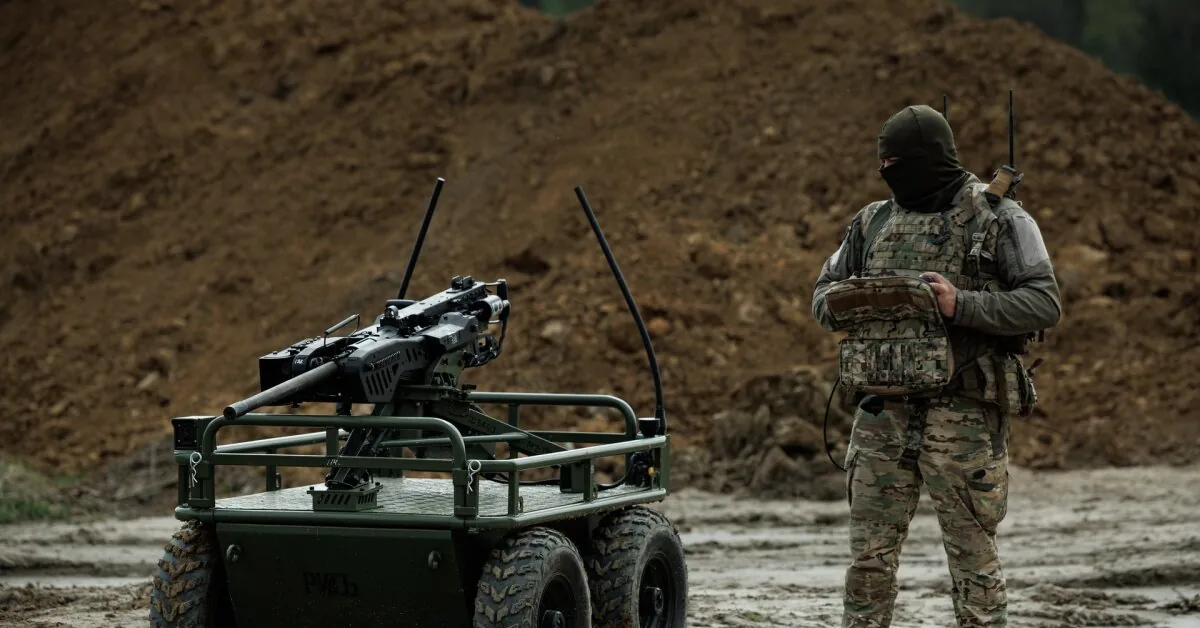
Every month, such robots carry out thousands of missions. They have become an indispensable technology for Ukrainian infantrymen, who spend months in bunkers, hiding from drones buzzing overhead.
Read more ES court rejects «OpenAI» trademark registration application
The most advanced unmanned ground robots are now doing what seemed possible only after several generations: attacking and capturing enemy trenches. In April, President Volodymyr Zelensky stated that Ukrainian forces had taken Russian-controlled positions using only ground and flying drones. No Ukrainian soldier was directly endangered during the operation.
In the field of ground robot development, Ukraine already surpasses the most advanced armies in the world, including Russia’s. However, it is not software geniuses behind aerial drones who lead the way, but welders and mechanics whose improvised creations help infantrymen continue their hard work.
“Flying drones were developed faster because they were created by highly creative IT specialists,” assessed Oleksiy Honcharuk, former Prime Minister of Ukraine and chairman of the board of the ground drone manufacturing company “Uforce.”
“Ground robot systems were mostly used in frontline infantry units, where the work requires more strength and is more practical, so it is important to figure out how to connect everything so that it all works,” he explained.
After the Russian invasion, Ukraine, in a desperate situation, resorted to increasingly complex technical solutions to hold its ground in an uneven fight.
Cheap quadcopter drones created with 3D printers are currently more important on the front than automatic rifles. Naval drones forced the Russian Black Sea Fleet to retreat to other ports. And Ukrainian systems that intercept unmanned aerial vehicles proved so effective that some were sent to the Middle East to help shoot down attack drones coming from Iran.
Meanwhile, ground combat—the kind most familiar to people—remained the least explored area. Robots on the ground established themselves slowly: debris-strewn terrain hindered them, and the machines were easy prey for attacking unmanned aerial vehicles.
Because of this, the development of these systems was considered a non-priority task. Much less funding was allocated than for flying drone development. Nimble drone operators quickly captivated the entire military world.
However, mechanics and infantrymen who saw the huge need for robots on the battlefield stubbornly defended their position.
One of the first was Captain Oleksandr Kharkovets, now leading the 93rd Mechanized Brigade’s ground robot battalion. Before the full-scale Russian invasion, O. Kharkovets ran an automotive electronics repair workshop.
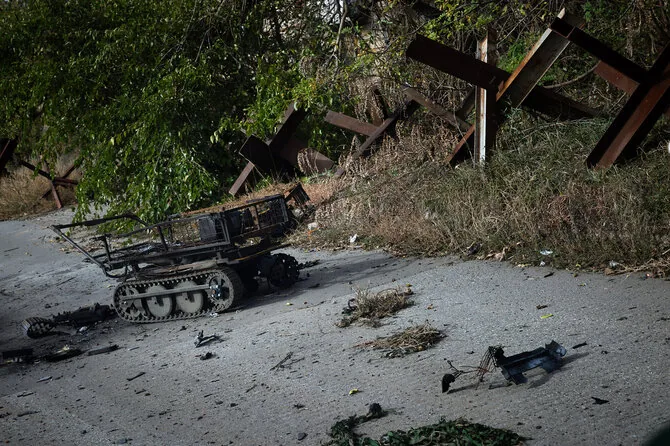
In 2023, he fought for every house in the ruins of Bakhmut. Once, while trying to avoid a bullet, a saving thought came to the soldier: “Machines can do this.”
When the order to retreat was given, many of his comrades’ bodies remained in those ruins. The man decided to use his skills as a mechanic to ensure that other soldiers, alive or dead, would not be left to fate.
He attached a hook and a machine gun to a remotely controlled machine so it could drag the dead and provide fire support at the same time. Later, the robot was used to retrieve the body of a soldier whom a special forces unit could not reach for a whole week.
O. Kharkovets filmed the mission, prepared a presentation, and insisted on convincing his superiors to start using this ground robot in combat operations.
“Then,” he said, “everything began.”
Saving lives
Mathematics is ruthless for Ukraine. The country’s armed forces have fewer soldiers than Russia’s side. Fighting for every soldier’s life is a kind of existential mission.
However, protecting them is becoming increasingly difficult because the so-called “kill zone”—a stretch of land along the front line where any movement attracts swarms of destructive drones—is constantly expanding. In some places, it extends up to 24 km into the rear, making it harder to reach a position than to hold it.
“We simply cannot afford to lose people,” said Oleksandr, whose surname is withheld for security reasons.
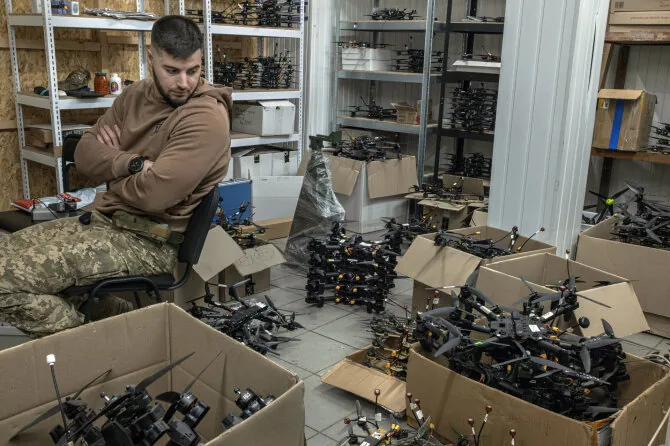
The soldier leads the “K-2” brigade’s unmanned ground systems battalion. It has more than 500 soldiers and over 600 robots. Fighters carry out five or six missions daily.
The brigade had to find a way to best protect its soldiers, Oleksandr said, otherwise “there would soon be a shortage of pickup drivers” who handle logistical challenges.
Ground robots changed everything fundamentally. They are smaller and slower than pickups but harder to spot from above. Also, they do not emit body heat. When they explode, no one dies.
Sergeant Dmytro Ivanov, commander of the 36th Brigade’s ground robot systems platoon, noted that when his unit received enough unmanned machines, they “performed up to 80% of tasks without humans—handling all transportation and deliveries.”
The sergeant’s decision to use robots for these tasks was driven by his own exhaustion. As a combat engineer, he had to carry mines in his backpack for 14 km. According to him, the brigade received few supplies, so his team had to manufacture most of the equipment from scratch.
Read more NVSC: Smoke from the fire in the «Ecoservice» unit in Marijampolė may be hazardous to health
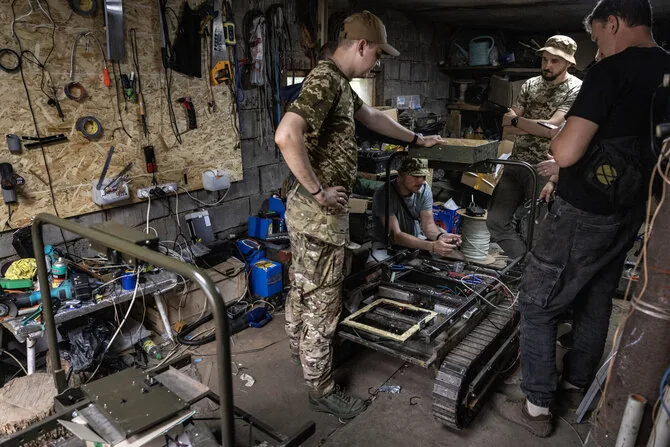
Today, the soldier leads two workshops near the front. One handles electronics, such as radio communication devices and controllers for the machines. The other welds and assembles buggies.
Even machines have limits
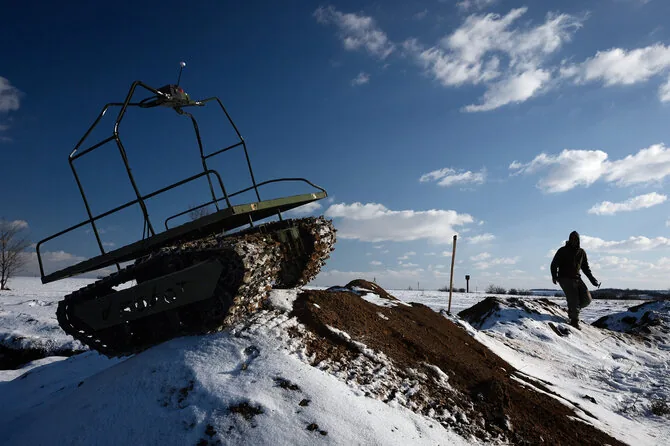
But even machines have limits. In flat steppe terrain, they become easy targets. A robot cannot climb a tree, jump into a trench, or improvise as a soldier can. Engineers rush to protect their robots by installing miniature air defense systems on them.
Another problem is the danger of friendly fire from their own troops. One unit came up with an experiment: they sewed microchips into uniforms, similar to those used in electronic tags (Radio frequency identification – RFID), so the robot turret could distinguish a Ukrainian soldier from a Russian one.
Ukrainians admit they can no longer imagine the army without ground robots. The country plans to produce 50,000 of them this year—almost twice as many as last year. Additionally, the Ukrainian armed forces are creating a center for these systems.
The Russian army also uses ground robots, often for the same tasks, but trusts them much less than Ukraine does.
As Maksym Vasilchenko, head of the Ukrainian Association of Ground Robot Systems Manufacturers, said, for the price of one armored infantry vehicle, a brigade can acquire 77 ground machines.
“That provides 77 opportunities to complete a mission without human casualties,” he noted.
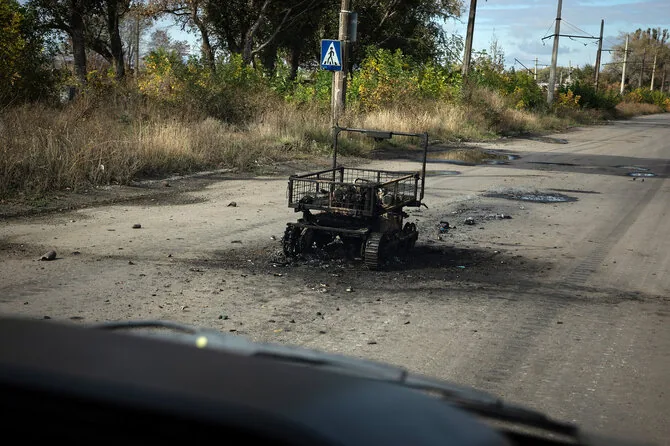
Many Ukrainian soldiers believe that ground robots will never be as widespread as flying drones.
A ground machine costs on average about 21,000 euros—twice as much as a large-capacity unmanned aerial vehicle and significantly more than a small quadcopter loaded with explosives.
Unmanned aerial vehicles can also supply soldiers faster and perform repeated flights, although they carry much smaller loads.
However, there are things flying drones cannot do.
Oleksandr’s unit recently evacuated an assault regiment soldier who stepped on a mine and lost a leg. According to him, the robot traveled 4 km through enemy territory, ran over three mines on the way, but brought the soldier out alive.
“Without this robot, it would have been impossible to save him,” Oleksandr said. “No one would have taken such a huge risk with their life.”
Where they replace soldiers
Although logistical challenges prompted Ukrainian infantrymen to create ground robots, now soldiers are most fascinated by the combat potential of these machines.
In December 2024, the “Chartyja” corps conducted what is believed to be the first attack carried out exclusively by robots. Coordinated drone forces in the Kharkiv region took Russian positions. Ground robots armed with machine guns, flamethrowers, and explosives moved through the forest, while flying drones observed them from above. Expectations were modest.
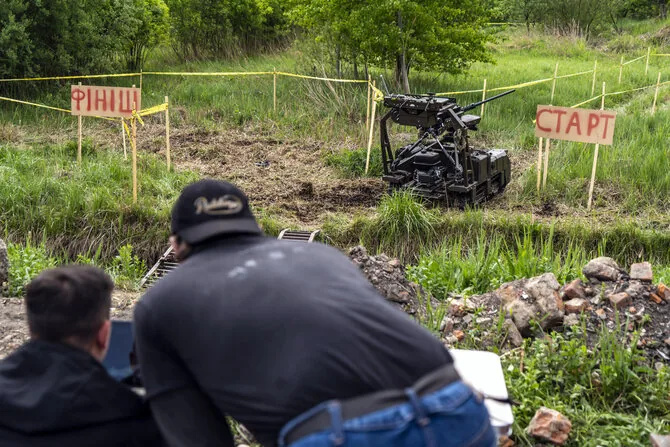
“Our minimum goal was to ensure that at least one robot reached the enemy position,” recalled Lieutenant Andriy Kopach, commander of the corps’ unmanned ground systems company, who helped plan the mission.
A year has passed. Now the lieutenant himself laughs at the result achieved during the attack.
“All we did was destroy some trenches,” he said.
Today, ground robots equipped with rifles or bombs can independently take prisoners and deliver them to Ukrainian soldiers located further from the front. In practice, it looks like this: a Russian soldier waves a white flag or raises his hands, and the robot escorts him to Ukrainian positions.
Machines can also hold positions. Near one village, a robot with a mounted .50 caliber machine gun stood guard alone for 45 days, said Junior Lieutenant Mykola Zinkevych, who led the 3rd Assault Brigade operation.
“Every morning it went on combat watch duty and returned in the evening to recharge batteries,” he said.
Soldiers hid the robot in three different positions, moving it every other day. The Russians never found out it was a machine, Zinkevych noted.
“War is a constant experiment,” said the junior lieutenant.
The latest achievement in this field is automated turrets designed to shoot down flying drones. Although still experimental, they have already worked dozens of times. Between shots, they turn off and cool down, making it difficult for enemy heat-sensitive cameras to detect them.
Zinkevych calculated that each drone shot down by these turrets can save the lives of three or four Ukrainian soldiers.
What happens next is decided step by step, month by month.
In the 36th brigade, Ivanov’s team is replacing analog cameras with digital ones, installing “Starlink” satellite devices for better navigation, and fitting armor on their robots to protect against shrapnel. His soldiers put airless tires on the robots that cannot be punctured by explosions, add extra batteries to extend the robots’ operating range to 48 km.
“There is no set tactic in war,” Ivanov said. “Everything depends on the ability to assess the situation, anticipate ahead, and endlessly improvise. Every day is different.”
Read more July 16 Horoscope: One Zodiac Sign Will Smile Upon Special Luck
This article was published in The New York Times.
© 2026 The New York Times Company