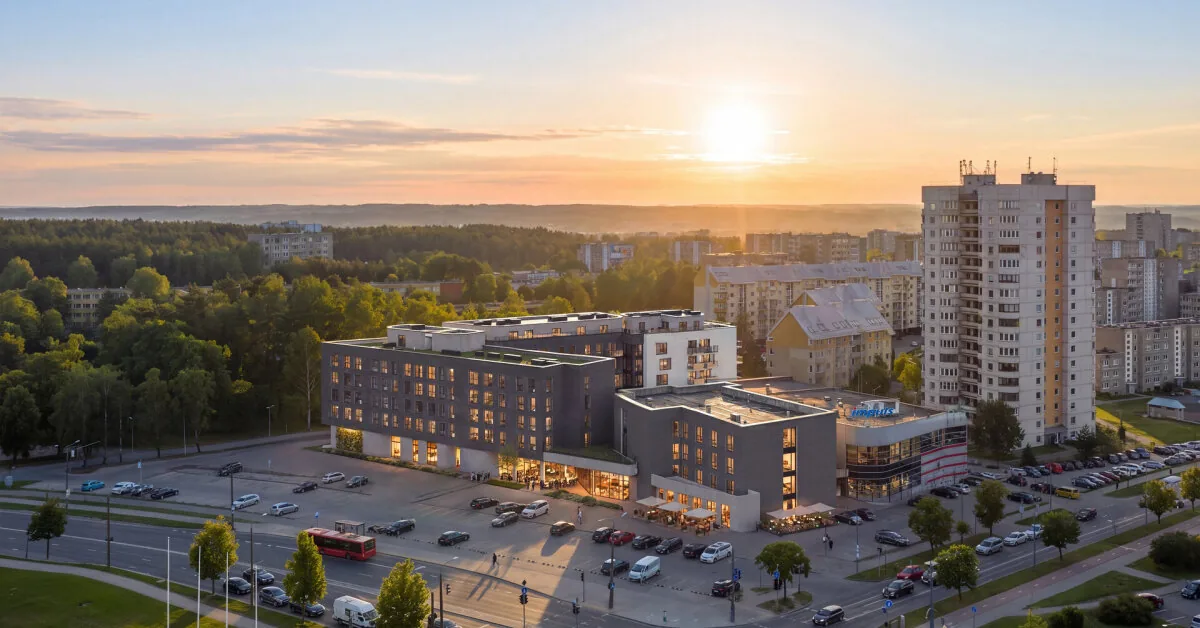
New construction has been active in all major cities of the country in recent years, especially in the capital. The limited choice of vacant plots closer to the center dictates that new housing development often clusters in several concentrated zones – in Vilnius, Pilaitė, the western part of Justiniškės, Pašilaičiai, Žirmūnai, southern Viršuliškės, Markučiai, and others now stand out in this regard.
Read more The weather surprised the coach of «Kauno Žalgiris» who landed in Farer Islands
However, the actual construction location does not always mean that residents most desire their new homes exactly there. Especially – longtime city residents.
Marius Čiulada, head of the Vilnius Old Town office of the real estate services company “Ober-Haus,” says he has seen for many years the phenomenon that people born, raised, living for a long time, or still living in one district primarily look for new housing precisely in the nearest environment, often in the same district.
“This phenomenon is definitely common. Speaking about the capital, it is most typical among first or second-generation Vilnius residents, born and raised in Vilnius. Usually, they attended a kindergarten or school in one or another district, their parents mostly live in their native district or at least in that part of the city, so naturally, their first choice for new housing is the same or adjacent part of the city. Few Vilnius residents are inclined to move to a new home completely on the other side of the city,” comments M. Čiulada.
However, according to M. Čiulada, the initial focus on the native district has many different but logical reasons. For some, it is important to be as close as possible to parents or grandparents; others’ choices are dictated by a time-tested or “scouted” educational institution. The workplace also plays a role. Some residents choose their native district for new homes because of time-tested, objective, or subjective peace, greenery, prestige.
It is true that the “Ober-Haus” representative notes that the “native district” trend in Vilnius is less valid for prestigious parts of the city, such as the Old Town, Užupis, or Žvėrynas. In other words, Vilnius residents who grew up in these districts also primarily look for new homes here, but these parts of the city are also gladly considered by everyone else when possibilities allow.
Read more Urbo bank raised another 3.14 million euros for expansion through bonds
Seen in practice
The strong native district trend has also been noticed for several years by the real estate development company “Homa Group.” The project “Jaunatis,” consisting of 116 apartments and commercial spaces, immediately attracted great interest from Fabijoniškės residents.
Eglė Krengauskė, head of the “Homa” marketing department, says that the company constantly observed the native district phenomenon, but in the case of Fabijoniškės, it became especially pronounced.
“In less than a month, more than half of the apartments in ‘Jaunatis’ were sold or reserved. From conversations with clients, we see that only about 25% of sales in this project are for investment: the rest buy ‘for themselves,’ and most of them are Fabijoniškės residents,” says E. Krengauskė.
“For people, it is psychologically easier, less stressful to be in a familiar district,” says the “Homa” representative.
Read more The second life of an old blazer: how a boring garment turned into a stylish and unique handbag