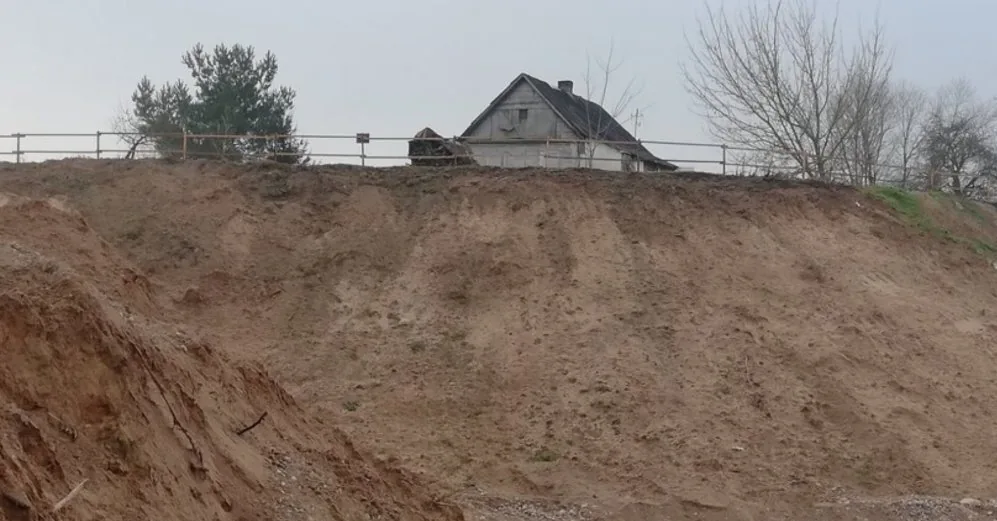
For many years, there has been no established minimum mandatory distance in Lithuania between open-pit quarries for mineral resources and residential buildings. Due to this legal loophole, sand, gravel, or crushed stone can be extracted in quarries right next to people’s homes, homesteads, farms, lakes, and local roads, according to a press release.
Read more Chairman of the Russian State Duma became a billionaire: how he succeeded
The problem has crossed the boundaries of one district
This is not a problem of a single community. The mayors of Kaunas, Klaipėda, and Jonava district municipalities have expressed the position that it is necessary to establish sanitary protection zones at the national level as a preventive measure to ensure public health and residents’ right to a safe environment.
Valerijus Makūnas, the mayor of Kaunas district municipality, says that this district, located in the valleys of major Lithuanian rivers, holds large sand and gravel resources, but their extraction has been causing tension between businesses and local communities for many years.
“The Kaunas District Municipality Council has stopped entrepreneurs’ plans to extract gravel in environmentally and culturally sensitive areas of Batniava eldership several times. Public interests had to be defended in courts as well,” says V. Makūnas.
Klaipėda District Municipality was also one of the first to raise questions nationally regarding stricter regulation of gravel quarry operations. According to Bronius Markauskas, the mayor of Klaipėda district, mineral extraction is an important business sector, but it cannot be developed at the expense of residents.
“We manage to cooperate with some companies, but we cannot find common ground with others, and we have no means to restrict their activities. This creates significant problems for residents who daily face the consequences of quarry operations. Therefore, it is necessary to change legal acts, regulate quarry activities more clearly, and provide for a clear sanitary zone so that the quarry is no less than 300 meters away from the nearest house,” says the mayor of Klaipėda district.
According to V. Makūnas, mineral extraction is important for the economy, but it must be carried out responsibly: “We understand that gravel and sand are needed for the rapidly growing construction sector, but business development cannot be carried out at the expense of local communities and nature.”
A. Radvilavičius: the state must act preventively
An initiative to establish a clear protection zone from quarries to residential and other sensitive buildings is currently being considered in the Seimas. Communities support the 300-meter limit as a real preventive protection against dust, noise, and vibration. According to residents, the most important thing is that a clear and nationwide applicable limit finally appears in the law, as there is none at all now.
The author of the initiative, Audrius Radvilavičius, a member of the Seimas Environmental Protection Committee, says that currently, each case of quarry development is decided individually, residents are often improperly informed about quarry development, cannot influence it, and are forced to prove themselves that dust, noise, and heavy transport worsen their living environment.
“The state should act in reverse – not wait until people feel the consequences, but establish clear preventive protection in advance,” says Audrius Radvilavičius.
According to the Lithuanian Geological Survey, a 300-meter protection zone distance to residential buildings would affect only about 11.7 percent of thoroughly explored deposits, while more than 88 percent of deposits would remain accessible.
Protection zones – common European practice
The principle of sanitary protection zones is not new in Lithuania – such zones are applied to preventively manage the impact of economic activities on public health. Previously, a minimum distance between quarries and residential areas was stipulated, but with changes in regulation, this clear limit disappeared. The current regulation of quarries has left a loophole: there is still no clear minimum distance between an open-pit quarry and a residential area.
Read more Thursday’s «Group»: will you group 16 words into 4 categories?
European practice shows that clear protection limits between quarries and residential areas are not an exceptional or radical proposal. Although there is no single mandatory minimum distance for all countries at the EU level, several states apply specific guidelines: in neighboring Poland, a distance of 250 meters is considered a criterion for significant impact, in Sweden, a distance of 200 meters to buildings is applied, in Finland – 150 meters for exploration works, in the Netherlands – no less than 300 meters, and in Germany – 300–500 meters. This confirms that a clear limit is a normal preventive measure that helps reduce conflicts between industry, local government, and residents in advance.
Thus, states can choose a flexible model, but at the same time establish clear limits that help protect residents and reduce conflicts between communities and businesses in advance.
Living without peace in the vicinity of quarries
Residents of such places talk about windows, vegetable gardens, orchards, livestock, and their feed covered in dust, the sound of machinery working from early morning until late at night, the noise of crushing and screening equipment, vibration, local roads damaged by heavy dump trucks, and tragically depreciated real estate – homes that families built for decades.
According to residents, the work and associated noise do not end during normal working hours: machinery is heard in the evenings, and quarry activities are recorded even on weekends, when people expect at least minimal rest in their homes.
“When in summer you can no longer open the window because dust covers the house and yard, when you hear machinery working from morning till night, when children and seniors live next to heavy transport traffic, breathing polluted air, it is no longer just an inconvenience. It is a matter of quality of life, health, and basic respect for a person’s home,” says Antanas Juknevičius, a resident of Trakai district, next to whose homestead, cherished for many years, a gravel quarry appeared.
Communities record cases where entire residential areas find themselves surrounded by quarries – next to excavation, crushing, heavy machinery, and constant dust. After quarry developers finish their work and mineral resources are depleted, such homesteads often remain surrounded by water-filled quarry pits, difficult to access, having lost their previous quality of living.
Residents emphasize that they are not against quarries and understand that Lithuania needs sand, gravel, and other construction resources. However, according to them, industrial extraction cannot begin right next to a person’s fence.
“They try to explain to us how much businesses can lose. But who will count how much people lose? Who will assess children breathing dust, constant noise, damaged roads, health concerns, and homes whose value suddenly drops just because a quarry is planned nearby?” asks A. Juknevičius.
Communities call this proposal a minimal civilized safeguard. According to them, a clear limit would help protect people, reduce conflicts, and provide more clarity for municipalities, institutions, and businesses.
“300 meters is a civilized limit that protects human health from industrial dust. It is not a prohibition on excavation, but a requirement for businesses to agree with neighbors, it is a minimal distance between industrial extraction and human life,” says A. Juknevičius.
Read more Is he planning to propose? 5 signs that your loved one is ready to get engaged