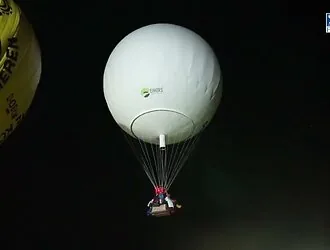
Noise about balloons arose on Sunday morning when residents of southwestern Lithuania saw hot air balloons in the sky, resembling from afar those used by cigarette smugglers. Local police officers reportedly received calls about them.
Responded to this was also Member of Parliament Dainius Gaižauskas. He addressed the National Crisis Management Center (NKVC) asking why residents were not warned about this. Marijampolė police officers reportedly informed the parliamentarian that Polish police and military exercises were taking place.
Soon the politician clarified that participants of the 69th “Coupe Aéronautique Gordon Bennett” world championship had entered Lithuanian airspace. D. Gaižauskas also added that he would still have questions about this incident.
Race participants (23 teams of 2 people each) started on Friday in the vicinity of Gladbeck (Germany) and aim to get as far as possible without landing. The balloon flight trajectory can be monitored here.
The Lithuanian team is also participating in the championship – Robertas Komža and Romanas Mikelevičius. However, they are no longer flying – on Saturday evening, after being in the air for 18 hours 4 minutes, they landed in Poland northwest of Łódź. The pilots moved 772.44 km away from the starting point.
On Sunday evening, only three teams remained in the air. Many participants landed still in Germany or Poland, one of the two British teams landed just after crossing the Lithuanian-Polish border, eleven balloons flew further, but most also ended their flights by evening.
Another balloon, piloted by Swiss Balthasar Wicki and René Erni, was immediately blown north by the wind, so the aviators spent most of the time flying over the Baltic Sea and reached Finland on Sunday evening. The pilots landed on its coast after 41 hours 4 minutes, having traveled 1,555.18 km. This allowed the athletes to become leaders.
Some were likely stopped from longer flights by the wall waiting ahead with Belarus. Not only this country but also eastern Lithuania, Latvia territories, and the entire Kaliningrad region are declared prohibited zones.
This is done not only because of the ongoing war in Ukraine but also due to a tragic accident three decades ago. Although this country was informed about the balloon race and received flight plans, a military helicopter met the athletes with a volley of shots. Another balloon was forced to land, the pilots of the third landed voluntarily but were fined for entering Belarus without visas.
Aircraft miscommunication
The tragedy occurred on September 12, 1995, during the same Gordon Bennett Cup. This race is named in honor of an American millionaire, press magnate, and athlete who financed the first balloon race held in 1906.
A military helicopter met one balloon with a volley of shots. Another was forced to land, the pilots of the third landed voluntarily but were fined for entering Belarus without visas.
Participants must fly as far as possible without landing, measuring the straight-line distance from the starting point. The actual distance flown and time spent do not matter. This is exactly the type of race held in 1906. That year, 16 balloons took off from the Tuileries Gardens in Paris.
Since these races are flown with gas balloons, not the more common hot air balloons, pilots can cover not only hundreds but thousands of kilometers, cross more than one or two countries, and spend several days in the air.
The 39th race, which started in the town of Wila in northern Switzerland and involved 17 teams, was marked not only by a still unbeaten record but also by the deaths of two participants and the detention of two others.
The winners, Germans Wilhelm Eimers and Bernd Landsmann, landed 1,628 km away in Latvia, having been in the air for more than 92 hours – this remains the record flight duration for this race.
VIDEO: Start of the 2026 Gordon Bennett Cup participants
Start of the 2026 Gordon Bennett Cup participants
The fourth day of the demanding endurance and skill competition was underway. In the morning, due to the rising sun warming the air, winds blew some balloons over Poland not northward to reach the Baltic states but more eastward toward Belarus.
Americans, main pilot 55-year-old Alan Fraenckel and second pilot 68-year-old John Stuart-Jervis, were approaching the Poland-Belarus border and sensed a possible victory. In total, three US teams were flying in the same direction.
Organizers had assured pilots that Belarusian authorities were warned about the race and the American pilots’ plans to enter its airspace. A couple of hours before the border, the pilots contacted the Minsk air traffic control center. Belarusians confirmed receiving the signal but responded incomprehensibly – in Russian, although English is usually used in international aviation communication.
At 9:41 am, after entering Belarus, A. Fraenckel and J. Stuart-Jervis were “tracked” by the air defense system for more than two hours until the air force command ordered to inspect the moving object in the sky. The balloon appeared suspicious because it flew just 4 km from military air forces and nearby strategic weapons bases.
The balloon with a 900 cubic meter highly flammable hydrogen envelope exploded and fell into the forest.
According to the Moscow daily “Izvestia,” citing Belarusian officials after the accident, the military helicopter “Mi-24B” approached the balloon but, despite clear weather, could not see anything. Belarusians claimed that the pilots did not respond to requests to explain who they were, so warning shots were fired.
The balloon continued flying, so the helicopter pilot decided there was no one inside. Belarusian air defense commander Lieutenant General Valery Kastenka ordered to open fire. The “Mi-24B” fired a machine gun salvo.
The balloon registered in Germany with a 900 cubic meter highly flammable hydrogen envelope exploded and fell into a forest in the western part of the country, 8 km east of the village of Berioza. It was pierced by about twenty bullets. Falling from 2 km altitude, the pilots died instantly.
The helicopter pilot explained he only saw the balloon and a closed gray metal gondola without any distinguishing marks. The military air forces stated that fire was opened only “after all efforts to establish communication failed.” Here you can read an excerpt of the military conversation about the balloon transcript (in Russian).
According to then vice president of the American Aeronautics Federation John Kugler, all similar flying devices use radios operating on standard international frequencies. The pilots had already been in the air for more than 60 hours, so most likely the radios’ batteries were dead, and there were no spares in the basket to save weight.
Order – via interview
Journalist, editor of the newspaper “Svobodnyje novosti” and correspondent for the Moscow-published “Military Journal” Vasily Zdaniuk witnessed this tragedy from the other side.
Just at the time when the Americans began flying over western Belarus, he started an interview in Minsk with the mentioned V. Kastenka.
Also read: The sky over A. Lukashenko: how the military shot two pilots in 1995
About 20 minutes later, military air force duty officers called: “There is a situation: an unidentified object appeared near our facilities, near the runway.”
Understand instantly
Balloons keep flying: this time students found a smuggler’s cargo
Nine people transporting contraband cigarettes by balloons were detained in Poland, including two Lithuanians
Residents reassured: balloons seen in the sky are not “smuggling” balloons
As if on purpose, before that V. Kastenka explained to the journalist the inconveniences caused to Belarusian air defense by low-flying probes, mostly balloons. The officer recalled that one such balloon flying directly over Minsk almost caused panic, although there was no danger.
“Look how lucky you are. We are talking about this and the balloon is hanging in the air!” – after the duty officers’ call, the interlocutor said to V. Zdaniuk and immediately asked to launch the “Mi-24B”.
When it approached the balloon, V. Kastenka turned on the loudspeaker. After five minutes, the helicopter circled the balloon, and its pilot asked what to do. “What to do? Shoot it!” – the general replied and added a few colorful phrases.
After the volley of shots, which the journalist could also hear, V. Kastenka stated: “You see how it works. This is how we operate.”
When the helicopter circled the balloon, its pilot asked what to do. “What to do? Shoot it!” – the general replied and added a few colorful phrases.
V. Zdaniuk said in an interview that he was sure the officer did not realize the balloon was piloted by people. He guessed the events would not have turned so tragically if V. Kastenka had encountered other American balloons. Perhaps the officer would have been interested in why the balloons fly one after another and would have learned that a world-class competition was taking place.
The tragedy was most likely caused by a stupid mistake and unfortunate coincidence. The Belarusian State Aviation Committee, which gave permission for the balloons to fly into its airspace, informed everyone except the military air force personnel on the ground. Confronted with an unknown object they could not identify or communicate with, they simply did what they had been taught to do during the long Cold War decades.
The Commonwealth of Independent States Aviation Committee, which conducted an investigation together with US and German aviation officials, stated that the reason for the shooting was “an unidentified balloon flight into Belarusian airspace without permission, lack of radio communication, and errors by air defense elements in identifying and classifying the aircraft violating Belarusian airspace.”