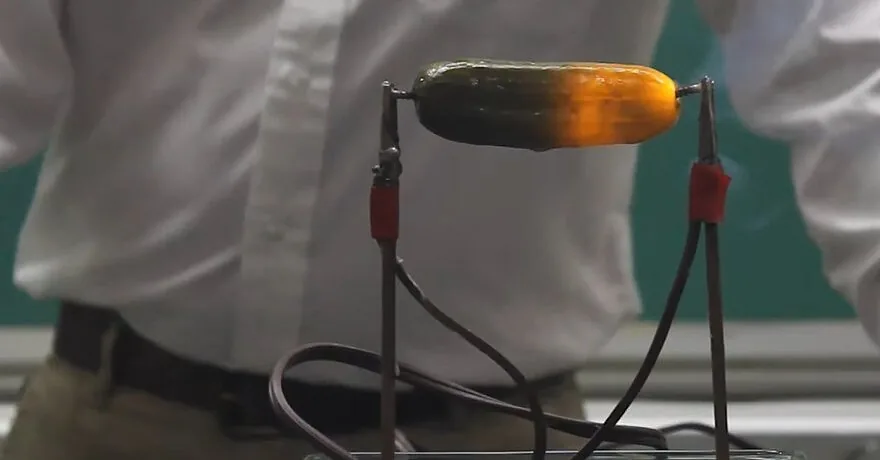
This unusual experiment was demonstrated at a meeting of the Electrostatics Society of America by Joshua Méndez Harper, an electrical engineer from Portland State University.
Read more Wednesday test: will you answer at least 8 out of 10 general knowledge questions?
The demonstration was not just a fun trick – his team of scientists in the lab was trying to figure out why a pickle connected to electricity starts to glow.
The scientist brought a jar of pickles and electrodes to the event.
Before turning on the electricity, he joked that he hoped they wouldn’t have to interrupt the event due to a fire alarm.
As soon as the electricity was turned on, the pickle began to sizzle, and one end soon glowed a bright orange. The smell of burning filled the air, and the demonstration was concluded.
Why does the pickle glow?
Scientists have long known that pickles can conduct electricity. This is because they are soaked in brine, which is rich in ions – electrically charged particles.
However, what exactly causes the glow has long been a subject of debate.
One hypothesis suggested that the brine boils at the electrode, creating a pocket of steam. This briefly stops the flow of electricity, causing sparks to jump across the gap.
Another version was based on electrolysis – a process where an electric current breaks down water into hydrogen and oxygen.
Such a gas mixture is explosive, and if heated sufficiently, it could cause small glowing explosions.
It turned out that both theories were correct
To find out what was really happening, scientists connected various sensors to a pickle in the lab, including a high-speed camera and a hydrogen detector.
Read more After a tick bite, a teenager developed a fatal reaction – the first case in the world
During the experiment, they used both alternating and direct current.
In both cases, hydrogen formation was recorded, meaning that electrolysis indeed occurs.
However, the glow only appeared when using alternating current – the kind supplied from a regular electrical outlet.
This led scientists to conclude that both mechanisms work simultaneously.
According to them, the constantly changing direction of alternating current helps maintain a pocket of steam near the electrode.
The sparks generated within it ignite the hydrogen and oxygen mixture, causing a bright orange glow.
When using direct current, the steam pocket likely dissipates quickly.
Although hydrogen continues to form, there are no more sparks, and thus no glow.
Why does only one end glow?
Scientists also answered another question – why only one side of the pickle glows.
It turned out to be very simple: the area where more brine accumulates glows.
When a pickle is held vertically, its lower part always starts to glow a bright orange, because that is where more liquid collects.
After the experiment, the scientists did not dare to taste the electrically affected pickle – it ended up in the trash.
Read more Slimming cheese from France: what do nutritionists say about it?