Over its lifetime, MO readings have become one of the biggest poetry events in Vilnius – bringing together different literary experiences, perspectives, and voices, and fostering new generations of listeners and authors.
“At the beginning of these events, for some listeners it was one of their first encounters with poetry, and now some of these people are actively creating authors, critics, editors themselves,” says Zigmas Pakštaitis, the initiator of the “MO lauke” poetry readings.
– Zigmas, what changes have you noticed over these eight years – from the audience gathering at the readings to the poetry scene itself?
– Probably the easiest to see is the changing number of listeners – and it keeps growing at the events. I remember at one of the first readings, poet Rimvydas Stankevičius participated, and together we thought that if thirty people showed up, it would already be good. More than fifty came – we considered that a great success. Now we get up to two hundred listeners at one event.
In the first years, the readings were mostly attended by people from the literary community, but now the audience is much broader. It’s gratifying when people who are not regular followers of such events or all cultural news, or new book handlers, come to listen and perhaps become interested in the authors’ work. For some, this might be their only contact with contemporary poetry.
Looking back, it’s even strange that we have changed little in these events since their beginning. It’s somewhat ironic – today there is often an emphasis on the need to constantly transform and improve everything so that activities can continue, while for us the opposite happened: every year we do the same thing and every year it goes well. (laughs)
– Probably the fact that the audience keeps expanding without significant changes to the format suggests a well-functioning organizational logic. What is it? How do you arrange the reading program, what is important for you to include, and what do you perhaps deliberately avoid?
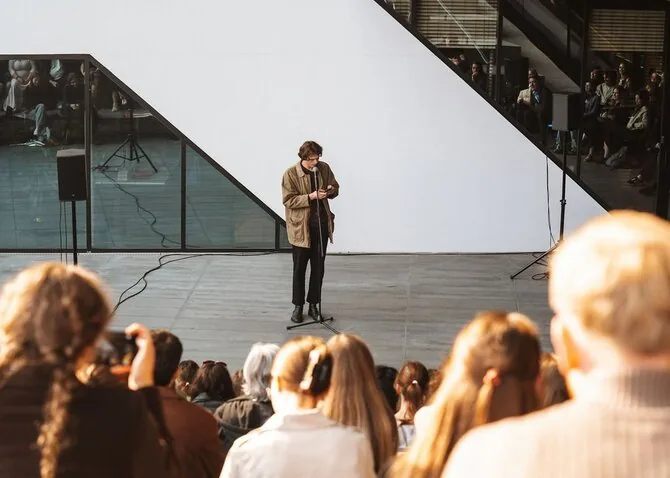
– Maybe I overstate a bit when I say we don’t change anything – after all, every year we include new authors, have done events with translators and deceased authors, invited to thematic poetry events in Kaunas and Vilnius, organized readings where authors change after reading one poem, have to respond with one text to another previously read text…
The beginning of these poetry readings was connected with a dream of what poetry events should be like, how they should sound, and in what literary process I myself with colleagues and friends would like to participate. Such events – especially in summer – were very few. Apparently, it worked – the number of visitors shows that I was not the only one who missed this.
Respect for the audience and authors is important – good sound, a comfortable place to sit, microphones that don’t squeak. I have attended several poetry events where very good authors read very good texts, but they cannot be heard because the equipment echoes and buzzes. Duration is also important – if events drag on, halfway through the second hour people start fidgeting or leaving, and then the authors feel bad. Therefore, we try to fit into one hour, and when more poets read – for example, at young authors’ events – we allocate the same number of minutes to everyone – listening to a literary text requires concentration, so it needs to be dosed.
I always try to invite several authors. The contrast between different voices and personalities, text architectures allows better hearing of them, participants highlight each other, and bring together each other’s readers. Sometimes even the authors themselves are surprised to hear how their poems sound anew. Overall, I invite to all events those authors I believe in and admire, consider masterful or becoming so. When this repeats event after event, listeners start to trust and return.
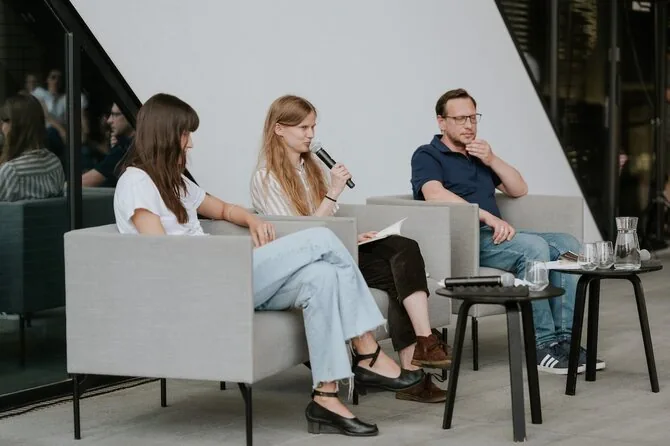
– For the third summer, one of the “MO lauke” poetry reading events is dedicated to new voices discovered through an open call. How important are these events?
– During these events, both I and the listeners step out of our familiar environment and hear something new. Usually, we announce an open call, ask authors to send 3 poems and a sentence about themselves, then we read and evaluate. Many unseen, unheard participants always come into view. Although these readings always scare me – I don’t know if – and who – will respond to the call, sometimes until the last days it’s unclear whether the event will have to be canceled at all, because many authors send texts at the last moment.
We have to send many negative responses as well, so probably the most important task both in such events and in cultural publication editorial offices is to be able to say “no” in a way that doesn’t close doors, encourages further learning and improvement. When there are fifty applicants and only ten places, someone inevitably stays out. But out of the line – not overboard.
We want to discover beginning authors who reveal they can run a literary marathon, have the desire or opportunity to become good writers. It’s important to encourage them, invite them, show them to the audience – if after these events even one person hooks and wants to be part of the literary process, it will be a success.
– Do you notice how the audience grows together with the event, gets involved in the literary world, and a new circle of listeners and authors forms?
Read more Former «Rytas» defender Metus reflected on past grievances: «I’ll be honest»
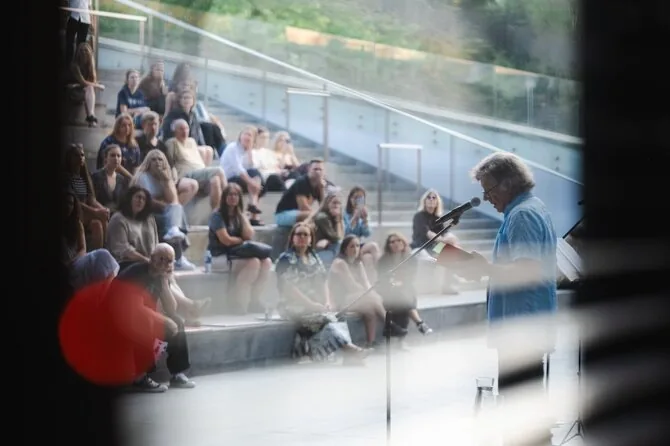
– Eight years of “MO lauke” poetry readings undoubtedly carry some weight. On the one hand, I have already invited a large part of the authors I dreamed of inviting to read, so every year I have to step out of my usual field of vision, explore and get to know new creators.
On the other hand, over a long time these readings have created a relationship with society and become part of beautiful personal stories: for some, at the beginning of these events they were seventeen or eighteen years old and it was one of their first encounters with poetry, and now some of these people are actively creating authors themselves, literature master’s students – writing reviews, engaging in criticism, organizing events themselves or working in publishing houses. I have heard: “I came to your events and realized that I need to be in the literary process.”
This is a long-term mark in the fabric of society, which is strange and gratifying to see. It reminds of responsibility and that events, processes, and people met have an impact – it’s easy to hurt, demotivate, say something that will turn off creativity forever. Bad impulses spread very easily, and good ones require effort.
– Organizing readings, you directly encounter a generation just beginning to establish itself in the literary world. How much do you manage to catch new or intriguing trends, themes, modes of expression in it?
– It’s very difficult to talk about significant trends when our events are quite short and many new participants join, but I definitely notice that in recent years there has been more humor and lightness in the readings.
I think not taking one’s own work too seriously is a great trait. Of course, it needs to be treated responsibly, but it’s important not to get angry, not to get stuck only in difficult, confusing topics, not to fill with affectations. That’s why it’s interesting when authors knock on the literary world’s door by examining small or witty things. A good example is poet Donaldas Kajokas, who can combine a light, brightening, smile-inviting text with depth, paradox, and changing insight. It seems that the younger generation of authors is increasingly seeking such lightness.
This year, the open call selection included quite a few professional poems, which I noticed in previous years as well. People work as data analysts, bankers, doctors, accountants, psychologists and write about their work. Perhaps this trend has not yet taken a tangible form, but over time it certainly could. Poetry should not be limited by stating that only certain topics or means of expression are suitable for it. The text itself usually justifies these means.
Why are professional poems increasing? It is likely that work topics have negative associations for the older generation and smell of the Soviet era – perhaps many authors born during that period avoided writing about work, it was more a plane of propaganda poetry. Now people who can take on professional topics without a repulsive trail are coming to them.
– An important role in the readings is also played by the MO space. Besides the qualities you already mentioned, what else does stepping out of the usual literary routes give to the readings? Does the museum context add additional nuances to the events?
– When these events started, the MO museum was still quite new and aimed to change society’s attitude towards museums, to show them as lively, attractive, interesting places. MO did many things that at that time seemed unusual for museums – from large-scale marketing campaigns to communication with the general public. I think events like “MO lauke” helped connect very different audiences – visitors looking for a fun leisure place and some cultural professionals who perhaps viewed MO museum’s brightness and playfulness skeptically.
At the very beginning, when communicating with authors, the museum did not have much trust among them, there were walls to overcome. Meanwhile, in the last five years, the attitude has completely changed – the museum has become a kind of springboard, a place where authors feel heard and seen. I think one of the most important things in these readings is that we do not try to impose anything on authors, we allow them to be in their creativity as they wish, we do not try to navigate them in one direction or another or put them in a box.
Because of this, we can invite less known, niche, very distinctive creators – listeners still gather in large numbers because they trust that they will really be good. And they are! Then small miracles happen when people get to know authors who may never appear in the top ten best-selling books, discover very authentic, deep, and warm poetry, and leave with wonderful impressions. The MO museum’s public trust, broad communication, and wide variety of activities allow poetry, which is usually a quiet and introverted activity, to be popularized and spread.
– “MO lauke” events – poetry readings, concerts, and other formats – have become a summer tradition in Vilnius, a kind of small city festival spread over the entire warm season. How do poetry reading events interact with the city?
– Looking for interesting authors, I have to look around other cities as well, but the more I look, the more it becomes clear that Vilnius is the poetry capital of Lithuania. And our poetry events fit quite well into the literary landscape of this capital – through them young authors grow a bit, less known ones appear more brightly, and listeners discover and get to know the literature of their time anew.
The festival includes not only poetry but also a musical program, reaching hundreds of young listeners with both. This is significant because it introduces both professional, top-quality creativity and various experiments, alternatives, or young, beginning authors. A twofold process happens here – in some cases, visitors come expecting culture as entertainment, but after coming, they always take away a deeper experience. From the very beginning, we created the festival to be open and free, so it is especially important now that the museum, having become a Vilnius cultural organization and supported by the Vilnius city municipality, can continue and grow it.
“MO lauke” poetry readings – August 13 at 7 p.m. on the MO museum terrace. The event is free.
Read more Contemporary art stirs even small towns – «Sūkuriai» begins in Valkininkai