The day the world changed
On January 29, 1886, K. Benz’s application became German patent DRP 37 435, which is even included in UNESCO’s “Memory of the World” program today. Although the patent’s wording sounded modest, its consequences were enormous: it triggered a transformation that created entire industries, changed cities, road infrastructure, and ultimately how we now perceive human mobility.
Read more On the rain-soaked Bauska track, Lithuanians demonstrated a fighter’s character
Automotive reviewer Egidijus Babelis says that K. Benz’s initiative is particularly symbolic when viewed through the eyes of an ordinary driver. According to him, it is no coincidence that Mercedes-Benz, co-founded by the patent’s author, is extremely proud of this fact and rightly considers it a universal reference point, as the company’s own activities and success are inseparable from the evolution of the entire industry.
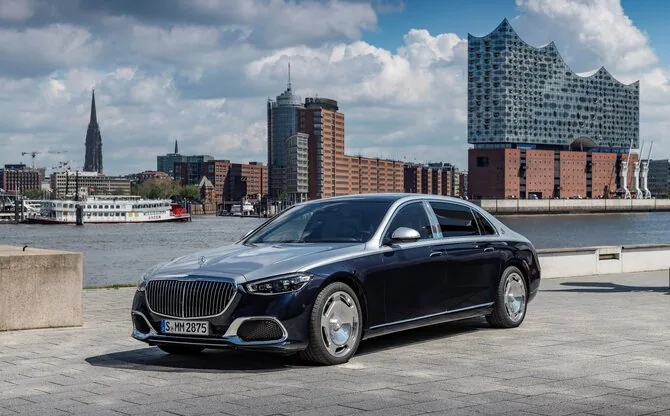
“If the technological breakthrough at the end of the 19th century was getting off a horse, then over 140 years of evolution, we have today reached a point where we have vehicles that allow a single driver to control an entire herd of horses with one press of the pedal, are incredibly safe, comfortable, and are already beginning to communicate directly with us, with traffic infrastructure, and with various digital systems,” describes the most significant steps of progress the journalist of the “Autopilotas” show.

Inseparable from K. Benz, Mercedes-Benz began to gain fame for innovations already at the beginning of the 20th century – the first production car with brakes on all wheels, the first with independent suspension, and so on. In the post-war era, the Germans became pioneers in safety technologies: in 1959, a body was introduced that included a so-called crumple zone, designed to absorb impact in the event of an accident and minimize its effect on passengers as much as possible.
The model that dictated the rhythm of evolution
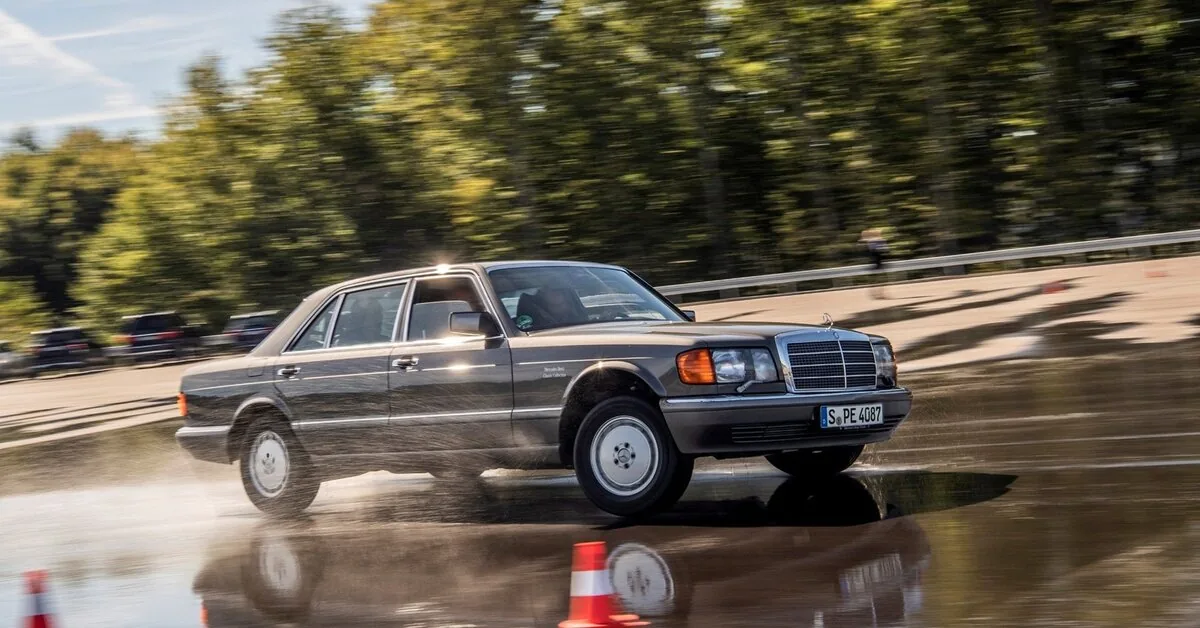
However, one of the most prominent examples of automotive evolution is usually a specific Mercedes-Benz model – the S-Class. Through it, the manufacturer has introduced innovations to the market for decades, which later become the norm for everyone.
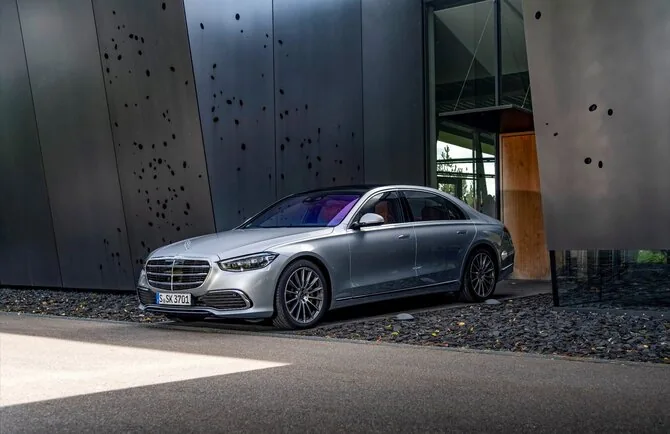
Officially, the “S-Class” name was first given to the model series in 1972, when the car marked with the code W116 debuted. Then, along with the new name for the luxury flagship, the manufacturer’s promise to create new safety and comfort standards was also introduced.
“Later decades proved that this promise was not a marketing gimmick. The Mercedes-Benz name is historically inseparable from both the consistent, comprehensive implementation of comfort and the multitude of car safety improvements, which primarily debuted in the S-Class. The ABS system in a production car, safety airbags and seat belt tensioners, electronic stability control – all of this was essentially given to the industry by one model,” reminds E. Babelis.
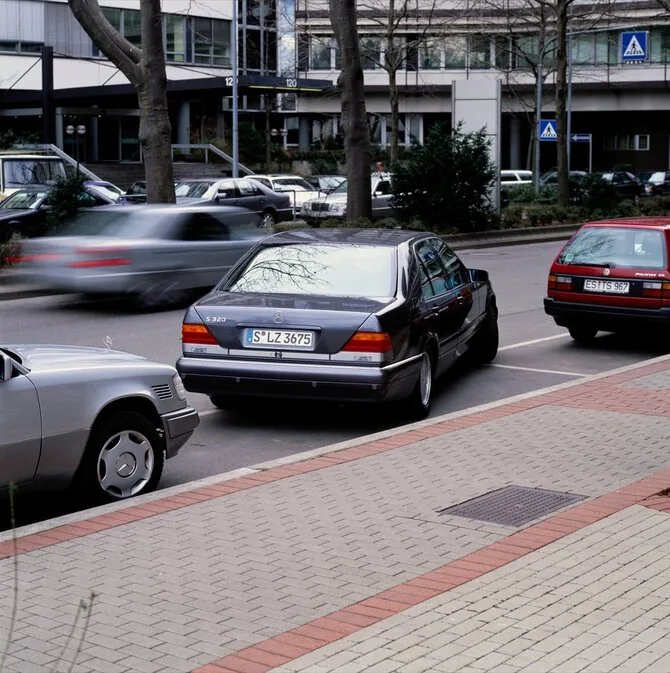
Today, these safety solutions are used in every new car manufactured in Europe – thus, standards have risen over time. However, at the time of their introduction (the ABS system debuted in a production model in 1978, the airbag in 1981, etc.), these were significant technological leaps that forced all manufacturers to improve and raise the bar.
Read more Bank of Lithuania allowed Gjensidige to merge with Ergo
BMW, with its 7 Series models, which began production in 1977, eventually brought to the world the on-board computer, xenon headlights, remote-controlled parking, and a solution for dealing with an excess of buttons: “dedicating” the control of numerous functions to one special controller. In 1994, the Audi A8 with an aluminum body offered the market a new argument – the idea of lightweight construction as an attribute of luxury.
Engineers’ capability measurement tool – luxury
In turn, the S-Class gifted the automotive world the concept of complete driving comfort. An eloquent illustration of the exaltation of comfort could be the W140 model (1991–1999), which was sometimes even criticized by reviewers for its massiveness and weight, but its engineers were stubborn: heavier double-layer glass used in the car ensured sound insulation unique to this model.
Today, digital technologies also open up new possibilities. An inseparable attribute of luxury and smooth driving is air suspension, but its operation is taken to another level by the active body motion control system, ensuring a more comfortable and smoother glide of the sedan regardless of road conditions. A steerable rear axle helps to maneuver a large car more easily and safely.
In the global luxury sedan segment, the S-Class also competes with models such as the Bentley Flying Spur or Rolls-Royce Ghost. The dedicated “Mercedes-Maybach S-Class” models further deepen the concept of luxury with solutions whose boundaries are traditionally defined only by the imagination of the specific driver: from handcrafted finishes and individually selected interior materials to airbags on seat belts, electrically operated rear doors, or equipment for rear passengers that more closely resembles private jets.
E. Babelis notes that in the history of Mercedes-Benz, the S-Class also plays a unique role as a laboratory for all innovations implemented in cars, not limited to just safety or comfort solutions. Some of them can be multifaceted.
“From a technological perspective, current cars are such complex and sophisticated creations that usually one solution has a broader effect. For example, the S-Class’s active headlights, made of individually controlled segments, are no longer limited to merely preventing dazzling oncoming drivers, but adapt to road, weather, and traffic conditions and adjust the necessary illumination accordingly. Thus, it is both safe and comfortable for the driver,” explains the reviewer.
There are more such examples. In previous S-Class sedans, and now implemented in perfected form, are the most advanced driver assistance systems, night vision cameras, massaging seats, active noise cancellation system, intelligent air suspension, energy-saving hybrid powertrains, and a comfort control system that allows individual adjustment of lighting, fragrances, seat massage, and climate control according to mood. It’s interesting to wonder what K. Benz would have said about these inventions 140 years ago.
Read more Fuel prices dropped on Wednesday: where is the cheapest?