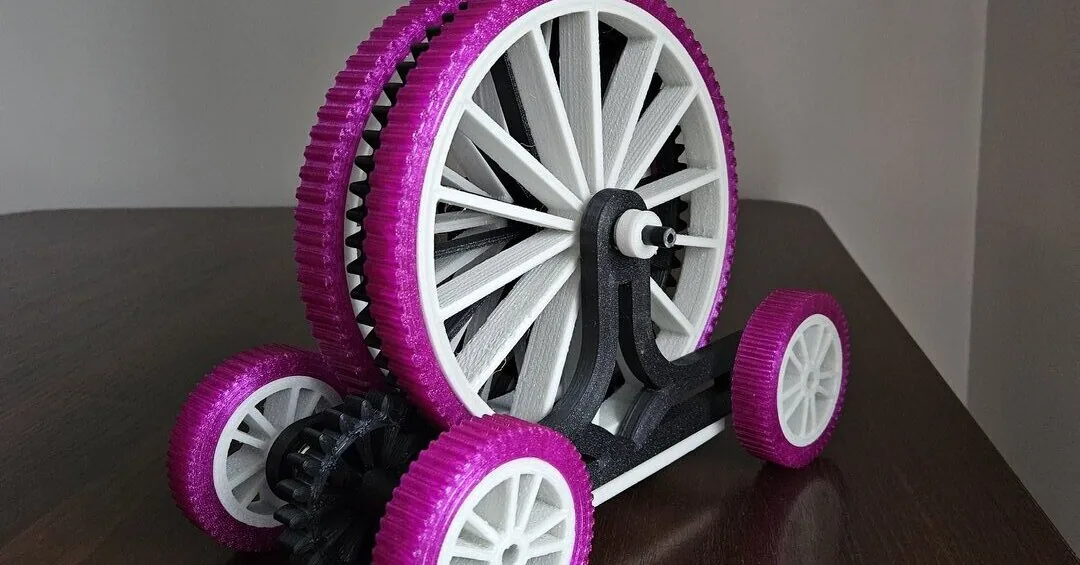
„I have been friends with the wind for a long time. I have been sailing since 2015, and for the past nine years I have been kiteboarding, so naturally I wanted to explore other ways to move using the wind. I wanted not only to create an object capable of moving against the wind, but also to achieve that it would move faster downwind than the wind itself blows,“ says a third-year Industrial Design Engineering student at KTU.
Read more In the newly formed Government – it’s already vacation time: half of the ministers will be resting
A paradox explained by physics
J. Pajaujis explains that usually you move against the wind in zigzags – this is exactly how he kiteboards himself. Using a hydrofoil and a larger kite, with a wind blowing at about 15 km/h, he can reach speeds up to 50 km/h. However, in this project, the student was interested in a different phenomenon – the ability to move perpendicular to the wind or downwind faster than the wind blows.
According to him, this is not just a theoretical idea – a full-size experimental vehicle called “Blackbird” has already been created in the world, proving that such movement is possible. However, understanding how it works is not easy.
“Many imagine that the ‘Blackbird’ starts moving because the wind begins to turn the propeller. But everything happens the other way around. At first, the wind simply pushes the entire vehicle downwind, and the propeller is turned not by the wind itself, but by the rolling of the wheels. Since the wheels and the propeller are connected by a certain gear ratio, as the vehicle accelerates, the propeller starts to act like an airplane propeller and creates additional thrust. Since this phenomenon is not easy to understand just by observing the wind’s movement, I created a mechanical prototype where everything is much clearer,” explains the student from the Faculty of Mechanical Engineering and Design (MIDF) at KTU.
To clearly demonstrate this phenomenon, the student replaced the wind with a mechanical model. In it, the effect of the wind is simulated by pushing the large wheel with a hand or a wooden board. Then the prototype starts rolling in the same direction as the surface pushing it, but moves faster than it. When the model is flipped and the small wheel is pushed, it starts moving in the opposite direction – as if moving against the wind.
From idea to working prototype
Although this prototype is not designed to operate using wind, it clearly shows how movement in a wind-driven system depends on the gear ratio. In a real version, a wing or propeller would be used instead of the large wheel.
“In this project, the most important thing was not to achieve the highest speed, but to practically demonstrate that such a principle of movement is possible at all. In the future, if it is possible to improve the design so that it can efficiently move in all directions faster than the wind blows, such a solution could already be applied in practice,” says J. Pajaujis.
The principle of movement itself, according to the KTU student, is not complicated, but there were technical challenges in creating the prototype. The biggest obstacle was wheel slippage, so it was necessary to make tires that ensure very good grip.
J. Pajaujis jokes that while working on the project, he spent more time explaining the unusual wind physics phenomenon to colleagues than trying to understand it himself. According to him, projects like this not only allow applying theoretical knowledge in practice but also learning to explain complex phenomena simply and clearly.
Read more Inga Balnanosienė: the situation regarding youth employment is not good – we live in a new reality