





This opportunity is being sought to be created through a targeted call announced by the Lithuanian Research Council (LMT) for comprehensive research on the Vilnius Cathedral. The ambition for the future project is not only to provide new scientific knowledge but also to help better understand the Cathedral’s place in Lithuanian and European history, to open the research results to the public, and to strengthen the culture of interdisciplinary work.
Read more Lithuanian hobbies are not cheap: it has been revealed how much Lithuanians spend on them per year
We discuss why the targeted call format was chosen, what complexity means in this case, and what kind of approach is expected from the research teams with Prof. Dr. Jurgita Verbickiene, Chair of the LMT Committee of Experts in Humanities and Social Sciences.
– LMT announced a targeted call for comprehensive research on the Vilnius Cathedral. Why was the targeted call format chosen? What added value can it create compared to regular competitive research calls?
– This call is intended for large-scale research focused on one specific and particularly important object in Lithuanian history. Different layers of Lithuanian history intersect in the Cathedral. It is significant not only as an architectural object but also as a symbol of culture, religion, and spiritual strength. Important historical figures are also associated with it, and recently there has even been talk about forming a Lithuanian pantheon in the Cathedral.
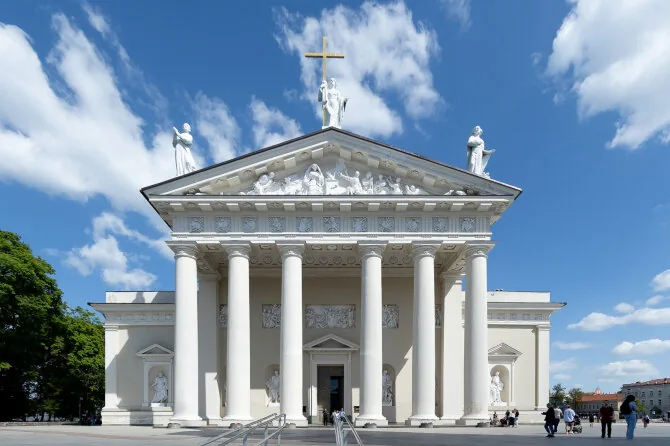
The need to announce such a call arose from the desire to better understand what the Cathedral means to us, what lies within it, and what unexpected discoveries it may still offer. The Cathedral has been quite extensively studied by Polish historians and art historians, and many of their publications have been released. Here we encounter a common situation in Lithuanian historical research, where scholars from other countries speak about objects important to us. Therefore, one of the intentions of this call is to encourage us to systematically evaluate what the Cathedral means to us and what we have in it.
The targeted call allows for the focused gathering of groups of scientists from different fields to study one object, its space, values, associated personalities, and other aspects. This is an exceptional call in terms of scope – LMT has not previously funded a project of this scale dedicated to a single object. Up to one and a half million euros are allocated for the research, so a broad, detailed, and multifaceted study of the Cathedral is expected.
At the same time, it is important to seek ways to present the research results to the public, reveal the significance of the Cathedral, and assess its place in the broader context of European cathedrals.
– The call foresees funding for comprehensive research of the Cathedral. What does complexity mean in this case? Why is it important for an object of this scale and significance that scientists from different fields work together rather than conducting separate studies?
– Until now, scientists could undertake research on a separate object or specific problem by participating in various funding programs, such as Lithuanian studies or research group project programs. In this case, much broader research is expected, which would provide a systematic result.
This means that different studies should be coordinated with each other, conducted following a clear common logic, and the applied methods harmonized. Complexity is not just a multitude of separate studies. It is important that their results complement each other and help form a comprehensive picture.
Interdisciplinarity is important today not only in the humanities or social sciences – essentially all sciences are moving in this direction. Due to technological changes, research increasingly requires specialized knowledge related not only to a specific scientific discipline but also to the application of technologies. Therefore, it becomes very difficult for a single scientist, no matter how good a researcher they are, to cover all aspects necessary for studying such an object.
– The call is oriented not only towards creating new scientific knowledge but also towards its application, cultural heritage understanding, and dissemination. What result is expected from the funded project? What, in your opinion, would be the greatest indicator of success for such research?
– I would not want to specify the expected result too precisely, as that would be a certain direction hint for applicants. I am confident that research groups can offer much more than I could currently anticipate.
At the same time, it should be understood that the current funding will likely not be enough to achieve an ideal and final result. Some necessary studies are very expensive, complex, and long-lasting. For example, genetic research could be such. Therefore, with this project, we are rather starting a new stage of Cathedral research and giving it an impulse, not expecting that all questions will be finally answered within four years.
Not only the scientific result would be important, which can take many forms, but also the actualization of certain topics, personalities, and objects. Solutions should also be found to help present the Cathedral more widely to both the public and the academic community.
The documentation of the research itself is also very important. If the research process were recorded, this material could become the basis for a documentary film, be used in schools, and help the public better understand the Cathedral’s significance in the context of Lithuanian and European culture and history.
Another significant result would be the training of a new generation of scientists and strengthening the culture of interdisciplinary thinking. Lithuania still lags behind Western countries in this area. Interdisciplinarity is a specific way of thinking that needs to be developed and learned to understand its benefits. This does not mean that every scientist must become an interdisciplinary researcher, but for some, such an ability would be a great advantage.
– The Vilnius Cathedral is one of the most significant objects of Lithuanian cultural heritage, but at the same time – a complex, multilayered historical source. What layers and meanings of its history could contemporary science still help reveal? Where do you see the greatest potential for understanding?
– Specific research directions should be proposed by the research teams themselves, and experts will assess whether the chosen path is appropriate. However, I think it is very important not only to discover new facts but also to unfold the significance of the Cathedral.
Read more „The Guardian“: Russia struck a US drone factory in Kyiv for the first time
We all seem to know that the Cathedral is important to us, but probably only a small part of the public could clearly explain why it is important and what the historical content of this object is. This often happens with historical phenomena or objects: everyone knows them, but it is much harder to specify how they relate to people and why they are significant today.
When talking about the Vilnius Cathedral, we talk about a period from the times of Mindaugas to the present day. It is an object that connects several centuries of very different and changing Lithuanian history – from the transformation into a Christian state to the persecutions of the 19th century and Soviet era and the strength of people in preserving the object itself.
It would be desirable for the public to better see, feel, and articulate these layers of the Cathedral. Of course, only part of the knowledge created by scientists will become relevant to the wider public and can be used for popularizing science. But alongside creating new knowledge, it is very important to encourage more active presentation of it to the public.
– In recent decades, archaeological, historical, natural science, and digital research methods have rapidly improved. How can modern technologies and new scientific methods change our understanding of the Cathedral and its history?
– The combination of applied methods will largely depend on the questions posed by the scientists. However, today we already see how many opportunities new technologies provide.
For example, genetic research can help determine human diseases, age, sex, and in some cases, if comparative data is available, even a specific individual. Scientists can study burials in the Cathedral’s crypts. Such research could tell more about the residents of Vilnius or other groups of people living in different historical periods: what diseases they had, what they ate, their origin, and how the lives of different social strata differed.
The Cathedral building has already been scanned, and non-invasive methods are used to search for cavities inside it. Such methods allow studying the object without damaging it and seeing what scientists could previously only inspect or guess. Today it is possible to more accurately determine the alloy from which the object is made, when it appeared, its condition, and also more precisely date various finds.
Technologies allow processing large amounts of data, searching for their interconnections, and comparing results. This is very important in historical research, where conclusions were sometimes based on only one or two documents, so interpretation played a significant role.
The combination of history, archaeology, natural science research, and art history methods in one project would itself be an innovation in Lithuanian humanities and social sciences. At the same time, it will be a huge challenge – scientists will need to agree on how to work studying the same object, what questions to raise, and how to harmonize the methods applied by different sciences.
– The call foresees attention not only to research but also to the accessibility of their results to the public. How, in your opinion, could the results of scientific research reach people so that they become not only academic value but also a living part of Lithuania’s cultural memory?
– Research results should be adapted to different groups of society. Scientists write and read one type of texts, while other texts are relevant and accessible to the wider public. It is very important not to forget students and youth of different ages.
The Cathedral can also be presented as a symbol of societal resilience. Symbolic meanings concentrated in one building can be relevant to very different people, so the forms of presenting the results can be very diverse.
Scientists will write articles and monographs, but alongside them, there could be documentary films, comics, textbooks, books for children. Stories about personalities associated with the Cathedral could be told, and architectural changes and reconstructions visualized digitally. It would be interesting to see how the Cathedral changed in different periods, what it was like before, and what Laurynas Stuoka-Gucevičius’s reconstruction gave it.
– What would you like to say to scientists and research teams considering submitting an application? What ideas, attitudes, or ambitions, in your opinion, would best reflect the goal and significance of this call?
– In this call, we expect ambition and focus from scientists because such a project can only be implemented by a sufficiently large and strong research group.
In science, unexpected, sometimes even provocative questions are always very important. One should try to find questions that no one has raised before. Even if the answer to them is negative, it would still be a new answer and new information.
Therefore, I would suggest research teams not to be afraid of creativity, a certain measured playfulness, and ambition. They should set themselves sufficiently high goals.
Read more «Omnivos» group revenue grew by 10% this year to 78 million euros, loss decreased by 30%