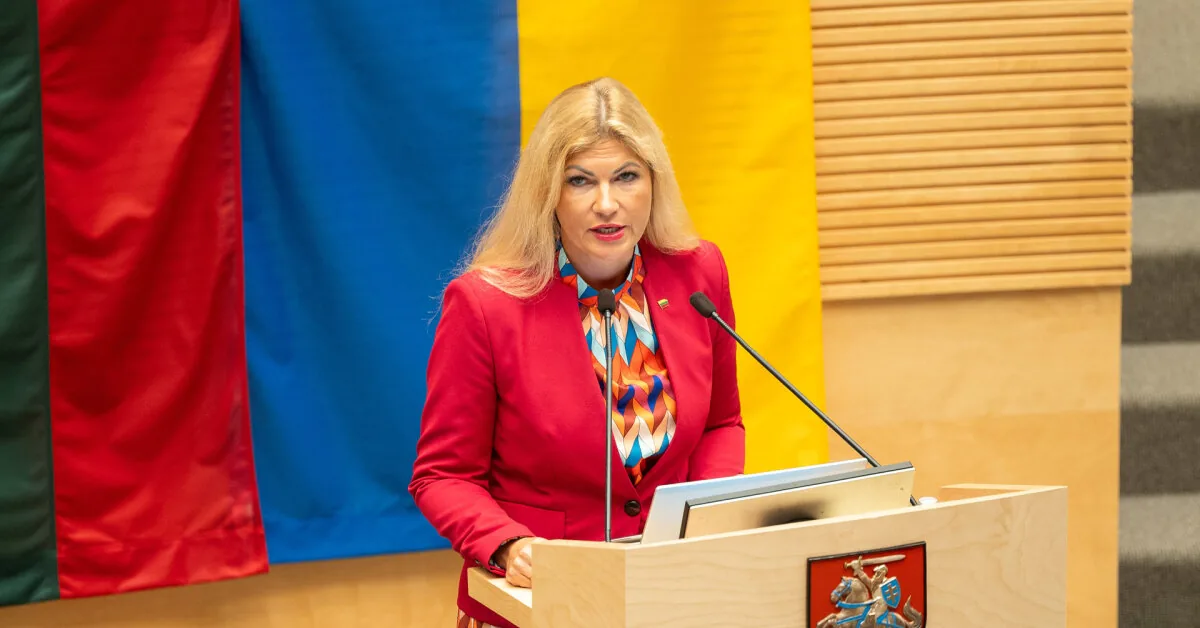
We have been discussing the issues of phone use in schools, social networks, and internet use impact on children for some time in the Seimas Education and Science Committee, but I view this problem not only as the chairwoman of this committee but also as a mother raising a teenage son. Like many parents, I see every day the significant influence social networks have on young people’s lives. They provide opportunities to communicate, learn, and create, but we cannot ignore the growing number of concerns about risks, children’s safety, and the negative impact on health and development.
In recent years, more and more scientific studies have drawn attention to the clear connection between intensive social network use and children’s emotional health – increasing problems with sleep quality, attention concentration, and overall well-being among children. This does not mean that social networks are inherently bad. However, we cannot ignore the excessive impact of the internet, especially when we talk about a child’s still developing personality.
Even more concerning is that social networks are becoming not only a space for communication but also for manipulation. Here, children face bullying, misinformation, fraud, sexual harassment, and other dangerous challenges, and recently, we have increasingly heard about cases of recruiting minors. Law enforcement agencies have repeatedly warned that criminal groups and various scammers actively seek vulnerable young people precisely in the digital space.
This is no longer just a family or educational institution problem. It is a matter of societal and state responsibility.
Therefore, it is not surprising that more and more countries are seeking solutions. Australia is the first country willing to restrict access to social networks for minors under 16 years old. Discussions about minimum age, more reliable age verification, and greater responsibility of technology platforms are also taking place in other countries. The European Union is paying increasing attention to protecting children in the digital environment.
A few days ago, on July 13, European Commission President Ursula von der Leyen stated that children must be ensured phased and gradual access to social networks. The recommendations of expert groups composed of doctors, scientists, youth representatives, and parents are clear:
- no screens for babies and young children;
- age-appropriate social networks for children aged 3–12 only under adult supervision;
- gradual independent use for teenagers aged 13–18 with mandatory basic safety features.
The Commission plans to present a specific legislative proposal by the end of this year. Some EU countries are already proposing stricter measures: Spain – restrict access for those under 16, France – under 15. Australia, as I mentioned, has already enshrined such a ban for those under 16 in law.
Lithuania should not remain on the sidelines of this important discussion. Current regulation no longer ensures sufficient protection for our children in the digital space.
Read more «Kauno Žalgiris» rookie awaiting debut in Lithuania: «This will allow me to pursue my goals»
Therefore, I urge starting a serious, scientifically based national discussion about the minimum age at which children could use social networks and additional protective measures. This discussion should include psychologists, educators, child rights defenders, law enforcement representatives, technology experts, parents, and the young people themselves.
However, I do not believe that bans alone are the answer to all questions. No law will replace parental attention, teachers’ work, or open family conversations. But the state cannot limit itself to recommendations and expect technology companies to solve problems on their own.
First, we must strengthen digital literacy education. Children should learn not only how to use technology but also understand how social network algorithms work, be able to recognize false information, manipulations, fraud schemes, protect their privacy, and behave responsibly online. This is a 21st-century skill that is no less important today than the ability to read or critically evaluate information.
At the same time, in my opinion, the time has come in Lithuania to start a serious national discussion about the minimum age when a child can start using social networks. Such a discussion should not be based on emotions or the desire to ban something. It must be based on science, the experience of other countries, and expert insights. We must hear the voices of psychologists, educators, child rights defenders, medical professionals, law enforcement, technology experts, parents, and the young people themselves.
As the chairwoman of the Education and Science Committee, I see it as my duty to initiate such a discussion. We must answer difficult but inevitable questions. Does current regulation sufficiently protect our children? Do technology platforms take enough responsibility? What additional measures are needed to ensure children feel safe in the digital space?
It is important to understand that this is not directed against technology. On the contrary – technology opens huge opportunities to learn, create, and communicate. It becomes an indispensable everyday tool. However, it is our duty to ensure that it does not harm children, that they do not become hostages of technology business models.
In Lithuania, keeping pace with other European countries, we will discuss and prepare our solutions on how to manage the impact of technology and harmful, distorted information on our residents, especially children.
Read more Latvian Minister: the real cost of «Rail Baltica» will be revealed in September