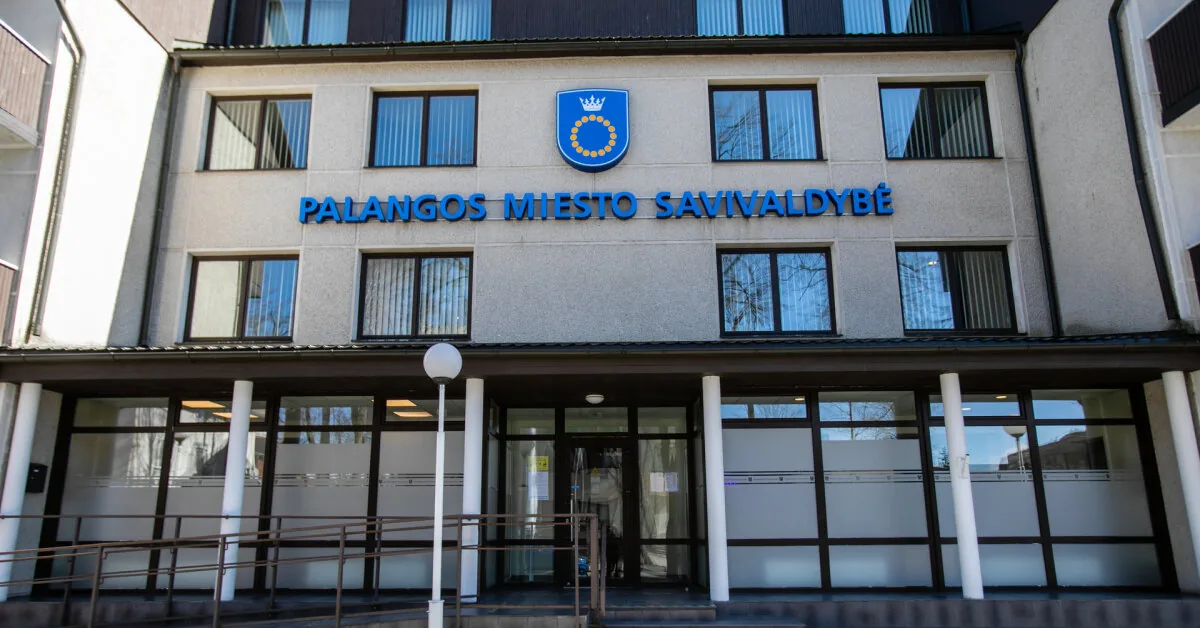
Palanga City Council member Svetlana Tučkė issued a statement indicating that local social democrats are addressing the Seimas committees, the Ministry of the Interior, the Government Chancellery, the Government Representative Office, and the Seimas Ombudsman’s Office regarding the rights of the opposition and the council minority in local government.
Read more Cash fever in Russia: tens of billions of dollars have «melted away» from banks
Attention is drawn to the fact that since the 2023 municipal council elections, the legally mandated minority hour has not been held even once.
Currently, two opposition factions operate in the Palanga City Council.
According to the social democrats, a situation has arisen where the implementation of rights granted by law to the opposition may practically depend on the will of the council majority or another opposition faction. Questions also arise regarding the representation of the opposition in the municipal board, where in fact only one of the two opposition factions is represented.
In December 2024, S. Tučkė officially approached the municipality regarding the organization of the minority hour. She then received a response that the two minority factions in the council must agree among themselves on which council meeting’s end they prefer the minority hour to be held. After representatives of another faction declaring themselves as opposition indicated that they did not need the minority hour, it has not been held to this day.
“The law provides for a minority hour at least once every six months, but in Palanga, it has not been held even once during this entire term. A situation has arisen where one opposition faction’s unwillingness to use it effectively becomes a veto right for the other part of the council minority. Therefore, we ask state institutions to clearly assess whether such practice complies with the law and whether the legal regulation itself needs to be amended,” says S. Tučkė.
The social democrats emphasize that the rights of the opposition and the council minority are not just a matter of interpersonal relations among politicians. Their purpose is to ensure government oversight, transparency of decisions, and accountability to residents.
Asked to agree
Petras Kaminskas, head of the Legal and Personnel Department of the Palanga City Municipality Administration, cites the Local Government Act, which stipulates that the minority hour of the municipal council must be organized at least once every six months. This provision is also incorporated into the rules of procedure of the Palanga City Municipality Council. Therefore, the right to the minority hour cannot be understood as dependent on the will of one or another opposition faction.
“At the same time, considering the specific situation, it is necessary to distinguish the right to the minority hour from the procedure for its organization. Paragraph 53.1 of the Palanga City Municipality Council’s rules of procedure states that during the minority hour, minority representatives may question the mayor, deputy mayors, the director of the administration, and the chairpersons of committees and commissions, who, if they hold office on the day of the meeting, must participate and answer questions. The rules also provide that questions must be submitted through the Secretariat no later than two working days in advance,” emphasized P. Kaminskas.
Therefore, according to him, organizing the minority hour is not just a formal matter – it also requires the participation of the council minority itself and adherence to the procedures set out in the rules. In this case, it is important that the council minority, as provided in the rules, did not submit or propose questions for consideration during the minority hour, nor were questions submitted in accordance with the procedure established in the rules.
He noted that in December 2024, Palanga Mayor Š. Vaitkus urged minority representatives in writing to agree and inform which of the planned upcoming meetings they would like the minority hour to take place. However, no response with specific preferences was received.
“Given this, there is no basis to claim that the minority hour was not organized solely because one opposition faction did not want to use it. Representatives of the council minority must initiate the content of this procedure – submit questions and propose them for discussion during the minority hour, but this opportunity provided in the rules was not used. So in this case, it is important to assess not only the fact of the minority hour itself but also whether the council minority performed the actions prescribed in the rules to exercise the right granted to it. In this case, no such questions or proposals were received from the council minority,” emphasized the official.