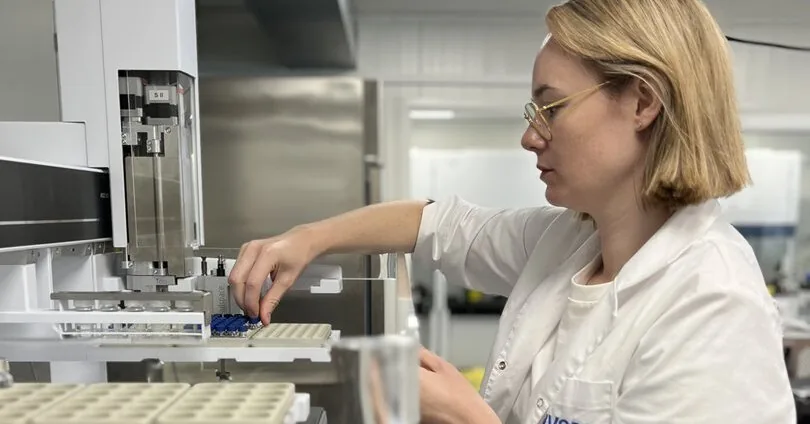
To help more accurately diagnose such cases, the National Public Health Surveillance Laboratory (NVSPL) is starting to provide a qualitative non-targeted analysis service of psychotropic and narcotic substances in blood. Using modern chromatographic–mass spectrometric methods, up to 2,000 psychotropic and narcotic substances can be identified in a single test, including benzodiazepines, amphetamines, opioids, antidepressants, hypnotics, and other drugs.
We discuss the possibilities of the new test, growing challenges for doctors, and the risks posed by new psychoactive substances with Dr. Toma Petrulioniene, head of the Chemical Research Department at NVSPL and acting director.
– Why did the need arise in Lithuania to start providing such a service?
– In recent years, toxicologists have increasingly encountered complex poisoning cases where the patient’s clinical condition clearly indicates the influence of psychoactive substances, but routine laboratory tests do not detect a specific substance. There are also situations where a substance is detected, but the clinical signs are not typical for it, raising suspicion of a false positive result.
The market for psychotropic and narcotic substances is changing very rapidly – new synthetic compounds constantly appear, which standard rapid tests are not adapted to detect. In practice, a person often does not know what they have taken or believes they took one substance, while in fact, a completely different compound or a mixture of several substances was consumed.
The market for psychotropic and narcotic substances is changing very rapidly – new synthetic compounds constantly appear.
New psychoactive substances often have very strong and hard-to-predict effects – they can cause severe consciousness disorders, seizures, heart rhythm disturbances, respiratory depression, or even death. Therefore, it is especially important for doctors to identify as accurately and quickly as possible which substance caused the poisoning. This increases the need for more advanced psychoactive substance identification, which would help make more precise clinical decisions.
– How does the new test differ from conventional tests?
– Conventional rapid tests are designed to detect only certain well-known groups of substances, so they often do not detect new synthetic compounds or may provide false negative or positive results.
The National Public Health Surveillance Laboratory uses modern chromatographic–mass spectrometric methods that allow simultaneous identification of up to 2,000 psychotropic and narcotic substances, such as benzodiazepines, amphetamines, opioids, antidepressants, hypnotics, and other drugs. The test methodology can be continuously supplemented with newly identified compounds, making it much more flexible than traditional rapid tests and allowing detection of a much wider range of substances.
– What is qualitative non-targeted analysis? How can an ordinary person understand it?
– When it is precisely known which chemical substances are being sought in a sample and it is important to determine their quantity, quantitative analysis is performed. However, in poisoning cases, it is often unclear which substance was consumed.
In such cases, qualitative non-targeted analysis is performed – first, the chemical compounds present in the sample are analyzed, and then they are compared with extensive databases. This allows detection not only of expected but also unexpected or less common substances. This method is especially important when it is unknown what the person has taken.
Read more Ingrida Alonderė: «Anger is like a musical sound that you feel with your whole body»
– In what situations is this test most useful?
– It is most beneficial when a patient is admitted to a medical facility due to acute poisoning, but the cause is unclear or the clinical signs do not correspond to the results of routine tests.
People often do not know what they are actually taking.
Although treatment of an acute patient usually begins before laboratory results are available, more detailed information about the substances used can help more accurately determine the cause of poisoning, choose the most appropriate treatment strategy, and monitor the patient’s condition.
– Who is this test intended for? Can it be done on one’s own initiative?
– The test can be performed both by a doctor’s referral when it is needed for diagnosis or treatment, and on a person’s own initiative. In practice, for example, parents of teenagers often seek testing suspecting that their children may be using psychotropic or narcotic substances.
The test is performed from biological samples – blood or urine, depending on the clinical situation. To perform such a test, one should contact the Customer Service Department of the National Public Health Surveillance Laboratory in Vilnius, Žolyno St. 36.
– What is the greatest risk posed by new psychoactive substances today?
– The greatest risk today is unpredictability and the high availability of psychoactive substances. People often do not know what they are actually taking – the composition of substances distributed on the illegal market can vary even among tablets or powders that look the same. Therefore, instead of one substance, a completely different compound or a mixture of several substances may have been consumed, and even a single use can have very serious consequences. This complicates chemical substance identification, treatment, and increases the risk of complications. The risk is further increased by the fact that the effects of many new synthetic substances have not yet been sufficiently studied.
– Are there plans to expand the test capabilities in the future?
– The psychoactive substance market is constantly changing, so we will seek to strengthen laboratory identification capabilities. We plan to expand the range of substances detected, supplement databases with new compounds, and continue to improve analysis methods to ensure identification of newly emerging substances.
– What worries you most as a specialist today?
– What worries me most is that the supply of new psychoactive substances is growing faster than society, especially adolescents and young people, can grasp the risks they pose. We increasingly encounter situations where a person does not know what they have actually taken, which complicates both treatment and poisoning prevention.
Therefore, it is very important not only to implement advanced diagnostic methods but also to strengthen public information, early prevention, and specialists’ preparedness to recognize health disorders caused by new psychoactive substances.
Read more Kremlin: relations with the UK will not improve under Andy Burnham’s rule