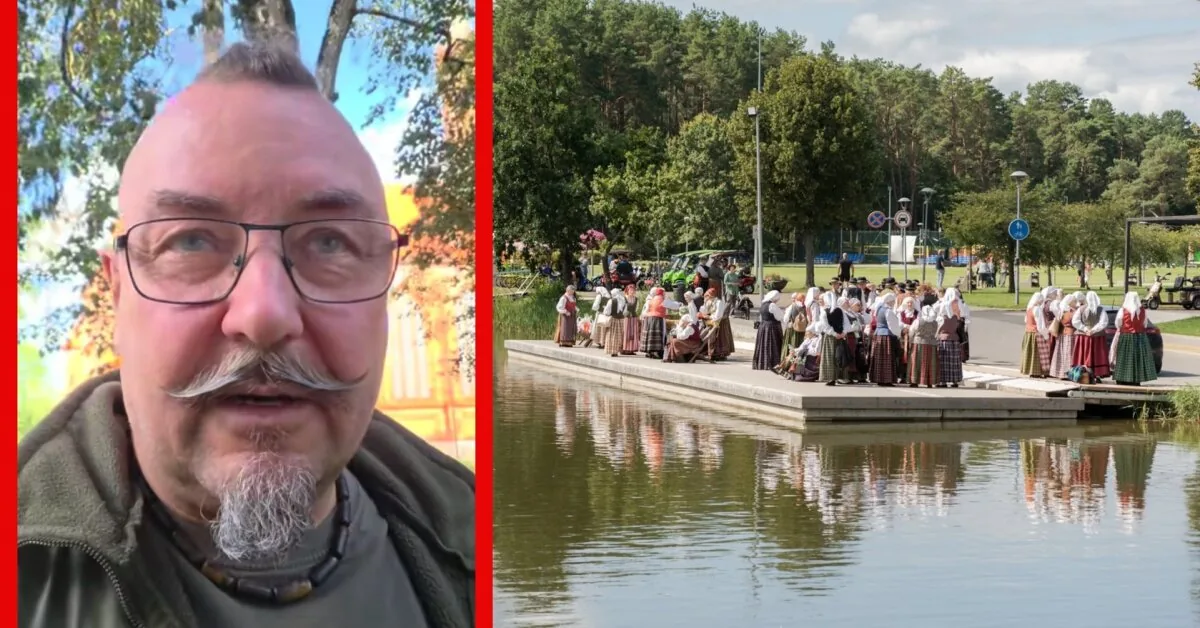
Folk artist and woodcarver Aivaras Norbutas is not bringing his works to Druskininkai for the first time – the man counts that he visits the resort two or three times a year. However, it seems that after this weekend he will not return to the resort.
Read more US President Donald Trump says he is exercising restraint in negotiations with Iran
“Friday was the first day of the Druskininkai Folklore Festival, we trade at the fuel fair. Well, from now on we have become persona non grata here,” the creator confesses.
The reason lies in A. Norbutas’s personal rule, which he has applied since the beginning of Russia’s large-scale invasion of Ukraine. The man does not hide that he has a unique communication filter with fair visitors who speak Russian.
“At fairs, to those who address me in Russian, the occupier’s language, I first say that I communicate in Russian only after the answer to whom Crimea belongs,” the folk artist explains his position.
According to him, visitors’ reactions fall into three categories. If the client answers that Crimea belongs to Ukraine, communication continues without any problems. It is quite different when trying to avoid a direct answer.
“There is a second category of people who say that Crimea belongs to villagers, people, and they do not engage in politics, asking what Crimea has to do with it. Then I say that at this point our communication ends,” says the woodcarver. And he is especially categorical with the third group: “If they say that Crimea belongs to Russians, such a person, or rather not a person, is sent after the Russian military ship.”
The creator emphasizes that everything on his part happens politely and without raised tone, but he firmly defends his principles: “I have the right not to sell my works to those who do not know whose Crimea is.”
However, such a civic test turned out to be unacceptable to the festival organizers. On Friday, the folk artist received attention from two representatives of the Druskininkai Cultural Center, who brought him unpleasant news.
“They told me that I am included in the blacklists because I do not respect Russian-speaking people who came to Druskininkai. They said that I will no longer be welcome at city fairs,” recalled A. Norbutas.
Although such news could scare more than one trader, the craftsman promises not to change his position. He is surprised that, as the brutal war continues, someone still tries to tell him how to behave.
Read more In the finals, the undefeated Edas Butvilas won his third Challenger title
“Unwelcome is unwelcome, but it is strange to me that in the fifth year of the large-scale war someone explains to me how I should love Russians. No, if I have to choose between participating in Druskininkai fairs and asking questions in Russian to those who address me, I will not change anything,” he said, adding that from now on he will send applications to the resort fairs specially. “And if they do not accept me anymore, they will not, but it shows the municipality’s position on this issue.”
The man notes that his attitude often receives support from buyers or passersby themselves. As an example, he cites a situation when a Polish woman standing nearby, hearing his question to a woman, encouraged him and said, “That’s how you should deal with occupiers.”
He also has to withstand provocations. “There was a situation when Belarusians asked me why I do not fight on the Ukrainian front,” A. Norbutas said. “I can say that because of my age. If I were forty, I would definitely fight on the front, but now I help Ukraine as much as I can. And I will do it until victory.”
The organizers’ position did not convince everyone
Amid the fuss, the organizers themselves publicly reacted to the situation on Sunday. The Druskininkai Cultural Center shared a tactful statement on their “Facebook” page, calling the Folklore festival a gathering of people in unity but did not hide their indignation at the folk artist’s behavior, calling it incitement of hatred.
“Unfortunately, the festive mood was spoiled by an incident caused by one person. It became a bitter spoon of tar in a beautiful celebration. The Druskininkai Cultural Center does not tolerate incitement of hatred. It has been so until now and will be so in the future,” the organizers wrote in the post.
The Cultural Center emphasized that on their event stages, music of various nations respecting democratic traditions is played, and support for Ukraine is proven by actions – inviting Ukrainian artists to create in Druskininkai and opening stages and exhibition spaces for them.
“We would like to continue talking about what unites us – music, culture, traditions, and unity, and not look for opportunities to divide them,” the official position states.
However, such arguments convinced far from everyone. Under the Cultural Center’s statement, well-known journalist Rita Miliūtė left her comment, asking the organizers a very specific and direct question: “Could you explain how the question ‘whose Crimea?’ spoken in Russian spoils your celebrations? Thank you.”
At least for now, this journalist’s question, which perfectly illustrates the resonance in society over the conflict between the municipality and the principled folk artist, remains without an official answer.
Read more Week’s weather: after the front passes, drier weather will remain