In the work, the author records extreme experiences, revealing how this war is different from the one depicted in the works of 20th-century literary classics. It is a fight where there is no room left for romanticizing or humanizing the enemy. In a poetic narrative imbued with cruelty and beauty, death, suffering, and faith become the cornerstones of a new reality.
Read more The court did not allow Vytautas Gapšys to be conditionally released
This work is not about strategies or political decisions, but about people whose fates lie beyond statistics.
Arturas Dronis is a poet, author of the books “Dormitory No. 6” and “Here We Were,” an infantryman in the Armed Forces of Ukraine, who voluntarily joined Ukraine’s 125th Territorial Defense Brigade just a few days after the Russian invasion, choosing the call sign Dovydas and serving until he was seriously wounded. Initially, he carried out combat missions in the Kharkiv direction, and later his brigade was transferred to the Zaporizhzhia front.
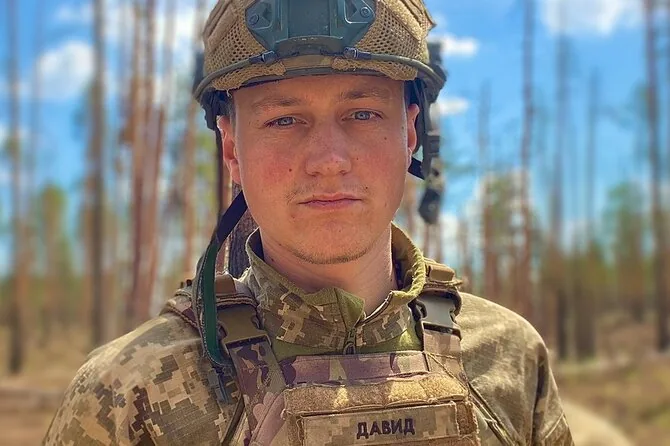
“Hemingway Knows Nothing” is the author’s debut prose book, created during recovery from a serious injury.
Review of Arturas Dronis’s book “Hemingway Knows Nothing”
Taras Pastukh
The short prose book “Hemingway Knows Nothing” by Ukrainian writer and Russian war veteran Arturas Dronis became a bestseller in his native country. The first edition of the book, published in mid-August 2025 with a print run of three thousand copies, sold out in less than two months. Many enthusiastic reviews about this book have been heard and read—both in personal conversations and on social networks. What makes this book so special and what does the author talk about in his work “Hemingway Knows Nothing”?
To provide context, it is important to mention that Arturas Dronis was born in the Ivano-Frankivsk region, graduated from the Faculty of Journalism at Lviv Ivan Franko National University, and worked as a manager at the publishing house “Vydavnyctvo Staroho Leva.” When Russia launched a large-scale invasion of Ukraine, he voluntarily joined the Armed Forces of Ukraine’s 125th Territorial Defense Brigade.
He was wounded in the war and underwent a long rehabilitation during which he wrote this book. The title hints at the author’s critical attitude toward Ernest Hemingway, well known in Ukraine as the author of war-themed novels such as “A Farewell to Arms,” “For Whom the Bell Tolls,” and “Islands in the Stream.”
Dronis went to war as a passionate admirer of E. Hemingway’s books but gradually became disappointed with his favorite writer and began to criticize his perspective. Dronis also critically views other famous authors who wrote about war, including Erich Maria Remarque, Ernst Jünger, Evelyn Waugh, Thomas Kenneally, and Kurt Vonnegut.
According to Dronis, these writers embody, in one way or another, an anti-war narrative (leaving aside the question of how much Jünger’s work truly fits this narrative), which spread in European culture after the two world wars and reached Ukraine after it gained independence. This narrative emphasizes individual and mass deaths, maiming, and the fates of people shattered by war.
Post-war veterans were classified as the “lost generation”—those who cannot return to normal civilian life and are “lost” in the new environment. Essentially, all this led to the conclusion that war is evil, and therefore militaristic moods that could encourage it must be suppressed by all means. Moreover, everything related to war (except, of course, condemnation of war) should be avoided.

Ernest Hemingway becomes, for Dronis, a symbolic representative of this narrative. He sees Hemingway as a man who goes “overseas” to participate in the war to “embark on an adventure,” as he wants “to become a hero,” and over time begins to condemn the war. Dronis himself, on the contrary, was forced to go to war with an enemy who invaded his homeland Ukraine. Under such circumstances, the idea that war can be avoided is completely inappropriate because “this is a war for our survival, from which fleeing or surrendering would mean the destruction of the entire nation.”
The initial positions of the writers are not the same: a distant war as an adventure and a war in one’s own backyard, posing an existential challenge, lead to completely different perceptions of it. An American writer can condemn such a war, while his Ukrainian colleague emphasizes the necessity to take up arms and defend one’s homeland. The northern neighbor of the country, still not renouncing imperial ambitions, does not give Ukrainians the luxury of professing pacifism.
Dronis quotes Ukrainian writer Hryhir Tiutiunyk: “After the war, there is a respite until the children grow up to be soldiers. After this respite, war comes again.” Dronis does not emphasize the nihilistic attitude toward war hidden in this quote as a recurring outbreak of collective destructive energies. He formulates the idea of a new narrative: “We need new, anti-war but not anti-militarist literature. Literature has gotten used to condemning weapons. However, it should distinguish those who attack with weapons from those who defend themselves with weapons. At the moment, we Ukrainians understand this best. We will never give up the right to shoot back because it is a matter of our security. Our literature will always condemn the aggressor but will never say ‘no’ to weapons.”
This change in worldview—the transition from admiration of anti-war literature to its criticism and the defense of military spirit in the cultural narrative—is determined by a changed perception of war: from an indirectly, through literature, known phenomenon to a direct confrontation.
The critical attitude toward the relevant literary canon is not only due to the prevailing anti-militarist narrative in it. Dronis writes: “It so happened that canonical works actually cannot tell us anything about the war in which we now live and die. The war they did not witness.”

He recalls a scene from Remarque’s novel “All Quiet on the Western Front,” in which the main character, German soldier Paul, finds himself in the same trench with the enemy and kills him. Looking at the documents and the wife’s photo of the killed man, Paul realizes that they had much in common: both were young and broken by a senseless war in which politicians “play by dividing territories” on the map.
Dronis is firmly convinced that the war depicted by Remarque and its context are completely incompatible with the current Russian war against Ukraine, in which Russians “from the first hours committed crimes against humanity. They killed and continue to kill civilians every day. Numerous cases have been recorded where Russians raped and then killed mothers in front of their children, raped children, even toddlers.
They set up torture chambers in schools. They carry out executions of prisoners, cut off heads, limbs, and genitals of the living, and post videos of these crimes online. Their wives say they “allow” their husbands to “have fun” with Ukrainian women. Some even encourage and joke that they need to show “what a real Russian man is.”
Dronis emphasizes the extraordinary cruelty of the Russians, giving this war an extremely inhuman shade and not allowing both warring sides to be considered equal. Moreover, the Ukrainian writer claims that Remarque’s established position of “poor soldiers deceived by [politicians]” will be used by Russians in the future to try to “exonerate” themselves, claiming that “a naturally good nation was blinded, deceived, and thrown into slaughter by cruel Putin and his accomplices.”
Dronis emphasizes the extraordinary cruelty of the Russians, giving this war an extremely inhuman shade and not allowing both warring sides to be considered equal.
In this way, Russians are given the opportunity to avoid collective responsibility for their crimes against humanity. And if there is no collective sense of guilt and corresponding repentance, history will repeat itself. It will be a war history marked by extremely cruel manifestations.
The current Russian war against Ukraine has a peculiar specificity determined by both the methods of conducting military operations and the contemporary cultural context.
As noted in Dronis’s book by French journalist David Di Nota, when the conversation turns to one of Hemingway’s novels: “People don’t talk like that in war!” The gender norms, literary conventions, and stylistic expression that prevailed after the two world wars have clearly changed. The contemporary cultural context demands a more spontaneous, lively, immediate, and individual perspective on events, especially when they relate to war. Because of this, long introductions are abandoned, the narrative quickly dives into the essence of the situation, the storytelling becomes fragmented and impulsive, and the expression is extremely intense.
The contemporary literary narrative about war increasingly leans toward documentary literature. On the one hand, the authenticity of the narrative and the personal involvement of the author or character in the described events are emphasized. On the other hand, certain literary and artistic requirements, now perceived as artificial and excessive, are abandoned.
Contemporary war literature generally begins to erase the boundaries between fiction and documentary literature. They increasingly intertwine and blur. Their fusion results in texts that convey real-life stories, situations, and characters, but at the same time highlight features of typification, expressive and semantic generalization, symbolism, and expressiveness. The author of such a text essentially no longer trusts literary and artistic narratives and “grand stories” with their characteristic storytelling schemes—in other words, literature itself. Instead, he writes about himself, about what he saw and personally experienced. It is precisely personal experience that gives the narrative reliability and authority. In the book “Hemingway Knows Nothing,” the narrator is Arturas Dronis himself, depicting his true war experience (shelling, injuries, removal of the dead from the battlefield), rehabilitation, and other experiences.
Dronis describes the death of some of his comrades, especially Oleksandr Kobernyk (call sign “Dok”), who previously worked as a teacher in Lviv. The author relies on real events that are part of his personal story and the war. In the narrative, they acquire existential meaning and symbolic expression. One particularly striking episode of Dronis’s narrative is the description of Menchykov Street in Lviv. On one side of it is a maternity hospital, and opposite it, across the street, is the so-called “Mars Field,” where soldiers who died in the Russia-Ukraine war are buried. This specific cityscape acquires an especially symbolic meaning in the author’s view:
“Those who come into life and those who left it are separated by two lanes of Menchykov Street. […] In war, the distance from life to death seems very short. Like Menchykov Street. Here is life, and beyond two lanes—death already. Just two lanes, and it’s over.”
This fusion of documentary concreteness and symbolism with typification typical of fiction is one of the most characteristic features of the author’s narrative.
The book consists of 25 parts, each like a suddenly emerging memory of certain events somehow related to the war. Dronis writes quite freely, sometimes recording certain fragments of memories or reflections on various topics. In some parts, he tells about events happening around, and in others, he focuses on his own memories and reflections. These parts of the book could mostly be called sketches: freely created images capturing the most characteristic features of a particular situation. These sketches could be used to create a broader picture, but each of them is significant in itself.
The book consists of 25 parts, each like a suddenly emerging memory of certain events somehow related to the war.
For Dronis, the meaning of literature is the opportunity to capture significant human existential experiences, not allowing oneself to sink into oblivion and say to death: “You cannot take everything from me.” Literature here plays a very important role as a guardian of memory. After all, as the author himself notes: “It is horrifying to remember. Worse is to forget.”
Translated from English by Gediminas Pulokas. Prepared based on the “Chytomo” publication.