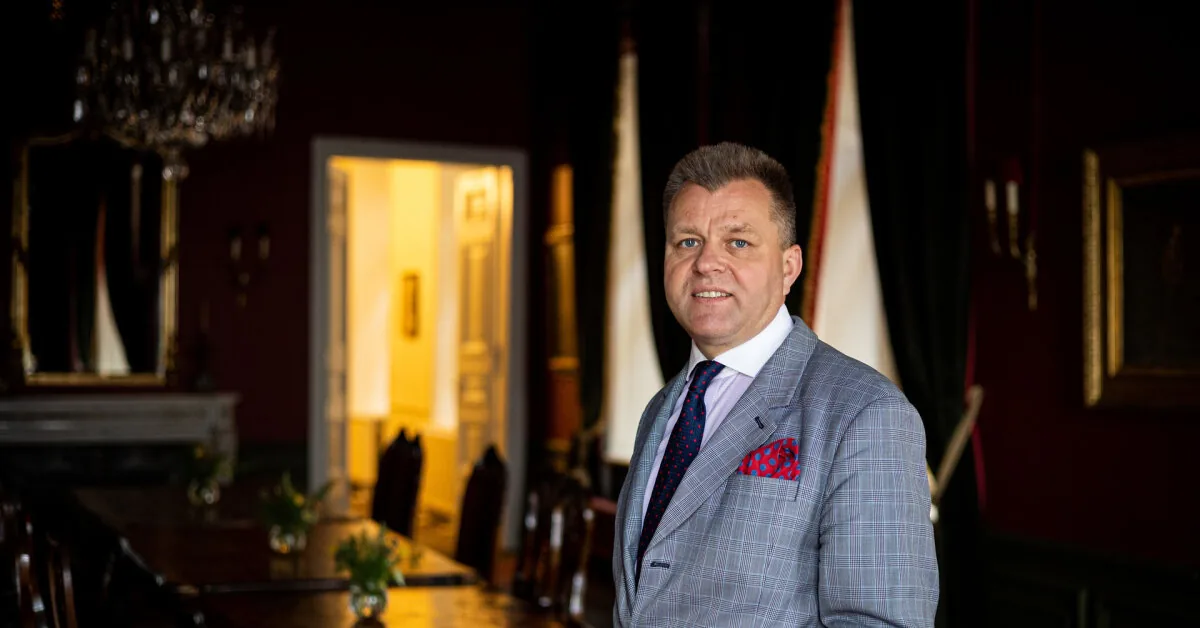
He has led several literary journals and publishing houses, founded the portal turksir.com dedicated to contemporary Turkish literature, and today coordinates the Istanbul International Poetry Festival. Author of five poetry collections: “Adım Ölüm” (“My Name is Death”, 1986), “Kendi Kendini Tatmin” (“Self-Satisfaction”, 1989), “Konformist” (“Conformist”, 1993), “Küçük Hayat Bağları” (“Small Bonds of Life”, 1999) and “Bu Son Olsu” (“This Will Be the Last”, 2025).
Read more Lukas Savickas: Poland’s distribution network operator will help Lithuania restore electricity
His poetry has been translated into 11 languages, and his books have been published in English, German, and French. He has written five novels and two books of literary criticism.
Metin Celâl is a guest of the international festival “Poetic Druskininkai Autumn”. The festival, taking place from September 23–27 in Vilnius and Druskininkai, will this year invite discussions about poetry rituals. Before the poet’s visit to Lithuania, we talk about the literary community, the relationship between poetry and politics, language, memory, and what poetry can reveal about our time.
– You got involved in literary life at a very young age. While still studying at the Middle East Technical University, you published your poems in literary journals, and in the 1980s you met the poet Ece Ayhan. What did it mean for a young poet at that time to become part of the literary world, rather than just reading about it in books?
– When you start writing, sooner or later you want to share what you have written with others. But usually, there is no one nearby who is truly interested in reading your texts. At least in my environment at that time, there were very few people who cared about literature or who generally liked reading books. So after a while, I discovered literary journals. I thought that if my poems were published there, many more people would read them.
Publication in literary journals also meant a certain recognition. When my poem was published for the first time, I felt as if I had received a young poet’s diploma.
When my poem was published for the first time, I felt as if I had received a young poet’s diploma.
– In one text, you vividly described the literary environment of 1980s Istanbul: cafes, taverns, editorial offices of journals and publishing houses where people talked about poetry, philosophy, politics, sports. Of course, gossip was not lacking in those spaces. Does literature still need such meeting places today?
– Live meeting places for literature are essential. We learned an incredible amount in those cafes and editorial offices. Unfortunately, the generations after us had far fewer opportunities to experience such a literary life. When I visited Istanbul cafes where poets and writers gathered, I almost always met someone from the older generation. We could greet each other, exchange a few words, or just sit at their table and listen to the conversation.
That alone was enough for me to learn a lot. Equally important was that in such places we met writers of our own generation. We read each other’s work, openly criticized it, and improved together. Many literary journals started from such conversations.
– Still, your generation was reproached for its close connection with older poets: Ece Ayhan, Hilmi Yavuz, and İsmet Özel. But you knew them not only as authorities: you published their books, talked about literature, and were in their circle. Your generation viewed poetry differently – paying more attention to aesthetics and personal experience rather than ideology. Several decades have passed since then. What would you consider the most important lesson you learned from the older generation of poets today?
– From the great poets and writers who created before us, I learned that literature requires extraordinary dedication. You have to work hard, constantly learn, and never give up. Their lives were full of struggle, and in countries like ours, that struggle never limited itself to literature alone. Writers are also expected to take a political stance.
Of course, not everything recognized writers say remains eternal truth. Some of their thoughts inevitably become outdated. The wisest thing is to listen carefully, accept what is truly useful to you, and ultimately find your own voice. As you mature as a writer, you gradually become a teacher yourself and can pass your experience to younger ones. Unfortunately, it must be noted that today the dialogue between generations has significantly weakened.
You have to work hard, constantly learn, and never give up.
– Critics, such as Terry Eagleton, classify your poetry as 1980s “imagery” poetry and emphasize the importance of aesthetics and language form. At the same time, your poems contain concrete historical and social events: war, torture chambers, changed cities and identities. Do you believe it is possible to be a non-ideological poet and still write poetry about politics and society?
– I agree with Terry Eagleton. It is impossible to completely detach from ideology. When we defended the aesthetics of poetry, we never claimed that literature must be without ideology. We criticized the previous generation’s tendency to see poetry primarily as a political tool. They believed that poetry could serve a political goal – socialism. We thought that poetry must first and foremost be simply poetry. Only when it becomes artistically autonomous and coherent can it serve other purposes. In other words, art must come first, and only then its purpose.
– Your biography interestingly combines different fields: you started studying petroleum engineering, then journalism, and finally your life became almost entirely literary. How does your earlier technical education still reflect in your thinking and poetry?
– Natural sciences and mathematics first taught me to think analytically. At the same time, it changed my worldview. I began to see events, phenomena, and things from angles that a person studying only social sciences might not notice. Such a perspective undoubtedly shaped me as a poet as well.
– You write not only poetry but also literary criticism, have been publishing journals for several decades, and work in publishing houses. You have mentioned that journal publishing is like an “incurable disease”: even after failures, you want to try again. What keeps bringing you back to journal publishing and building the literary community?
– Poetry may seem like a very solitary art, but you cannot fully understand its value without communicating with others, especially writers of your generation. The journals we published were like a school for us. In editorial meetings, we could read, discuss, and evaluate each other’s work, and at the same time defend our poems and literary ideas with articles and criticism.
Actually, we started publishing journals because the most important literary publications of the time did not want to print our thoughts. So we began publishing our own, where we could freely express our views.
Publishing journals is not easy, but at the same time, it is very meaningful work. In the end, you create something tangible that you can share with the entire literary community. That is what I have always liked most about journal publishing.
– You also founded the contemporary Turkish literature portal turksir.com. How has literature changed as journals gradually began to “move” from paper to the internet?
– Poetry in Turkey has always been widely read. Even today, books by poets who could already be called authors of contemporary classics attract many readers. The real challenge falls to younger poets and those who are just beginning to publish their poems.
The internet has gradually pushed out literary journals, making it much harder for the younger generation to reach readers. Although poetry is read online, new poets’ work rarely receives as much attention. Since there are almost no literary journals left, publishing a book has become almost the only way to be noticed. But it is understandable that readers are not very willing to buy books by poets they have never heard of. This creates a strange and rather unfortunate cycle.
Poetry in Turkey has always been widely read.
– You published your first poetry book “Adım Ölüm” (“My Name is Death”) in 1986, and in 2025 your latest poetry book “Bu Son Olsun” (“This Will Be the Last”) appeared. Almost four decades separate the books. Today, looking back at your early poetry, do you still recognize yourself in it?
– I was recently invited to a school where my poem was given to students as an exam task. Two hundred eleventh graders had to interpret it, and I was asked to explain what I wanted to say with that poem. Reading it again after many years, I realized that I look at that poem no longer as its author but as an ordinary poetry reader. Over time, you distance yourself from your own work.
On the other hand, I can still recognize my former self in it – my memories, my thinking. Only now I discover them as a reader and literary critic. Every good poem, like every good poet, must be able to surprise the reader. Without the ability to surprise, true poetry is impossible.
In recent years, Turkish poetry has changed along with the changing world. Our poets now write poetry that is much more open to the world, which differs significantly from what was before. I follow with great curiosity what the younger generation creates and try to understand what the new poetry tells about our time.
– Your poetry often features people living between what can be said and what must be kept silent about. In the poem “Mus sieja gyvenimas” (“Life Connects Us”), you write: “when asked, we had to be silent / it was forbidden to talk about a life we did not live” (translated by Donatas Petrošius and Skaistė Keršytė). While living and creating in Turkey, did you yourself experience periods when silence was not a choice but a certain survival strategy?
– Turkey has always experienced difficult political periods, and they continue to this day. In my life, I have encountered four military coups. The years following them were especially painful. Poets, writers, artists, scientists, and academics suffered greatly. People lost their jobs, were imprisoned, or forced to emigrate. Unfortunately, the situation today has not changed as we would like.
In my life, I have encountered four military coups.
– The lyrical subject of the poem “Kūno kalba” (“Body Language”) asks: “Do wounds necessarily bleed, bearing witness with words?” Can poetry testify to trauma, violence, or loss even when it does not speak about them directly?
– Poetry testifies to everything we experience. That is how it should be. A poet can never completely detach from the world in which he lives. Even when it seems that we write about another world, we inevitably remain rooted in this one. But the most important thing is that what we write is first and foremost good poetry. We should not sacrifice the artistic truth of a poem for the desire to testify.
– “Who has Benjamin’s bag?” – the very title of the poem evokes an association with Walter Benjamin, his relationship with history, memory, loss. In the same poem, you write: “back then, Turkish was spoken everywhere,” and later – “there was no one left to recognize us by face.” How strongly do language and the time in which a person lives determine identity?
– Walter Benjamin’s fate and the persecution he experienced remind me of the experiences of many Turkish intellectuals, artists, poets, and writers. After the 1980 military coup, thousands of people were forced to leave Turkey illegally. I myself had to live abroad for several years. Only then did I understand how important language is. Losing your language is like ceasing to exist. You can be an important person in your own country, but in a country where you are forced to start everything anew, you are nobody.
– The subject of the poem “Trisdešimties” (“Of Thirty”) asks: “What does it mean to rethink the city?” What does rethinking the city mean to you personally: to look again at its history, change your relationship with it, or perhaps see the people who lived there differently?
– This poem is like a tribute to Ingeborg Bachmann’s story of the same name. I think that when a person turns thirty, they basically start to look differently at both the world and themselves, especially if at that time they are forced to leave their city or country and live elsewhere. When I wrote this poem, “rethinking the city” meant to me remembering it down to the smallest details. Most of those memories were very personal.
– You are the coordinator of the Istanbul International Poetry Festival, so you know well how poetry can connect different languages, cultures, and countries. Soon you will participate in “Poetic Druskininkai Autumn,” one of Lithuania’s oldest poetry festivals. What do you discover in Lithuanian poetry? What generally interests you more in the literature of another country: what is recognizable and universal in it, or what might be missing in your own literature?
– I will be honest: I know little about Lithuanian poetry. My knowledge is mostly limited to those Lithuanian poets who have visited Turkey and our festival, as well as those I have met at other international festivals. That is why I value poetry festivals so much. By participating in “Poetic Druskininkai Autumn,” I hope not only to get to know your poetry better but also to meet poets from various countries and better understand their literatures and cultures.
Turkish poetry has traditionally been quite closed and communicated little with the wider world. Therefore, it sometimes seems that it exists in a completely different world than much of contemporary European poetry. Poetry festivals help better understand these differences and allow us to ask why they have formed.
– This year’s festival theme is “Poetry Rituals.” How do you understand the poetic ritual? How does the personal experience of a poet become something that another person, a reader, can experience?
– This theme about poetry made me think not only about words written on paper but also about a sequence of meaningful, almost magical actions through which we give form to life.
When poetry “leaves the room” or the pages of a book and enters the public: it is read on the street, on stage, or at a festival, the audience also becomes part of this ritual. I hope that at the festival I will experience exactly that – the special moment when poetry becomes a shared experience for all of us.
Read more US robotaxi company «Waymo» plans to start operations in Germany