








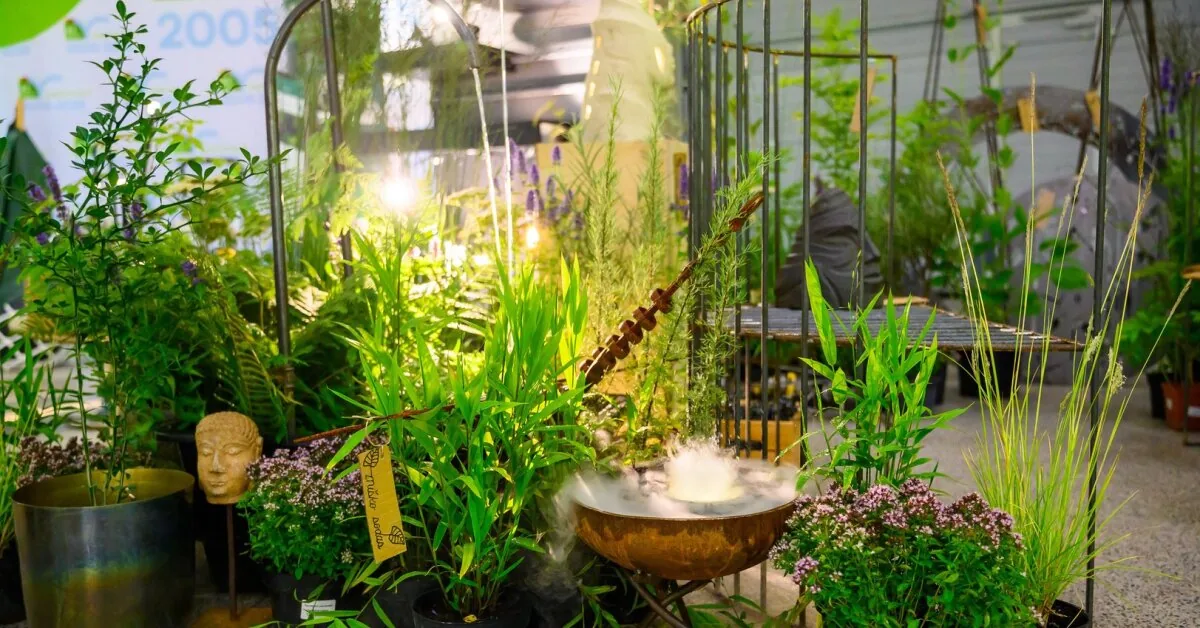
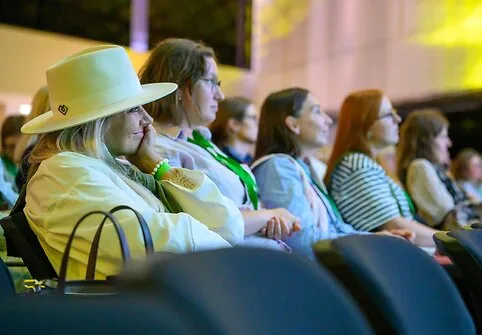
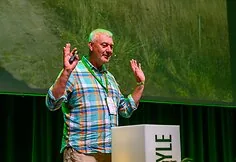
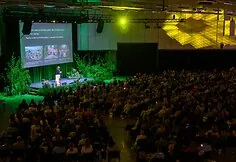
It turns out – quite a lot. At this year’s environmental design conference “Garden Style,” specialists from various fields talked about very diverse topics, but a fairly clear overall picture emerged: landscaping today is no longer just about what to plant and how to beautifully combine plants.
Read more Put this with green tomatoes – they will ripen much faster: a simple trick
More and more attention is being paid to how greenery affects biodiversity, how space is created for people, how the garden changes over time, and whether it has value not only when everything is blooming at its most beautiful. So from the entire conference program, we selected several of the most prominent landscaping trends worth knowing for both professionals and those creating their own yards, according to the press release.
Biodiversity is no longer just a nice promise
A blooming meadow near an office building looks beautiful. We can say that it is beneficial for insects. But how do we know if that is really the case?
Landscape specialist Ingrida Vainauskienė presented the environmental project of the “Sanitex” administrative building, created by the UAB “Gruta” team. There, biodiversity was not only encouraged but also actually measured. It turns out that insect diversity can be determined by the DNA traces they leave on flowers, without even catching the insects themselves.
And the results are impressive. In the blooming meadow sample, 208,339 DNA molecules were detected, 75 taxa and 63 species identified. Among them are various flies, bugs, thrips, hymenopterans, beetles, butterflies, moths, as well as spiders and ticks.
In a private yard, of course, we are not required to collect DNA samples, but we can still ask ourselves: does our garden have something to offer not only to humans? Does it have different flowering plants, water, shelter spots for insects and birds? Is it really necessary to mow and control every corner down to the centimeter?
First – not plants, but people
Another clear trend is that the garden is increasingly designed not as a collection of plants but as a space for living. I always say that it is too luxurious to have a yard and not use it! And that is exactly what often happens: a house is built, a terrace appears, and everything else is just something around, whatever is left.
I talked about this at the beginning of the conference, presenting the “7 elements without which the yard feels empty.” It is gratifying that landscaping trends do not turn away from people – even more, it is very important to come up with activities you will do in the yard and create the yard based on that.
Will you want to eat outside? Will you need space for children? Will you want to host friends here, or have a quiet corner for one person with a cup of coffee? That is why before deciding what to plant, it is worth agreeing on what you want to do in the yard.
From that naturally arise garden zones, paths, privacy, shade, accents, and plants. In other words, plants come to help create a life scenario, not the other way around.
Plants become a tool for creating space
Dutch landscape architect Arjan Boekel spoke at the conference about plants through structure, layers, and time. His presentation seems to continue my thought: plants are not just decoration. They can shape the space itself.
Trees and tall shrubs provide verticality and scale, plant masses can cover or open views, create “walls,” and through a left gap direct the gaze to another part of the garden. Even a small yard can be divided into separate “rooms,” and then it immediately becomes more interesting – there is something to discover, and the entire plot does not open up at a single glance.
Another important word here is time.
The garden is not a photo. Trees grow, perennials expand, some plants begin to dominate, others disappear. What looks quite modest in the first summer can become the main garden structure after five or ten years.
And there is nothing wrong with that – it is even more interesting to create because everything is constantly changing.
Less “copy-paste,” more specific to the place
Constant change means you can copy plant combinations – in your yard, they will still look different than somewhere in a picture.
But don’t stop there: uniqueness can be given by:
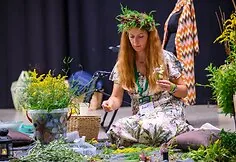
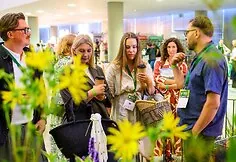
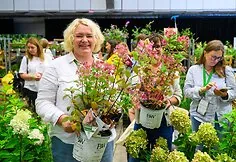
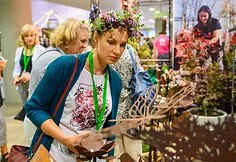
- rare plants – many such unseen ones were presented at the conference exhibition;
- non-standard ideas that provide the basis for the entire garden.
An interesting way to look for ideas was presented by landscape architect Agnė Dailidaitė (MB “Bauland”). She suggests first starting from the landscape scenario – she proposes thinking about where a person will come from, where they should stop, where the view should open, where they will crouch or sit, which way they will go out, what they will see in the morning and in the evening. By creating such a scenario, you can understand where a bench is needed in the garden, where a wider path, and so on.
Her team applies these principles in large projects – they are creating Mammoth Park in Vilnius, Molainiai Filtration Park in Panevėžys, Perkūno Oželis Square, and other non-standard objects. But this principle can also be applied to a small garden when looking for ideas.
The beauty of the plant is no longer enough
Of course, a lot was said about plants at the conference. Landscaping trends still revolve around resistant, reliable, healthy plants – the new thing is that we can find more and more of these.
French rose breeder Matthias Meilland spoke about modern rose varieties. Of course, a rose still has to be beautiful – otherwise, what kind of rose is it? However, today other factors are becoming increasingly important in breeding: health, disease resistance, long blooming, reliability.
This reflects a broader trend – we evaluate a plant not only by its most beautiful week. It is important how it behaves throughout the season, how much care it requires, and how it fits into the overall composition.
Read more «This is nothing but a scam»: buyer surprised by fruit prices in a Kaunas store
The use of roses is also changing. They do not necessarily have to grow in a separate classic rose garden. More and more often, roses are combined with perennials and ornamental grasses – becoming part of the entire greenery, not just its lonely star.
Fire pit as the focal point of the yard
The conference always includes practical design topics – because everything beautiful needs to be created and maintained.
Kateřina Zahradníková from the Czech Republic spoke about fire pits and outdoor kitchens as gathering places in the yard. Estonian Merilen Mentaal showed private garden projects (a very poetic and at the same time very practical presentation). In all these topics, the question of human experience was repeated.
We can have a very beautiful flower bed, but is there a place to sit next to it? We have a large terrace, but is it comfortable to be there on a hot summer afternoon? We have a lawn – but what really happens on it?
Sometimes the yard lacks not another plant at all. Maybe it lacks a shade-creating tree, a small seating area, a cozier corner, or a path that not only leads from point A to point B but also allows discovering something along the way.
That is why the human scale becomes increasingly important. We design not a plan that looks beautiful from above, but a place for a person who sits, walks, talks, and looks here.
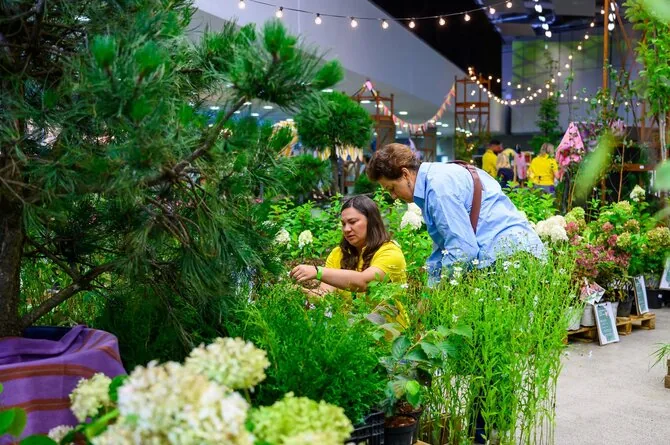
Japanese garden reminds us that good things take time
Šarūnas Kasmauskas presented the principles of how he created opening views guided by Japanese garden traditions, but it seems the conference audience was most impressed by his own story.
For many years, he has been creating the largest Japanese garden in Europe in the Kretinga district. The impression is made not only by the scale of the project itself but also by the fact that the garden was started without additional funding – simply from a very strong idea and the desire to implement it.
After the conference, answering visitors’ questions, Šarūnas wrote that he only began to enjoy the results of his garden now, after 18 years. And in Japan, people come to admire gardens that are 200, 300, or even 400 years old.
This is a good reminder of something we sometimes forget in modern landscaping: a garden is not a quick result. It grows, matures, and changes over time.
Another thought from Šarūnas at the conference sounded unexpected – the most beautiful garden for him is in winter. When there are no flowers and bright colors, nothing distracts attention, and what is most important stands out: tree silhouettes, stones, space, water, composition, and tranquility.
This is also a very good test for any garden: is it still interesting when nothing is blooming?
If the answer is “yes,” it means it probably already has not only beautiful plants but also a strong structure.
Many remembered Šarūnas’s relationship with the place he is creating. Asked what motivates him to continue the same idea for so many years, he called his Japanese garden like another family member – “here is a son.” Such openness and love for his work became one of the strongest parts of the entire presentation.
So, where is landscaping heading?
Looking at all these topics together, the direction is quite clear.
Landscaping is moving away from a purely decorative approach. It is no longer enough for it to be just beautiful. It is increasingly important whether greenery truly supports biodiversity, whether plants are reliable and suitable for the specific place, whether the garden has structure and remains interesting not only at the peak of blooming.
At the same time, more and more attention is paid to people: how they will feel in that space, what they will do there, what they will see, where they will want to stop.
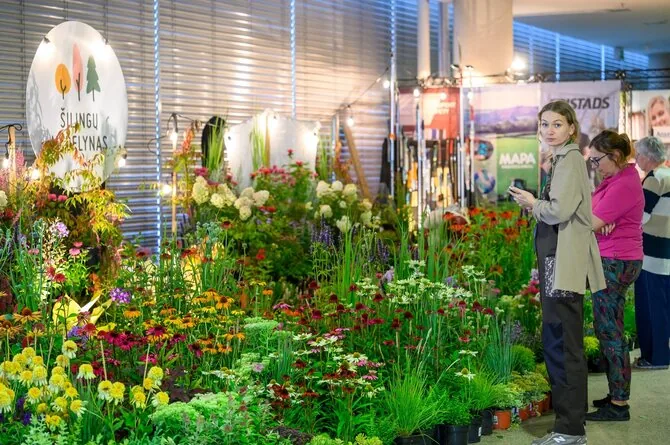
And also – time. A good garden is not necessarily the most beautiful in its second year. Sometimes it takes decades.
Perhaps that is why the most important trend in modern landscaping is quite simple: the garden is less and less perceived as a beautifully landscaped plot and more and more as a living, gradually changing space for people and nature.
Read more Palanga lifeguard Kajus Pirožnikas announced unexpected news