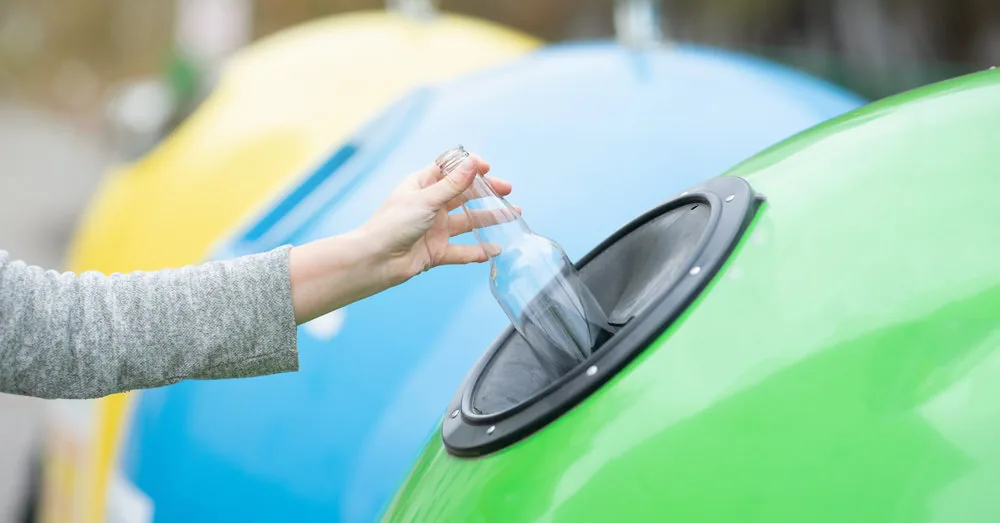
Experts emphasize that properly collected and sorted packaging after leisure time in nature ensures not only more attractive green spaces today but also less microplastic pollution in the future.
Read more The giant «Wildberries» attacked by Ukraine is dragging the Kremlin bank down with it
Although the microplastic problem is becoming increasingly relevant, Justinas Kilpys, a scientist at the Institute of Geosciences of Vilnius University, first notes that obvious plastic pollution in Lithuanian nature has decreased in recent years.
“A decade or so ago, when traveling to a lake or through forests, various kinds of litter were definitely seen more often. Now the situation is better, and this is likely due to various environmental cleanup initiatives. For example, the ‘Darom’ campaigns today take place not only in forests but also near rivers, and the deposit system also positively affects environmental cleanliness, so when coming to the edges of water bodies, we see far fewer piles of trash, flying bags, or other abandoned waste,” the scientist admits.
He points out that positive changes are important not only for a more aesthetic environment – timely collected plastic waste will not reach the stage where, after several or even many decades, it will start to decompose into microplastic under environmental influence.
“Microplastic today is truly a global problem – plastic particles almost invisible to the naked eye enter the environment not only from decomposing improperly discarded waste but also from many other everyday sources. Microplastic is now found everywhere – even in lakes, seas, or Arctic glaciers farthest from cities. It is detected all over the planet because it also enters the natural, untouched environment from the atmosphere,” explains the Vilnius University scientist. Therefore, according to him, even cleaner coasts do not guarantee that a water body is not affected by microplastic pollution.
Water is polluted not only by decomposing packaging
J. Kilpys reminds that plastic waste in nature is only one of the causes of microplastic formation. Most of it is formed in everyday human activities.
“High concentrations of microplastic in rivers come from treatment plants. For example, when washing synthetic clothes, fine plastic particles are released each time, which enter treatment plants with wastewater. Filters are used to collect them, with an efficiency of about 90%, so they cannot capture absolutely everything,” says the interviewee.
Another very significant source of microplastic is car tires. “Microplastic particles naturally form as tires wear down, spreading in the atmosphere and being carried far from one place to another. This is diffuse pollution, which is practically impossible to fully control,” explains the scientist.
Why is there more microplastic in some water bodies than in others?
The amount of microplastic in water bodies is not uniform. “If a water body is in a natural environment, it usually contains less microplastic. However, due to the water circulation cycle, plastic and microplastic tend to accumulate in larger water bodies. Small streams flow into larger rivers, which flow into the sea, so everything eventually accumulates in the Curonian Lagoon and the Baltic Sea. Because of this, microplastic concentrations are higher there,” says J. Kilpys.
Read more A hair’s breadth from a tragic accident: a kitesurfer had to fight for his life at sea
A similar accumulation principle applies in wildlife. “The smaller the fish, the less microplastic it contains. As you go up the food chain, it accumulates, so predatory fish contain more,” notes the scientist.
Continuous microplastic or coastal pollution studies are not conducted in Lithuania, but their results can be predicted, according to J. Kilpys. “The highest pollution would be found near city sewage outlets and in urbanized areas. So if we wanted to create a pollution map, it would be enough to mark the largest Lithuanian cities – it would be quite accurate,” says the interviewee.
What can each of us do?
Although it is no longer possible to completely avoid microplastic today, everyone can contribute to reducing its entry into the environment. According to J. Kilpys, it is important not only to sort waste properly but also to ensure effective wastewater treatment, choose fewer synthetic products, and in cities, whenever possible, use public transport, bicycles, or walk more often.
Asta Burbaitė, head of communications and marketing at the organization “Žaliasis taškas” (Green Dot), emphasizes that one of the simplest ways to reduce future microplastic pollution is to prevent plastic packaging from remaining in nature.
“‘Žaliasis taškas’ always reminds a simple rule – take out what you brought into nature. Even if there is a trash bin at the recreation site, it is better not to overfill it. It is preferable to take all packaging and other waste generated during leisure time home and sort it properly where facilities are provided,” says A. Burbaitė.
According to her, this is why many European countries completely avoid trash bins in recreational areas and nature trails.
“People often complain that there are not enough trash bins near lakes or in forests, but in many natural places, there is no possibility to service them regularly. The longer waste remains in nature, the greater the chance it will enter the environment and eventually turn into microplastic. Therefore, in many countries, visitors are asked to take all waste generated during leisure time with them. This is a small additional action that helps preserve cleaner nature and reduce microplastic pollution,” notes A. Burbaitė.