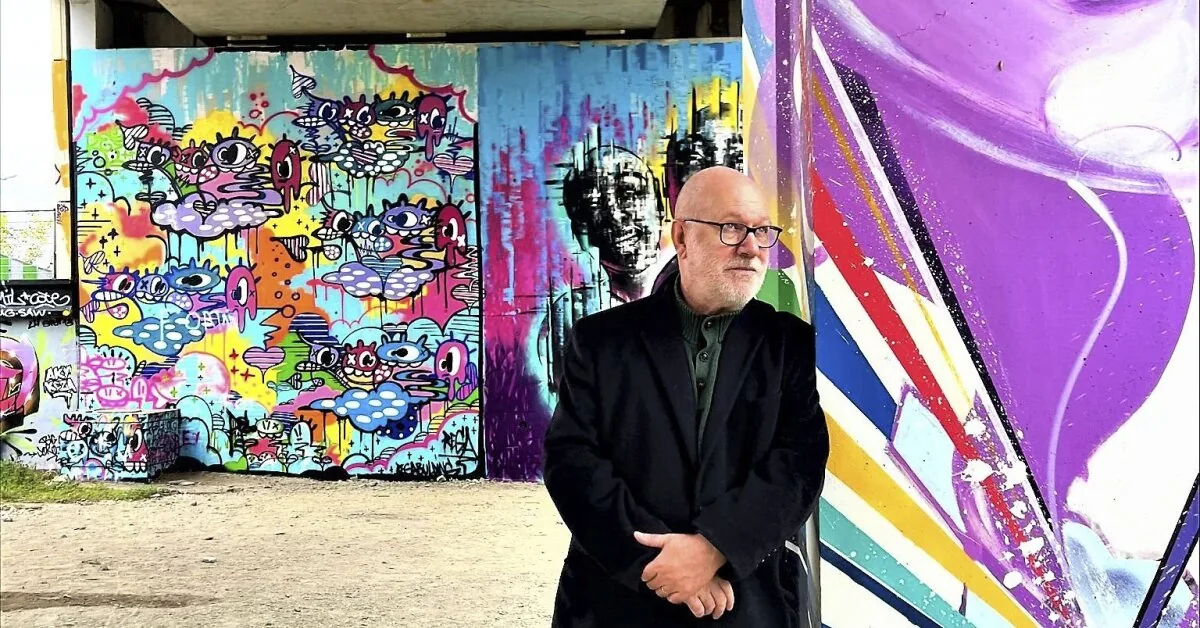
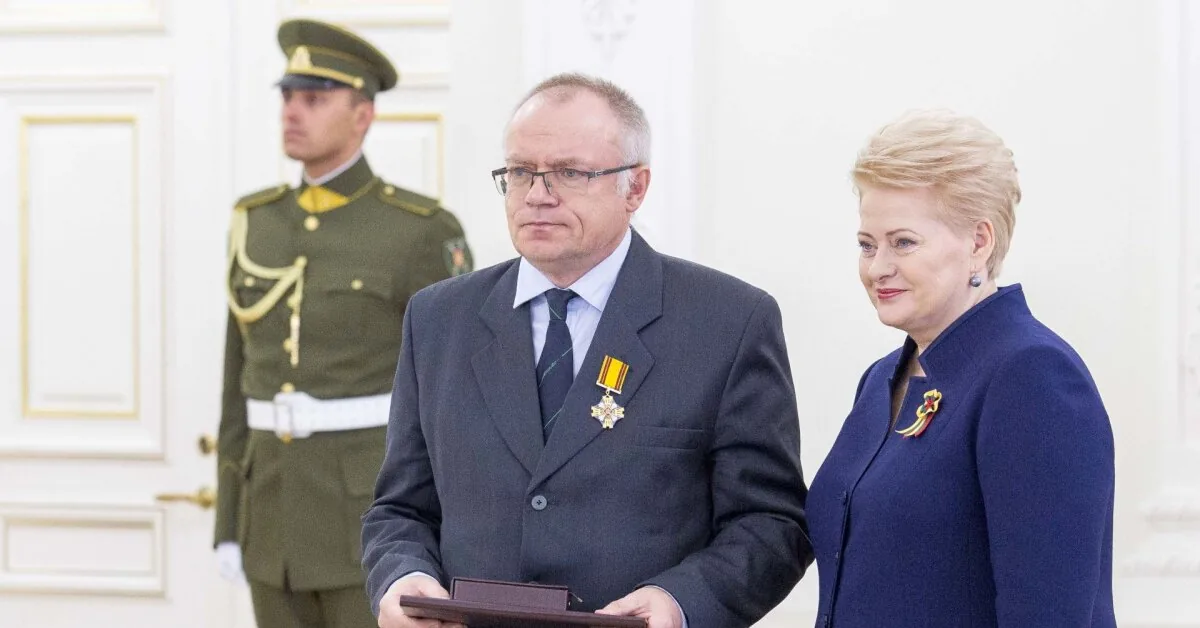
Today the same person works in a completely different space – a sound studio, and viewers do not know his name, but thousands hear his work in cinemas.
This conversation is about two lives in one head: about how discos at Biržiska Gymnasium evolved into “Sound Architecture,” how G. Bush Sr.’s autograph ended up on the way to Hollywood, and why the same person who knows how to lift the whole hall says that silence is sometimes what he needs most.
Benediktas Sakalauskas is interviewed by Aneta Anra.
– Let’s start with a paradox: you are a person whose work is heard on all the biggest cinema screens, but no one knows your name – yet as a DJ you are on stage where everyone sees you. Which of these two “yous” is closer to you?
– The paradox is quite fitting and, I would say, naturally developed. When the studio matters began, I had to focus all my attention on the work, managing processes, communicating with clients, and so on. It turned out that the DJ’s bread was no longer bread – it became just crumbs, and I had to push it into the background. Sometimes I would still pull out the card, play beautiful sets, but dubbing work took over.

Both roles are close to me, they are connected one way or another, so I don’t torment myself much – I am still in the studio, still doing what I like, and I don’t feel that I suffer from Jekyll and Hyde syndrome. Although parallels can be seen – during the day I can be one person, at night I can be quite another, but I carry the same body, and the head seems sewn on as one.
– By the way, let’s clarify right away – are you the founder of “Sound Architecture,” or did you join an already operating studio?
– I am the author of the name, the founder, a shareholder. We started everything from scratch with colleagues.
– You started playing while studying at Biržiska Gymnasium: what attracted you then – the sound itself, the people on the dance floor, or simply the opportunity to control the space through music?
– School discos were a great opportunity to test my knowledge about crowd control through music. I liked the feeling that by playing I could raise emotions, steer them in one direction or another, because in a club all differences of opinion usually turn into one mass and rise to a transcendent, or how to say, ethereal level.

There, no opinion matters anymore – only the feeling remains, few lights, a bunch of emotions, and sometimes at school discos there were “we are dating” proposals and so on. All this can be transferred far beyond school times and space, I would say, music as a means to reach others appeals to me, and I do not hesitate to use it.
– And when did that hobby of playing first turn into the idea that sound could be connected to a profession, not just a hobby?
– Probably those first times when I came back after a disco, opened a drawer, and there was so much that nothing else fit. I bought record players, a mixing console, went to the USA, worked there, earned even more, bought better equipment, better records, and so the mill started turning.
– You studied political science at TSPMI – how does that fit with sound? Is there a connection between analytical thinking and musical hearing, or are these just two completely separate lives of yours that happened to occur at the same time?
– I will echo the answer to the previous question – when I was studying at TSPMI, I went to the USA, Maine state. Working there, I met G. Bush Sr., snagged his autograph on a book published by TSPMI, paid a decent sum, returned to Lithuania, and with friends Andrius Kauklys and Marius Šmitas, we made the best musical phenomenon of all time back then – Happyendless DJs.
Play after play, and we were at the top of Olympus in Lithuania. We were not meant for abroad, but my international relations studies were not in vain – led by colleagues from international relations, I turned them into relations with Hollywood studios. Industry friends helped a lot. We still work with some of them today, with others paths have diverged, but I think everything revolved around the same planet – we eventually created a studio that had dubbing, DJ activity, and “international” relations.
Play after play, and we were at the top of Olympus in Lithuania. We were not meant for abroad, but my international relations studies were not in vain…
– What was the first day with “Sound Architecture” like – when it was still unclear whether it would become a business or remain an experiment? Do you remember the first film you gathered actors’ voices for?
– To be honest, there were many first days, and we knew we would succeed. The first film we dubbed was “Ice Age 2,” in which the whole team performed excellently – from the creative tandem of Andrius Rožickas and Vilius Tamošaitis to Rimas Šapauskas, Arūnas Sakalauskas, Dainius Svobonas, Evelina Kauklienė, Lina Budzeikaitė, and quite a large number of other voices.

– Have there been situations when you invite an actor to voice a character, but during work it turns out that he is completely unsuitable for the role?
– Over our twenty-year history, such cases have, of course, happened, but they are rare because we know whom we want to invite. Usually, we have already decided that this voice will go to the character. However, everything is never too perfect, and we have had to admit mistakes and give the character another voice.
– Can anyone dub films, or does it require acting skills? You have invited singers to dub as well.
– If you remember, there was “La Troškinys” and the phrase there – anyone can produce. That’s not the case in dubbing. Trying out, testing yourself in the booth – yes, anyone can do that, and I have even invented and implemented a primary selection, or as we also called it, the “dream fulfillment” “Sound Architecture” app: a person sends their voice, and if we like it – we invite them to the studio.
And guess what – one of those who sent in, not being an actor, got the main role in the film “Bull Ferdinand”: he voiced John Cena’s character, and it turned out great. So maybe anyone can really dub?

– Who selects the voices for characters in your studio? For example, if you need to dub George Clooney or another Hollywood celebrity whose voice is recognizable, how do you find a match among Lithuanian voices?
– The process consists of several parts – first, we agree locally with the dubbing director Vilius Tamošaitis, then we coordinate the selected options with the creative supervisors, and there is a “bingo” moment if our and the supervisors’ opinions coincide.
Sometimes voices can be selected even by the actor’s appearance. For example, the original actor of the Addams Family, Oscar Isaac, was quite similar to Viačeslavas Mickevičius (Slavka Channel), plus the timbre and acting fit, and he was chosen for the Lithuanian Gomez.
A similar story happened with Justin Timberlake in “Trolls” and Vaidas Baumila. In any other film with Justin Timberlake, it is very likely that we will hear Vaidas in Lithuanian.
– Why did film dubbing become the main direction, and not, say, advertising or music production – after all, having DJ experience, you could have gone in a completely different direction?
– Apparently, the window of opportunity suggested that this direction suits me and I like it, and together with the team, we can achieve very good results. The DJ experience probably had the least influence on this choice; other components had a greater impact. By the way, advertising voice-over is also one of my jobs, maybe only music production is excluded from this chain.
The window of opportunity suggested that this direction suits me and I like it, and together with the team, we can achieve very good results.
– Do you yourself like to watch films? Which of your studio’s works do you think is the most successful?
– I have seen “La Troškinys” many times, also “Garfield,” I like our dubbed “Lorax,” “Coco.” Both parts of the musical “Wicked” required a lot of effort. The first two parts of “Cars” are fun, “Ice Ages,” even the dubbed “Wonka” with Timothy Chalamet, “Lego Batman,” “Villains,” “Wild Rose,” and many other very successful releases, none of which I would single out as the “most,” “best” – they all carry a good aura, all are precious in their own way.

– How many films do you dub per year (on average), are there “bad years”?
– It depends a lot on the studios – it is also seasonal, depends on many factors, so there is no fixed number, it would be hard to specify.
– When you play in a club, you immediately see if the audience “bought” your decision. In dubbing a film, there is no such direct response – how do you understand that the sound “worked” if the viewer does not think about your work at all?
– There is such an agency – the Lithuanian Film Centre, and in its reports on the number of viewers, you can get an idea of whether it succeeded or not. Often, our dubbed projects manage to exceed the threshold of more than 40 thousand viewers.
– And how are the films you dub selected – do you decide yourselves what is worth dubbing, or does it always come “from above,” from distributors and studios? Do you have to follow film world news as a kind of market pulse, similar to how you follow music news?
– About four world rulers sit at the table, open big books, and in them is written the whole future of the world, including which animation will reach cinemas soon. Then we turn on magical spheres, and projects settle in our studio. All this is practical magic. True, there was a request from above not to publicize this matter much, so we have to follow the protocol.

– How many people are needed today for one animated film to “speak” Lithuanian – from script translation to the final result?
– A lot of talented people are needed – translators, actors, directors, producers, distributors – the whole chain, because of which the final result happens.
– What is the most difficult stage of dubbing a film that the viewer does not even think about?
– The best thing that can happen and what we strive for is that the viewer does not think at all that it is dubbing but immerses in a world that is familiar and recognizable to them.
Among less known things, I can mention the number of syllables, rhythm, synchronization, final quality control – in other words, this is part of the magic that creates a recognizable world. If the viewer starts thinking about dubbing, it means that somewhere in the chain there was a “short circuit” that causes a side effect of “not immersing in the dubbing.”
– How does voice selection for a character happen: do you first hear the original and look for the closest match, or do you let the Lithuanian actor find the character in their own way? And – what is more important when choosing a voice: the actor’s acting skill or simply the right timbre for a specific character?
– In short – first the original, then we look for someone who matches it by timbre and the ability to embody it. Timbre alone is not enough.
If the viewer starts thinking about dubbing, it means that somewhere in the chain there was a “short circuit.”
– Have you ever disagreed with the studio’s (e.g., Disney’s) decision about a voice? Thought: “Hm, I would have chosen better”?
– In situations where our and the creative supervisors’ opinions differ about voices, we look for a compromise because our vision of voice selection is not always correct. Of course, the opposite also happens.
– How do you work with actors who are not professional voice specialists – do you have to “teach” them to speak into the microphone differently than on stage?
– This is already the dubbing director’s territory, where my role is minimal. Sometimes I myself stick my snout into the microphone booth and get excellent lessons on how to “set” that voice.
Here, more can be said about children, who are certainly not professional actors yet, but you wouldn’t believe how many talented ones there are – sometimes we ourselves are amazed at how quickly young talents manage to “get into” a role that requires a lot of effort.

– Do you notice that certain actors “grow into” a character over several films – and what happens if that actor can no longer work in the sequel?
– Such cases have happened, and then you have to choose others for the character again, looking for the best voice match.
– Let’s return to your double professional life – does the ear trained in the studio hear something in the club that other DJs do not?
– I have no idea what that could be, but certainly there are already frequencies that the ear no longer hears (laughs).
– You have been playing with the “Happyendless DJ Team” for many years – is it still a serious activity, or now more of a break from the quiet, invisible studio work?
– “Happyendless DJs” is a hibernating project that, like the Etna volcano, may one day still flare up.
– What can the viewer basically not notice in cinema, but without which the film would “collapse” in terms of sound?
– If in regular cinema it is still possible to use ambient sounds, live dialogues, imagine that in animation everything is created from an idea, from silence, from paper, and everything is gradually grown with sound – the environment itself, characters, all rustles, engine sounds, tree rustling, precipitation, dialogues, and how all this weaves into one beautiful braid.
Imagine – you watch a Sunday show about animals, and it’s not Valinskienė’s voice. Here’s your introduction to dubbing.
The viewer does not notice that the dialogue could have been recorded on different days, that part of it was rewritten in the studio, that an environment is created for each editing cut. Our job is to ensure the continuity of dialogues, but the filmmakers, even before dubbing, have to make everything sound like one real space.
When this is done well – no one notices. When bad – in a film or animation you immediately start feeling: “something is wrong here.”
– If today you had to explain in one sentence what you do to a person who has never heard of dubbing – how would you explain it?
– Imagine – you watch a Sunday show about animals, and it’s not Valinskienė’s voice. Here’s your introduction to dubbing.

– If you could invite any Hollywood actor to voice a character in a Lithuanian dub without any restrictions, who would it be and for which character would their voice fit?
– I would invite Jason Statham to voice an autobiographical film about his unique life. If this is an attempt to invent a Hollywood alter ego – well, who else if not a like-minded person to a like-minded person (laughs).
I also really like Antonia Desplat’s voice, but what she would voice, only the gods know.

– And now, in summer, when the day ends – are you more drawn to watching a film (and can you even watch films “just like that,” without analyzing the sound), listening to music, or after all the noise during the day do you mostly want silence and peace?
– It depends a lot on the day, mood, events, but the essence probably remains the least sound pollution possible. The best help for that is walking, books, films, and conversations in which you listen more than you speak.
– Can you reveal which of your studio’s dubbed films we will see in cinemas soon?
– Still this season, in autumn, the screens will see “The Angry Birds 3” and Dr. Seuss’s “The Cat in the Hat,” as well as a very strange, very interesting animation based on Filipino legends “The Forgotten Island.”
Read more Radžis announced sad news: «That’s it»