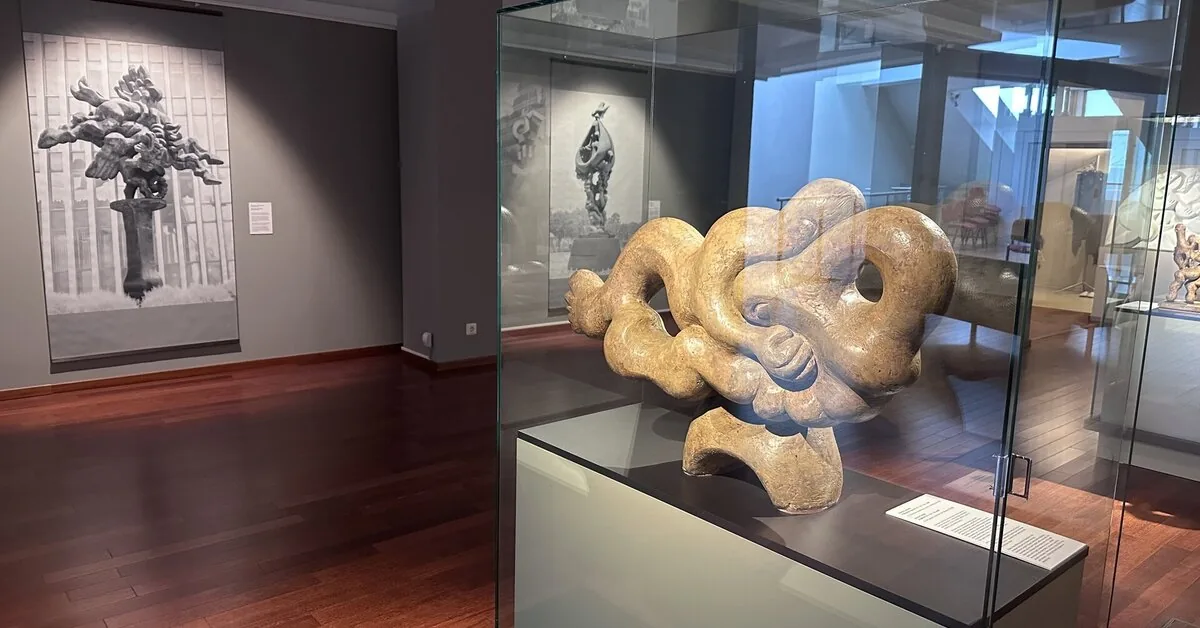
At a press conference held this morning, Sergejus Kanovičius, director of the Vilna Gaon Jewish State Museum, and the exhibition curators Aušra Rožankevičiūtė, Ieva Šadzevičienė, and Ieva Bernotaitė presented the concept of the exhibition and the context of Lipchitz’s work to the media.
For the first time in Lithuania, works by Jacques Lipchitz from the collection of the Valencia Institute of Modern Art (IVAM) are presented. Eight sculptures are exhibited in Vilnius, revealing different stages of the artist’s work – from stricter cubist forms to more plastic, open, and dramatic compositions.
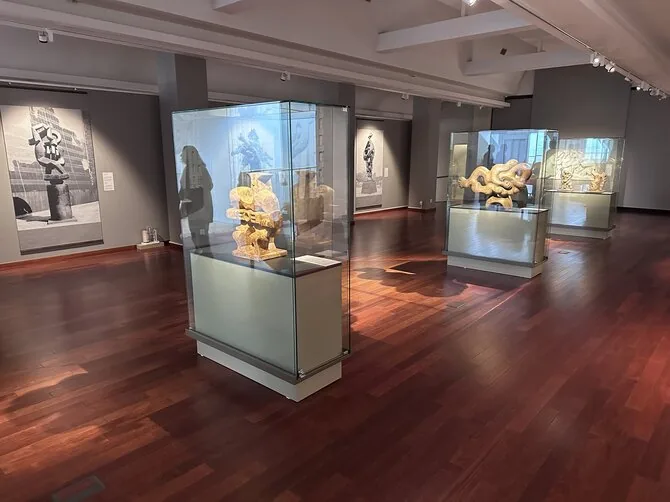
A special focus in the Vilnius part of the exhibition is on Lipchitz’s connection to the city where the future sculptor chose the artist’s path. The artist himself said: “I learned sculpture in the churches of Vilnius. They still stand before my eyes.” The city’s architecture, Baroque churches, and lessons at the Vilnius drawing school became an early foundation for the artist, who later transferred the language of cubism into sculpture.
The Samuel Bak Museum exhibits a narrative dedicated to Lipchitz’s relationship with Vilnius, supplemented by photographs by Jan Bułhak, quotes from the artist, and images of the city from the early 20th century.
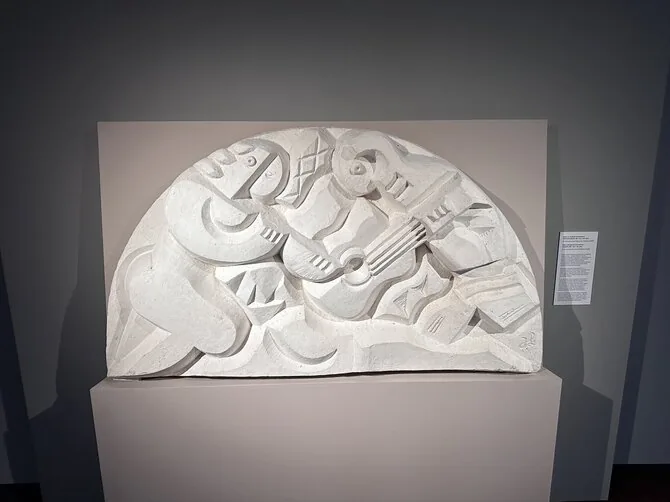
The exhibition offers the opportunity to see Lipchitz’s works made of plaster, terracotta, and other primary, sensitive materials up close. These retain traces of the sculptor’s handwork – surface irregularities, shape corrections, and fingerprints, allowing a glimpse into the creative process itself. One such very rare work is the 1923 plaster bas-relief “Figure with Musical Instruments.”
In it, Jacques Lipchitz develops one of the most important cubist themes – the relationship between the human figure and the musical instrument. The unified scene is deconstructed: figures and instruments are broken down into geometric planes, merging into a rhythmic architectural composition. The human body and instruments in the bas-relief become equal plastic elements.
The motif of musical instruments is connected to a broader cubist tradition, where the guitar, mandolin, or Harlequin often associate with Spanish culture. This context was close to Lipchitz: he traveled through Spain with Diego Rivera and created works inspired by life on the Mediterranean coasts.
Read more Kaunas will allocate funding for apartment building renovations: invites to submit applications
Musicians and musical instruments in the 1920s and 1930s were one of the favorite themes of cubists, enabling the exploration of form, rhythm, space, and the play of light and shadow. These motifs were used not only by Lipchitz but also by Pablo Picasso, Georges Braque, Juan Gris, and other cubists.
The exhibition also presents other themes developed by the sculptor. In the 1946 work “Song of Songs,” Lipchitz interprets the Song of Songs – a book of the Old Testament / Tanakh, a poem of love, desire, beauty, and spiritual union. The sculpture is not a direct illustration of the Song of Songs. Intertwined, organic forms evoke the closeness of bodies, movement, and inner rhythm. Created immediately after World War II, this sculpture gains a broader meaning. Love in this work becomes a sign of life, hope, and renewal – a quiet but strong response to the loss experienced during the war.
The exhibition “Jacques Lipchitz. Sculptures-Pilgrims,” opening in Vilnius and Druskininkai, will offer visitors interesting events and meetings.
On July 21 at 5:30 p.m., at the Samuel Bak Museum, there will be a meeting and tour with exhibition curator Ieva Šadzevičienė titled “Does music fit in a cube?”. During it, visitors will be invited to explore cubist sculpture as a work unfolding in space and time and learn how Lipchitz’s journey through Spain established musical motifs in his work.
On July 26 at 12 p.m., visitors are invited to a meeting and tour with the exhibition’s concept author and curator Aušra Rožankevičiūtė.
This Friday, July 17, at 6 p.m., the exhibition will be opened at the Jacques Lipchitz Museum in Druskininkai. There, visitors will find four sculptures from the IVAM collection, and on July 18 and 19 at 12 p.m., tours with exhibition curators Aušra Rožankevičiūtė and Ieva Bernotaitė will take place at the museum.
Read more US military launched a wave of strikes on Iran
The exhibition will run until November 22.
Exhibition locations:
Samuel Bak Museum, Naugarduko St. 10, Vilnius.
Jacques Lipchitz Museum, St. James St. 17, Druskininkai.