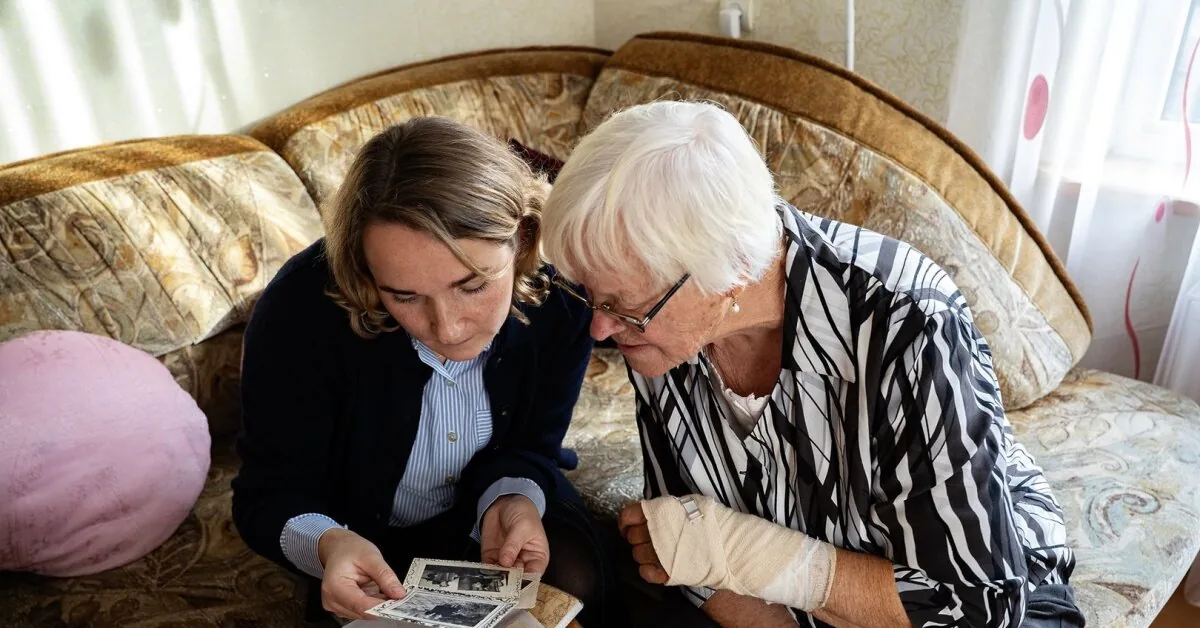
As reported by the Kaunas Ninth Fort Museum in a press release, Jadvyga Jūratė Jotautaitė-Peleckienė was born in 1942 into a farming family in Šeduva, Radviliškis district.
Read more „Reuters“: Poland and Latvia respond to potential threat from Russia
Her parents Benedikta and Kazimieras Jotautai were hardworking and respected farmers who raised a large family.
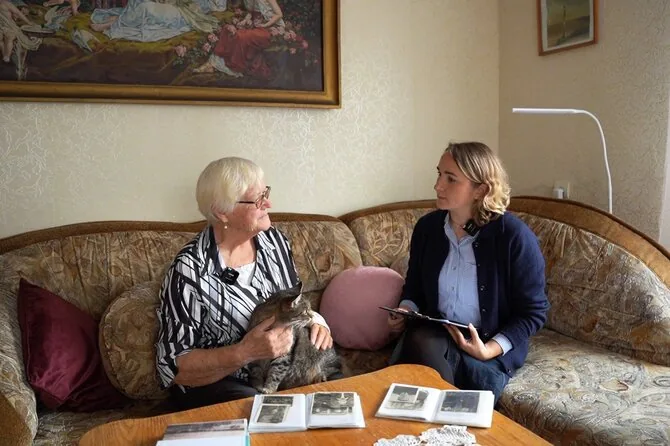
One of the few memories the interviewee has of her childhood in Lithuania is her parents’ hospitality.
“People used to say: at the Jotautai’s there was always a bed for every guest,” she says.
“You will die on the way anyway”
When Jadvyga was only seven, her family’s life changed irreversibly. The entire Jotautai family – parents, five daughters, and a son – was deported by the Soviet authorities to the Irkutsk region, Tulun district.
“They took us away because we had a lot of land and worked well,” the interviewee says.
From her parents’ stories, Jadvyga remembers that on the fateful night of April 21, 1949, when Soviet soldiers came to their home, her sister was pulling bread out of the stove.
“You won’t need that bread, you will die on the way anyway,” the soldiers said.
You won’t need that bread, you will die on the way anyway.
However, one of them, glancing at the group of children, added: “Take a sewing machine and an axe. You will need to live.”
Hymns accompanied the journey
The Jotautai were taken to the Šeduva train station and seated directly into a carriage where six other families were already waiting.
The journey to Siberia lasted a month. Conditions were extremely harsh: when the train stopped, it was forbidden to get out of the carriage, and seven families had to share one “toilet” – a hole in the floor of the carriage.
The interviewee recalls that the adults constantly watched the children to prevent them from falling onto the stove inside the carriage.
“It was cold, so they kept lighting that ‘buržujka’ (stove – editor’s note). They also warmed food there. <…> We still had some food at the beginning,” Jadvyga recalls.
According to her, later they had to eat “pachliobka” (thin soup – editor’s note) brought in buckets.
“Whether it was edible or not, I don’t remember. But until the end of the journey, we managed to feed ourselves,” she says.
Still, the seven-year-old Jadvyga was most struck by the Lithuanian hymns sung throughout the journey to Siberia.
“They stay in the city, and you – to the village”
When the train reached its final stop – Tulun – a difficult beginning awaited in a foreign and harsh land.
“Even now, the image stands before my eyes of how we moved out of the carriage. Everyone was guarding their belongings, as what you brought was precious,” Jadvyga says.
Since the region was dominated by the timber industry, the so-called kupčiai (traders – editor’s note) first selected able-bodied people, and families with children were taken last to a barrack (a wooden building intended for temporary housing of a large number of people – editor’s note). There, the deportees were assigned to different zones of the settlement.
The Jotautai were instructed to stay in the city, but a familiar family who had to move to the village asked Jadvyga’s father to help persuade the supervisors.
“Well, the kind-hearted father asked. And the (supervisors – editor’s note) replied: ‘Okay, they stay in the city, and you go to the village,’” the interviewee recalls.
Read more “Flaming Revolution”: even Albanian prosecutors worried about Trump son-in-law’s plans
Thus, Jadvyga’s family ended up in a small village. At first, they had to share living space with locals. But later, Jadvyga’s father managed to repair an abandoned house, and the whole family moved to live separately.
“They didn’t believe I would survive”
Daily life was hard.
“In the first year, mainly my mother earned our bread by sewing,” Jadvyga recalls, adding that in exchange for sewing work, they could get potatoes or a liter of milk.
Jadvyga’s routine was filled with school, and in her free time – fishing in the river. In summer, she had to work hard carrying and raking hay or weeding fields. In winter, older sisters went to cut forests.
Unfavorable living conditions in exile caused health concerns.
“I was in Siberia for eight years – I had pneumonia eight times. They didn’t believe I would survive. Fortunately, when my sister worked as a nurse, she got penicillin, which saved me,” Jadvyga says.
“Bandits” brought culture
Not only the deportees had to adapt to the new environment – gradually, the attitude of the local Russians towards Lithuanians changed.
“For the first two years, we were ‘bandits’ to the Russians. <…> But then, when they saw what culture we brought them, how we know how to communicate, how to spend time nicely, they changed a lot.
With them, it was like this – a bottle in one hand, a ‘čierka’ (glass – editor’s note) in the other, and they go through the village singing. And we started celebrating name days, gathering for May devotions. <…> They especially liked the May devotions. <…> There were such women, Russians, who wrote Lithuanian words in Russian letters and came to sing,” Jadvyga says.
They didn’t believe I would survive.
According to her, the locals were amazed not only by the culture of Lithuanian deportees but also by the variety of food preparation: “They didn’t even know how to bake cookies. They would slaughter a pig of about two or three months and put it in the snow. It would freeze, and that was it. But when they saw that we could make sausages, smoke meat, cook aspic, they were wowed.”
Faith helped to survive
Jadvyga is convinced that the strength of the family and faith helped the most to survive in exile: “Probably my parents never once thought that we wouldn’t return. Not even once. <…> And if we hadn’t believed, there would have been no devotions, no šliūbos (wedding ceremonies – editor’s note), they even started baptizing children. Priests came from exile, visited. Then several families, several villages gathered and socialized.”
The interviewee also recalls the patriotism prevailing in the family: “At school, they forced us to join the pioneers. We came home with a neckerchief and a badge pinned on – well, we were pioneers like everyone else. My brother saw it – he tore off the neckerchiefs, threw away the badges. And he said: I don’t want to see you with those rags anymore.”
Return home
In the spring of 1957, after eight years of exile in Siberia, the Jotautai family was allowed to return to their homeland.
“Everyone from the barrack gathered to see us off,” the interviewee recalls, adding that this time the month-long train journey was accompanied not by hymns but by songs.
“We arrived, picked the first apples in spring. Jesus, how many there were, how tasty they were!” Jadvyga remembers returning to Lithuania.
However, she does not hide that traveling towards her native home she was anxious about finding the homestead in disorder. Jadvyga’s fears were confirmed:
“There was no order, only someone else’s property,” she says.
“But imagine, in a month or two, we had cleaned everything up. After a month, people laughed, the Jotautai were gone – the road was overgrown. The Jotautai returned – the road was made. Everyone came, visited,” the interviewee smiles. “We all returned to Lithuania. That is the greatest joy.”
Jadvyga’s life story testifies not only to painful memories but also to great strength and love for the Homeland.
The interviewee started a family in Lithuania and now shares her memories with her granddaughters and other relatives.
I was in Siberia for eight years – I had pneumonia eight times.
Jadvyga’s live story can be heard on the Kaunas Ninth Fort Museum’s YouTube channel.
In 2026, it will be 85 years since the beginning of mass deportations and the Holocaust in Lithuania. The Kaunas Ninth Fort Museum invites reflection on the impact of totalitarian regimes, sharing the stories of affected people, and honoring the memory of the victims.
Read more Surprise: long-time «Aura» leader Letukaitė did not reach the minimum score in the competition