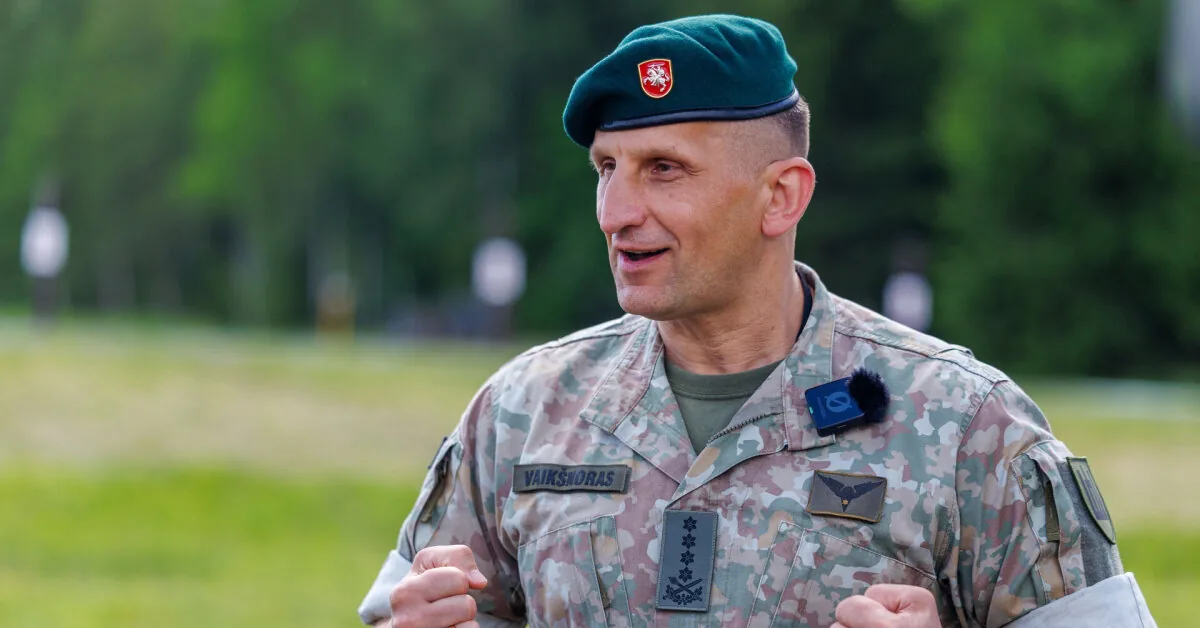
“A month ago I wrote about universal conscription. I see that it is worth returning to this topic.
Read more Against the backdrop of new road traffic rules – the cycling team’s shout: «We want one»
First of all, our goal is not only to have as large and as well-prepared an active reserve as possible, but also to maximally respond to citizens’ desire to serve, even with objective legal, infrastructure, or human resource limitations,” writes R.Vaikšnoras on his “Facebook” page and goes on to elaborate his thoughts, which we present to 15min readers.
Growth of the Lithuanian Armed Forces
The Lithuanian Armed Forces are growing. By 2030, 12 new military units will be established, which we will have to fill with soldiers. In professional military service alone, we have about 800 soldiers’ growth per year, but for the growing army, professional service soldiers alone are not enough. We must also increase the number of soldiers performing compulsory initial military service, train more citizens for the active reserve, and ensure that already trained soldiers do not lose their acquired skills.
These directions must grow together: professional military service, compulsory initial military service, and the active reserve.
These directions must grow together: professional military service, compulsory initial military service, and the active reserve. They are directly connected because the same instructors, infrastructure, and other military capabilities are needed to train soldiers. Therefore, we are increasing not only the number of soldiers but also the army’s ability to train them.
One of my priorities as the commander of the Lithuanian Armed Forces is a systematic move towards a universal conscription model. We must also acknowledge that universal defense is difficult to implement without universal conscription.
Additional forms of service
So, what has been done to prepare as many soldiers as possible for the active reserve in the Lithuanian Armed Forces? Alongside the 9-month compulsory initial military service, we have created and are expanding additional forms of service that allow more people to acquire military training, taking into account their profession, studies, work, or health limitations:
1. Service can be performed in the National Defence Volunteer Forces (KASP) on weekends over 3 years. I see this model as one of the most promising. By the way, it was already used in the Lithuanian Armed Forces in the past. This would reduce infrastructure needs, young people could study or work normally on weekdays and perform compulsory service on weekends. We are already implementing this model on a voluntary basis, but broader application requires removing certain legal restrictions.
2. We train specialists in professions needed by the army, such as signalers, mechanics, engineers, IT and electronics specialists, through 3-month programs.
3. We increase the number of places in the Junior Officer Leader training for students who are trained as reserve lieutenants.
4. For those who have expressed a desire to serve but did not pass the health check due to certain health limitations, we provide opportunities to serve. Essentially, people who want to serve voluntarily, even if they do not meet certain health requirements, can find their place in the Lithuanian Armed Forces.
Read more Forget expensive chemicals: a moss remover that many pour down the drain
Through these additional forms of service, we prepare about 1,000 soldiers annually for the active reserve. Removing the service restrictions in KASP could at least double this number.
A larger number of soldiers also requires greater training capacities. Therefore, we have strengthened the non-commissioned officer corps and trained twice as many junior leaders.
This year, we increased the number of soldiers in the 9-month compulsory initial military service by 200. We are assessing the capabilities of existing infrastructure to maximize the number of soldiers trained in current units.
Of course, our long-term goal is universal conscription, but we also have objective limitations – about 50% of conscripts are deemed unfit for service after health checks. Should the requirements be lowered? This is a debatable question for the future. Currently, we have created the aforementioned form of service so that people who do not meet health standards can still voluntarily join the Lithuanian Armed Forces.
About 50% of conscripts are deemed unfit for service after health checks. Should the requirements be lowered? This is a debatable question for the future.
Active reserve
Overall, universal conscription is not just a larger number of conscripts. Every person must be trained qualitatively, equipped, and have a place in a military unit. But training a soldier is not enough. We must ensure that the skills acquired are maintained, so soldiers’ service does not end with the 9-month compulsory initial military service.
According to the plan, to keep active reserve soldiers in the military training cycle for 15 years, we call them up for refresher military training. This way, a person who has once acquired military training does not lose contact with the army, their unit, and their skills.
This year, we plan to call up about 4,000 active reserve soldiers for refresher training, and from next year, we also plan to increase this number.
In summary, the Lithuanian Armed Forces are growing in all three directions – the number of professional military service soldiers is increasing, more soldiers are trained through 9-month and additional forms of service, and the scope of refresher training for the active reserve is also increasing. We will continue to expand service forms and increase their flexibility and the army’s training capacities to prepare more soldiers and systematically approach the universal conscription model.
Read more Lithuanian foursome reached the World Championship final