KnyguKurejai.lt – a project telling about children’s and youth books and their authors. The theme of 2019 is the anatomy of books. Writers and artists open the doors to the backstage of their works, sharing special stories never published before.
Read more Cat, unexpectedly rescued from the rubble in Venezuela, became a «ray of hope»
The anatomy of the text according to Goda Raibytė-Aleksa
Beginning
The idea of the book was born while walking down the street. I thought about writing it for a long time, mentally developing the concept. I knew I wanted to combine the scientists I met, space, and a grandfather into one, but I couldn’t figure out how. My thoughts drifted to various sci-fi scenarios, but I rationally understood that I wouldn’t be able to implement them myself, as I had never written science fiction, even though I love reading it.
And then one day, walking to the Mažvydas Library, practically crossing Independence Square, I had a eureka moment. While walking, I was writing a stream of thoughts on my phone, it was raining heavily, the buttons didn’t respond well, so I wrote everything down in a half-alien language. I started implementation about half a year later. I wanted to write everything down first so I would know what and why I was doing, and only then start. I’m not the kind of person who says – oh, I’ll figure it out while writing – I wanted to have the framework right away.
Preparation
Oh, a long story… I interviewed some people in person, others online. I had already been to NASA, so I talked online with the scientists I met there (e.g., Jonas Žmuidzinas, Charles Elachi).
I visited the European Space Agency in person, having arranged in advance with Paolo Ferri to interview him. I hadn’t met Jill Tarter in person, but I was an old fan and had long dreamed of writing to her, so I did… And she replied within a few hours (which really surprised me!). I met Pete Worden at the Asteroid Day celebration in Luxembourg; during dinner, I revealed the book idea to him and immediately arranged an interview.
Probably eating the most delicious strawberry dessert made it easier to persuade him to contribute to the book than just writing. I knew Steven Goldfarb from an earlier visit to CERN; he had already been to Lithuania, so during one visit, I presented the idea and immediately interviewed him.
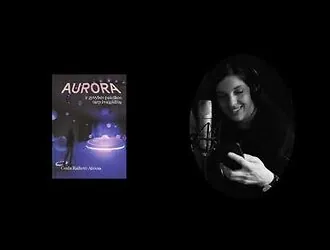
I met Eglė Čekanavičiūtė unexpectedly, was very impressed by her stories, but interviewed her by email. In short, little by little, the book’s characters were coming together.
And I read scientific news before, while writing, and still do. The hardest part was deciding how much to include in the book.
Characters
At first, the main character was supposed to be Vera, in honor of Vera Rubin. I came up with this while reading Rubin’s interview and biography. Rubin became fascinated with astronomy at exactly 12 years old. I decided it would be a great starting point. Her stories were told by her father, and mine by my grandfather.
But everything changed with the birth of my son. When he came into this world, historically bright auroras danced in the sky. I didn’t see them live because due to a difficult prolonged labor, I couldn’t get out of bed until dawn. But I watched what Lithuanian astrophotographers captured. It was just an incredible coincidence that the child chose to be born on such a night. That’s why Aurora became Aurora!
I wanted her to be a simple girl who doesn’t necessarily dream of becoming a scientist but gradually discovers the charm of science, understands that it is possible to touch it without being a scientist. Of course, a bit of me remained in her. It was hard to detach myself because I wrote imagining how I would behave in such situations.
I chose scientists based on human factors. After all, scientists are diverse. With some, you manage to establish a connection, with others – not. I wanted children to meet them, to know that such wonderful people exist. Maybe some child will Google them and learn more.
The parents’ characters are entirely my creation. I wanted to avoid stereotypes – that the father also cares and shows emotions. I didn’t need to create the grandfather – I only created that he was interested in space.
Environment
I had a rough narrative and story arc when I started writing, but everything changed significantly while writing and rewriting. I consciously wove in motifs of Lithuanian history because I felt it was an extraordinarily important part of my grandfather’s life. As I mentioned, I consciously avoided stereotypes. I didn’t use any clichés describing children or adults. I really wanted to include more scientific facts and details, but in many places, I had to write more abstractly – so it wouldn’t just be a long lecture about space. The essence of the book is popularizing science, so the educational function remained the most important to me.
Plot
Since I was creating this type of story for the first time, I had no confidence in myself, so planning was very important. I’m not the kind of person who says let it flow in life; I need a plan and clarity, and I write accordingly. Again – I didn’t manage to plan everything. Just like in life!
When Aurora was nominated in the Book of the Year awards, it was written “[…] this is an educational book disguised in the veil of a fictional story.” That veil part was the hardest, raised the most doubts, and was revised.
Speaking of the most beloved parts of the book, the realization of them came after writing the book. Relatives read it and kept writing that they were moved in the parts about the grandfather. I was most nervous when I gave the book to my grandmother – my grandfather’s wife. She knew him best of all! But we both cried while talking.
And one relative wrote: “When I got on the bus, I was reading your book, it was given to me by my sister-in-law after hearing that this book was inspired by my uncle. When I got home, I couldn’t put it down, devoured every word, searched for traces and thoughts of my beloved uncle, my mother’s favorite brother. A painful lump stuck in my throat; I swallowed the book in one evening. Lying down, I couldn’t stop thinking about my uncle and you. I was very happy that you brought him back to life; he truly deserves it. I remember all his stories too.” While writing, I thought about how I wanted to tell the world about my grandfather, but I certainly didn’t think it would be so important for family and relatives to remember him. That was the strongest experience.
Creative process
The first notes on the phone – early 2019. Then I laid out the idea, concept, wrote down the scientists I wanted to interview. I refined the topic because I didn’t want it to be just “something about space.” Then I gathered material, topics, conducted scientists’ interviews. It all took more than a year.
I seriously started writing when the pandemic and quarantines were underway. At that time, I didn’t have a family yet, so I got up at 5–6 a.m., made the best coffee, and wrote for several hours while the city was still quiet. Since I had gathered a lot of information, the hard part was weaving it all into a story.
In about half a year, I had the first draft, found editors to help polish the story and add their insights. This also took more than a year, but it was not only a creative but also a logistical task.
Then I started looking for an illustrator because I immediately knew that Kristina Alijošiūtė would do the design; I had no other option. At a birthday party, I saw a portrait drawn by Julija for the celebrant, then I went to her exhibition in Kaunas and realized I wanted to decorate the book with her works. And again, correspondence… and again, several months passed.
It seemed like everything was ready to publish, but I decided I wanted to include Ann Druyan – Carl Sagan’s wife, who co-wrote The Pale Blue Dot and is now creating the series “Cosmos.” She gladly agreed and strongly supported the book’s idea, but due to unpleasant circumstances with the then publisher, we decided to continue the friendship in the English version of the book.
Read more Ukrainian drones struck three oil bases in Russia at once
Those unpleasant circumstances caused the book’s publication to be delayed by at least a year. Moreover, at that time, I was pregnant and about to give birth soon, so other things mattered more.
When the child grew up, the book came to my mind more often. I had already started writing another book (“The Biochemistry of Time”), but I couldn’t let go of Aurora. I went to Raštinė Saulius and Ieva, saying – I have such a book, I really like you, let’s publish it together. They “signed” and about a year passed until I held the first copy in my hands.
Ups and downs, but I’m glad the book was published. And the pleasant and unpleasant experiences remain only a story that I now tell.
There was a lot of rewriting. I kept putting the draft in the drawer. I felt it wasn’t ready to reach others. This is my first attempt to include some fiction, so my confidence was zero. After all, my daily bread is a completely different style, a completely different kind of writing.
When I decided it was time to publish the book – I rewrote it again. The character’s name changed, her contact with Paolo Ferri changed (in the previous version, she had to go to the European Space Agency herself, but I already felt there would be too many adventures), a notebook appeared whose cover was “copied” from the sweatshirt my son was wearing at the time, and I updated the scientific information a bit because the planned missions had launched into space.
Then it again seemed that it was not the time yet, that maybe it needed rewriting… but I realized I would be stuck forever and the book would never come out because it could always be improved more! I think only the first two chapters remained from the initial version, from the first draft; everything else changed almost with the seasons. And I still don’t know which version was better, but the one printed is my favorite.
The anatomy of illustrations according to Julija Račiūnaitė
Style
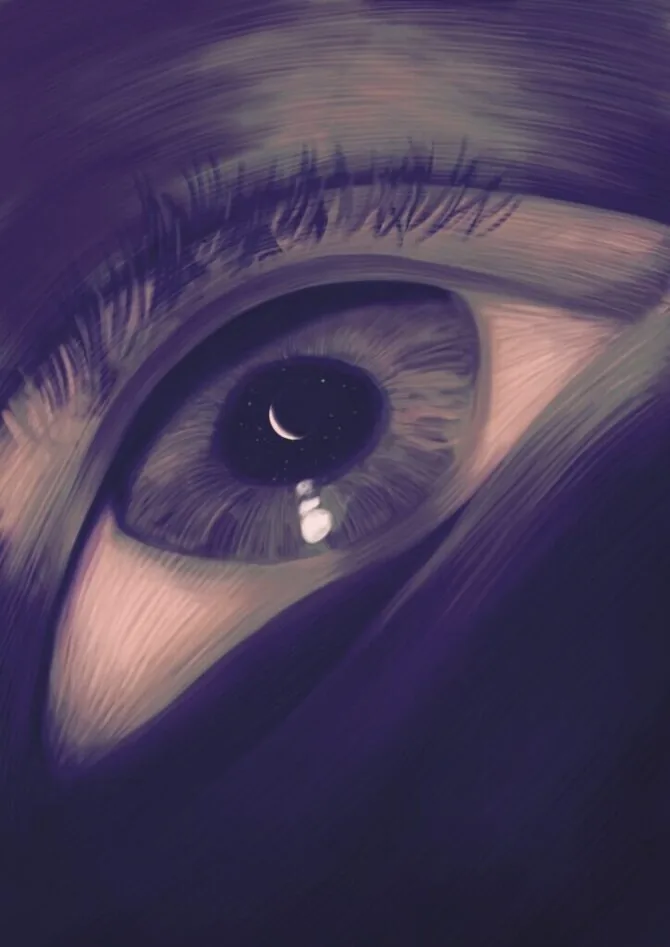
Probably the most characteristic stylistic feature of these illustrations is the color palette. I tried to choose an otherworldly one – both because of the space theme and because the book’s plot often unfolds in Aurora’s imagination, her reflections on newly perceived truths, expanded semantic horizons.
Characters
Since the scientists drawn are real people, it was important to me that they be recognizable, but at the same time, I aimed to depict them playfully, adding symbolic, associative details about their fields of activity.
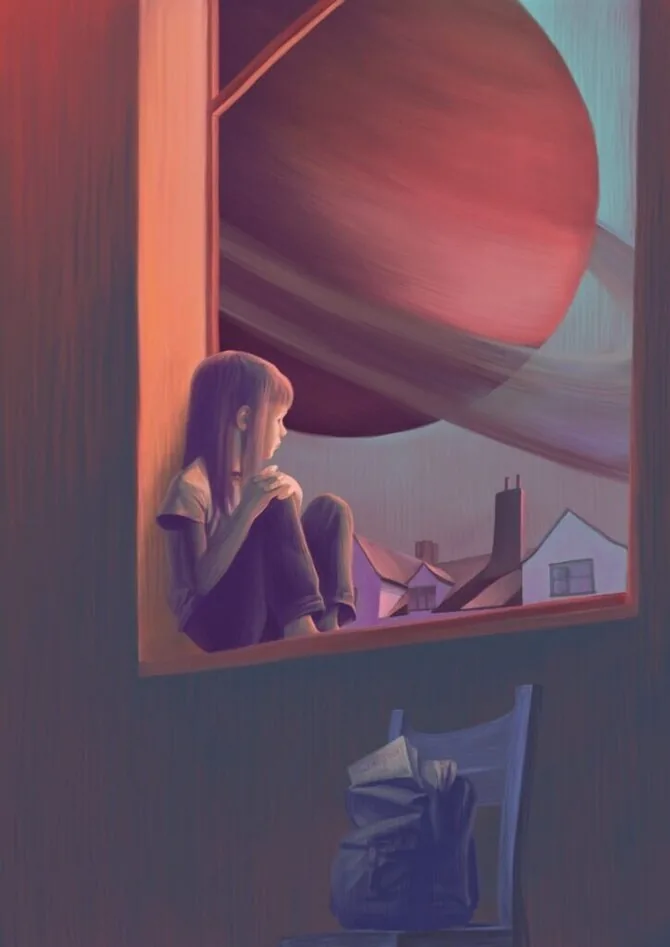
It’s harder to describe how the main heroine sneaked into the drawing – I had to sketch a bit until I found her. However, from the very beginning, I knew the girl would have bangs, which, for some reason, always remind me of sharp, curious children. Maybe because of the 1996 film “Matilda.”
Environment
After reading a chapter, I usually write down keywords (symbols) that seem important to depict. Then I arrange a kind of collage from them, looking at which elements interact nicely with each other. Sometimes, the first time reading, I already see the composition in front of my eyes – then I just have to transfer it to paper, or rather, to the tablet screen.
Plot
Goda gave me a lot of creative freedom, so I made most of the visual storytelling decisions myself – of course, consulting on certain key aesthetic and plot steps. Sometimes I prepare a storyboard, or the so-called book doll, to check if the rhythm, the “breathing” between emptier and more intense compositions, is felt when turning pages.
Creative process
The creative process started quite a while ago, three or four years ago, so most circumstances have faded from memory. Probably the most important thing was that life around illustration was very turbulent then, which I had to start from quite a fat zero.
At that time, I was moving back to my native Vilnius after a decade spent in Kaunas. I drew most illustrations in a cramped one-room apartment on Klaipėdos Street, watching the life of wealthy neighbors through the first-floor windows with one eye.
Currently, all my attention is wrapped around my three-month-old daughter Tilė Marijona. But occasionally, I manage to draw something, write, or chat with someone.
There were bumps and stalls due to my personal problems, but the team and I got along perfectly.
Authors’ biographies
Goda Raibytė-Aleksa
I was born on 1988-11-07 in Švėkšna.
I studied cultural history and anthropology, then also management. I finished some, dropped some, started others again, I am always learning or studying!
My first job was in a factory – I made charging sockets for electric cars. I got up at 3:30 a.m. and started work at 6 a.m. With the money I earned, I bought a dress for graduation and pants with many straps and skulls. They were very expensive and otherwise unaffordable for me. From the age of 16, I wrote articles, and I received my first fee (154 litas!) at 17. Since then, I have been writing more and more.
I have written another children’s book – “What’s happening in space” (Alma Littera, 2023)
Julija Račiūnaitė
I was born in 1989 in Vilnius. I graduated with a bachelor’s and master’s degree in applied graphics from the Kaunas Faculty of the Vilnius Academy of Arts.
Posing during graphic studies in Kaunas, around 2015.
I have worked as a museum worker at the National Čiurlionis Art Museum; in cultural journalism; taught at the Academy of Arts; participated in various artist collectives; organized exhibitions; worked in illustration, art, photography, and graphic design.
Illustrated children’s books:
- “The travels of Gąsinas Gagis” (Aidas Jurašius, Charity and Support Fund Let’s Light Up Children, 2021)
- “Kamandosė” (Eglė Jasė, Charity and Support Fund Let’s Light Up Children, 2024).
- “Aurora and the search for life among the stars” (Goda Raibytė-Aleksa, Raštinė, 2025)