Which country publishes the most daily newspapers? That is India.
Which country produces the most electricity per person in the world?
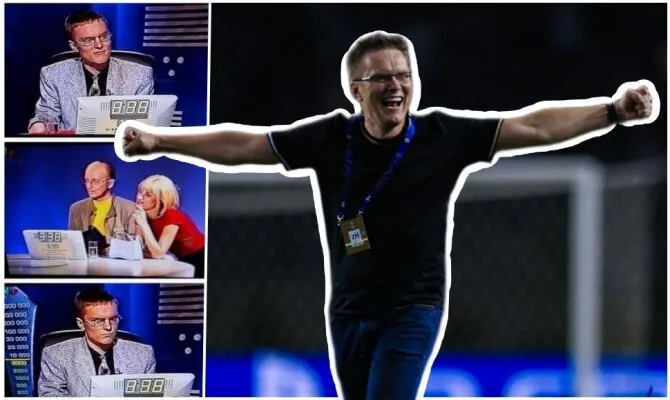
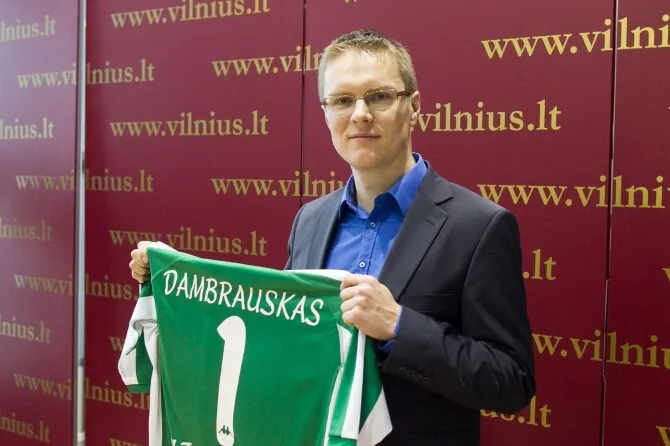
His family members shook their heads upon hearing the answer, but he was right again: in 2002, the answer was Lithuania.
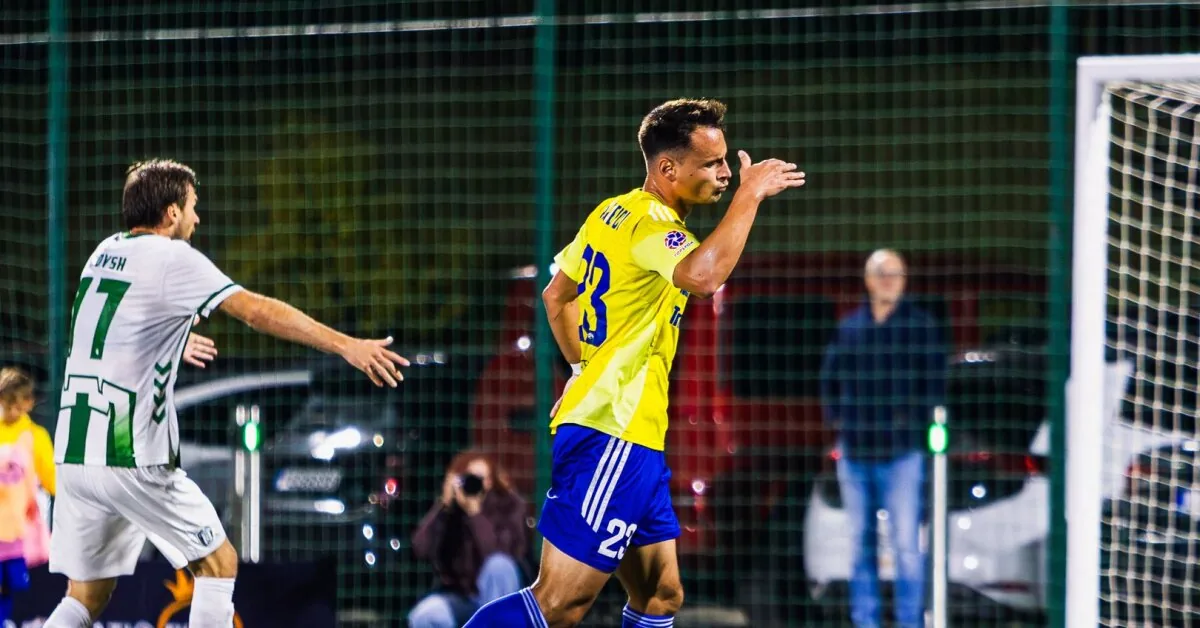
This is how V. Dambrauskas’s participation in Arūnas Valinskas’s old show „Šeši nuliai – milijonas“ was presented by „The Guardian“. One of England’s biggest publications devoted much attention to V. Dambrauskas’s journey in football ahead of the Lithuanian coach’s debut match in the Champions League on Thursday.
Lithuanian sports fans are quite familiar with the path of the 49-year-old from Pakruojis, which led him to the Champions League while coaching Baku’s „Sabah“ – an Azerbaijani club founded only nine years ago.
Before the „Sabah“ match in England against „Manchester United“ (the match starts at 10 PM Lithuanian time), we present V. Dambrauskas’s thoughts on important life stages, now shared with „The Guardian“.
Understand instantly
Major Champions League intrigues: Dambrauskas, rookies, favorites, and fabulous money
Premier League club noticed Dambrauskas: why did the Lithuanian leave England?
Valdas Dambrauskas – praises from the „Manchester United“ strategist
About the 4,000 litas won in the TV game: „At that time, it was quite a lot of money. I could have bought an apartment in my hometown (Pakruojis); at that time, there was a recession there, so apartments cost almost nothing. But my plan was to go to England and pursue the dream of becoming a coach, so that’s how it all started.”
About the trip to England with his then-girlfriend (now wife Ingrida Dambrauskienė): „I would have done it anyway – the TV show appeared halfway through our planning.”
About why he chose England (although before that, in 2000, he earned money in Norway): „In Scandinavia, I realized where real football is. There were no ways to coach in Lithuania if you hadn’t been a football player; it was impossible. But I understood that if I took courses in England, maybe I could get a chance later in my own country.”
About the eight years spent in London: „The beginning was very, very hard. I didn’t speak English well, had no contacts, knew no one, we lived in different places, worked various jobs (V. Dambrauskas worked in a pub, delivered newspapers, worked in a kindergarten, as a gardener, salesperson, freelance craftsman, often working more than one job at the same time).
Understand instantly
V. Dambrauskas completed studies in philosophy and social sciences in Lithuania;
In England, he started working as a football coach, initially coaching children on Saturday mornings during school holidays;
After several job interview stages, he got the opportunity to coach children at „Manchester United“ football schools.
About the first chance given: „It was John Shiels, the head of the „Manchester United“ foundation, who gave me the chance. I don’t know what he saw in me – I came with broken English and couldn’t express myself as I can now – but he really supported me.
At the end of the year, he wrote me an evaluation of what I had done. He said I worked well and could do even more. It was a huge, huge boost for me.”
About starting to coach a semi-professional team („London Tigers“): „That’s where it really started, I began coaching at a certain level.”
About juggling jobs (since he worked as a coach elsewhere: Fulham and Brentford): „It was a period without holidays, without days off. I am a big book lover, I read all the time and studied constantly. Sometimes I finished my study work on the bus. I took every opportunity to learn, attended every course I could.”
Over the years, I participated in many interviews for coaching roles, for jobs in football centers in London and beyond, filled out so many CVs and applications, but I quickly realized that it is very hard to climb the career ladder in England, and coaching at a professional level was almost impossible. I don’t know if there is a story where someone went all the way from a community scheme to become a head coach (in a professional club), I haven’t heard of such yet.”
About the decision to return to Lithuania (there he started coaching 17-year-olds and working as an assistant at Panevėžys „Ekranas“): „I had a job at „London Tigers“, 15 hours a week at Brentford, and here and there. We lived well, and people thought it would be madness to return home where I would earn about five times less than in England. But the biggest risk in life is not taking risks.
Forever grateful to my wife, who is always my support. We often had questions: a 20 or 30-year-old guy is still learning, trying to work in football, spending all the money on books and courses instead of buying a home or something else for the family. But I am very happy with how everything turned out, now no one questions those decisions.”
About his father: „My childhood was not a gift. My father died when I was 11. If he had known that later I would work at Vilnius „Žalgiris“ and that we would win so many trophies, he would have been the happiest man on the planet.”
About not stopping: „You are basically nobody, but suddenly you get that job (at Vilnius „Žalgiris“). Then you have to prove your worth to everyone again, again, and again. You climb to the next career step, but what next? How to move to the next level?”
About other teams coached (after „Žalgiris“ came Riga RFS, Croatia’s „Gorica“ and Split’s „Hajduk“): „They are like tattoos you can’t remove – they leave a mark.”
About other stages (Bulgaria’s „Ludogorec“, Greece’s „OFI Crete“, Cyprus’s „Omonia“, Hungary’s „Diosgyor“): „These are some of the countries with the greatest potential in Europe.”
About „Sabah“: (this Baku club founded in 2017 tempted V. Dambrauskas for a couple of years until he took the job in 2025 and with which he defeated the biggest Azerbaijani club „Qarabag“ in the fight for the national championship title): „I am grateful to „Qarabag“. Every match against them is like a scientific study.”
About his team’s international composition, with which they passed the Champions League qualifying rounds: „If you don’t understand the people around you, it is very hard to convey ideas to them and build trust.
What is important in East Africa may be completely different in West Africa or somewhere in Europe. You need to be able to understand different cultures, different traditions, different ways of behavior and communication. Without that, it is impossible, I believe this is where my strengths lie.”
About goals with „Sabah“: „We will respect every opponent, but fear nothing. There is a very beautiful song by the Lithuanian group „Colours of Bubbles“ called „Truth or Dare“.