









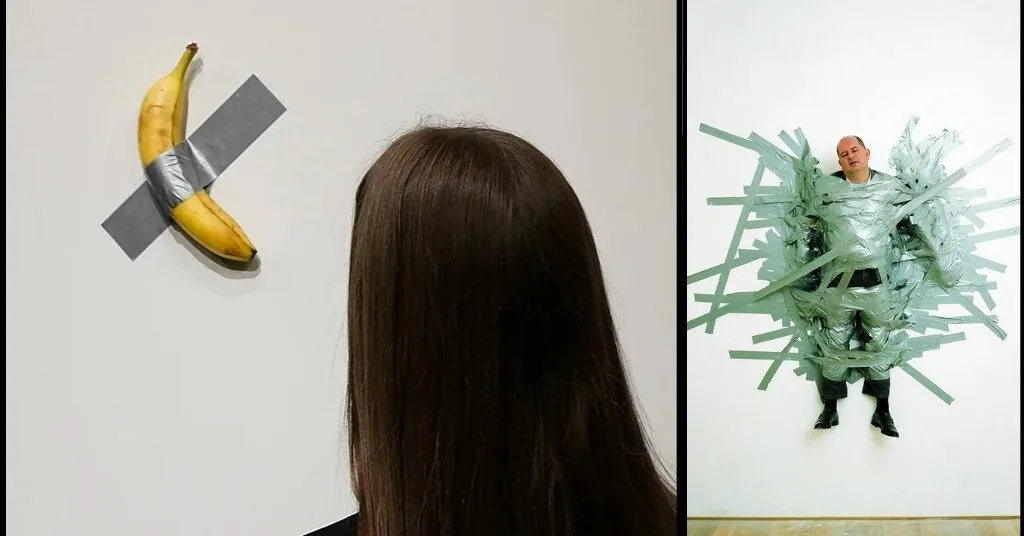
On December 4, 2019, when “Comedian” was first presented to the public, Leonardo DiCaprio, Michael Bay, and Travis Scott attended the VIP opening of Miami’s Art Basel.
That morning, the luxury art event featured impressive prices. A Helen Frankenthaler painting was sold for about 1.42 million euros, and a work by Willem de Kooning could be purchased by anyone with 6.9 million euros to spare.

However, for journalist Sarah Cascone from Artnet News, the most important object of the event was Maurizio Cattelan’s latest work – a banana taped to the wall with duct tape.
Later that same day, S. Cascone published the first detailed article about the work and reported that two copies of “Comedian” were sold for 103 thousand euros each. A few days later, the third and final copy was purchased for 129 thousand euros.
Each buyer received a certificate of authenticity and instructions on how to display the work, including the directive to regularly replace the banana.
Each buyer received a certificate of authenticity and instructions on how to display the work, including the directive to regularly replace the banana.
During Art Basel Miami Beach, hundreds of visitors photographed the work and shared their reactions online. Within just a few days, “Comedian” became a viral phenomenon – it sparked outrage, amazement, laughter, and soon a whole category of memes emerged, where people imitated the work by taping bananas to walls.
As BBC writes, in the media, blogs, and YouTube videos, people debated the aesthetic and intellectual value of the work. Paradoxically, those who hated “Comedian” the most wrote about it the most.
If M. Cattelan’s goal was to draw attention to himself, “Comedian” was an incredible success. Few contemporary art pieces have managed to cross the boundaries of the art world and become globally recognizable phenomena within just a few hours.
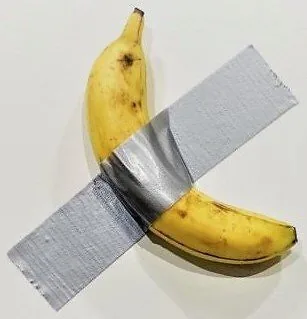
The fame of the work further increased its market value. In 2024, one of the three copies of “Comedian” was sold at auction for 5.38 million euros.
In 2024, one of the three copies of “Comedian” was sold at auction for 5.38 million euros.
This deal sparked discussions again – critics were outraged by the huge sums paid for M. Cattelan’s work.
However, as BBC states, the paradox of “Comedian” is that practically everything that shocked people in it had already been done before.
A closer look at the work reveals a centuries-old tradition of provocation and well-thought-out rules of the art world, which M. Cattelan masterfully manipulates.
A 400-year-old tradition of satire
One of M. Cattelan’s main strategies is provocation. The artist long understood that in a competitive creative industry, talent or intellect alone is not always enough for success. However, controversies and scandals attract attention, and more attention means a larger audience and more potential commissions.
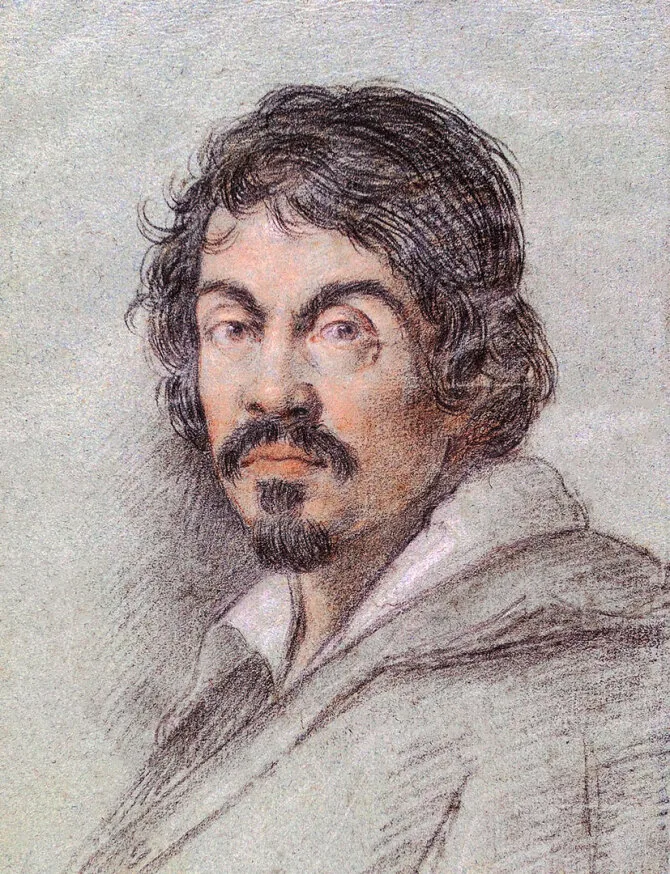
Art history confirms this. Over 400 years ago, Caravaggio divided opinions among his contemporaries by showing an unprecedented level of violence, sexual tension, and darkness in religious paintings. This helped him gain international fame.
19th-century artists, now considered some of the most important – J.M.W. Turner, John Constable, Édouard Manet, Claude Monet, Paul Gauguin, James McNeill Whistler, and Paul Cézanne – also created in new ways that were mocked by critics.
According to BBC, at the beginning of the 20th century, artistic innovation and public outrage were increasingly seen as two sides of the same coin. Some modernists, as well as musicians, writers, and film directors, considered public disapproval a necessary companion to authentic experimentation.
Others mistakenly regarded unpopularity with critics as a sign of genius, not realizing it could also signal a lack of talent. But in both cases, one thing was understood – dissatisfaction has great power to promote the creator.
M. Cattelan learned this lesson very well. He constantly plays the role of the art world’s provocateur, deliberately annoying and provoking the audience.
“Comedian” aimed to mock the values of art world events like Art Basel Miami Beach – much like a comedian on stage delivering a biting, industry-specific remark, BBC says.
Read more Peskov admitted: Russia strikes «everything in a row» in Ukraine
However, M. Cattelan’s provocations differ from those of earlier artists. They are less related to the artistic process or theory.
Some of his most famous works include the 1999 “La Nona Ora,” in which Pope John Paul II is struck by a meteorite, and the 2001 “Him,” depicting a praying boy with Adolf Hitler’s face. Both works are based on globally recognizable objects and figures, making them understandable even to people who usually do not visit art exhibitions.
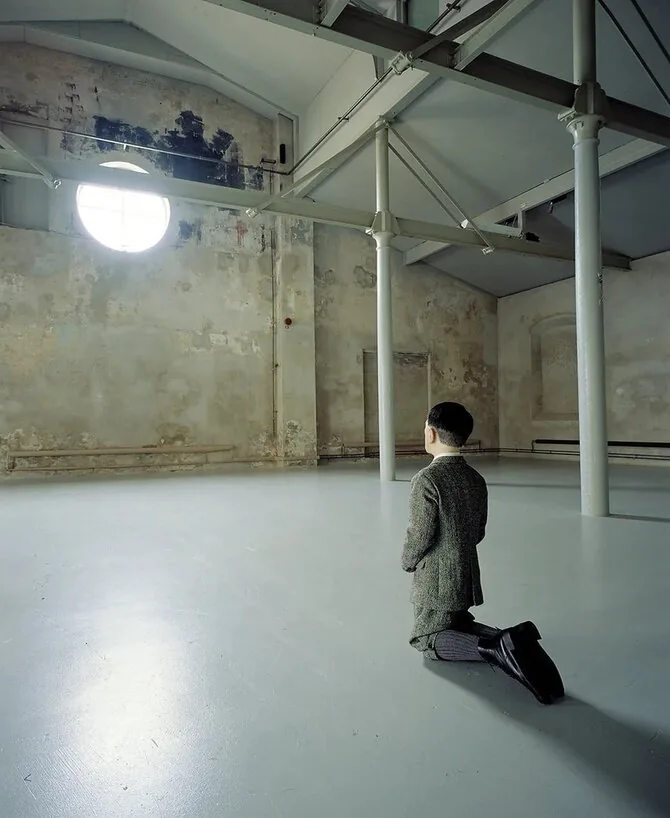
M. Cattelan also uses humor and irony, targeting the powerful.
In this respect, he continues a long-standing tradition of satire in art history, developed by artists like James Gillray and Honoré Daumier. They chose institutions recognizable to everyone and thus questioned and mocked their power.
In the 1999 work “A Perfect Day,” M. Cattelan targeted the art market itself. Instead of hanging an artwork on the wall, the artist taped his Milan art gallery representative Massimo De Carlo to the wall with duct tape. The seller himself became the spectacle.
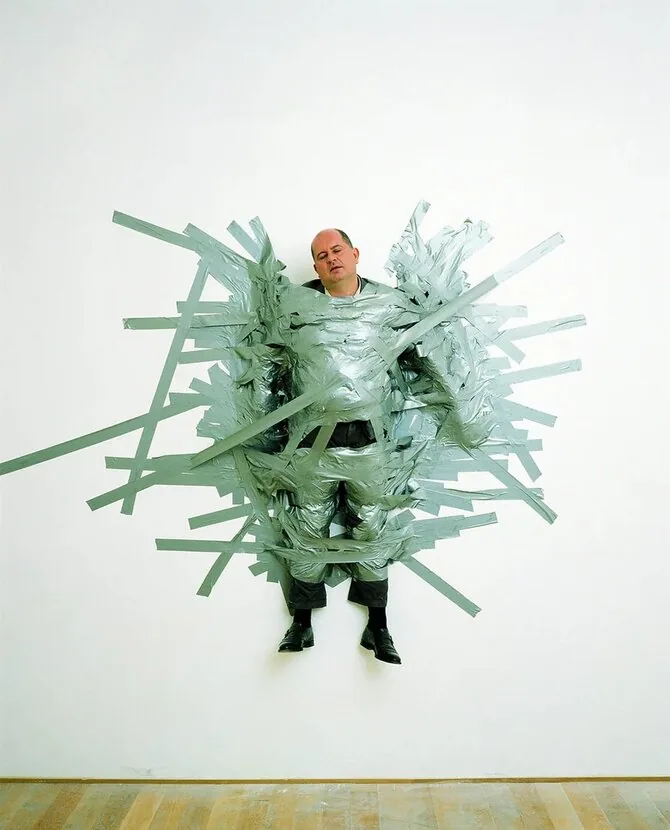
Almost exactly 20 years later, in “Comedian,” M. Cattelan used the same silver duct tape. As BBC writes, this choice was a clear signal to those who followed the artist’s career: like “A Perfect Day,” “Comedian” aimed to mock the values of art world events like Art Basel Miami Beach.
The “old shock” effect
But why a banana?
“Besides its ambiguous shape, the banana has long been used in comedy, especially physical humor; many artists depicted bananas in their work even before M. Cattelan, including Giorgio de Chirico, Andy Warhol, and the artist group Guerrilla Girls.
The banana is simply an incredibly well-known object. And the idea of turning a food product into a work of art is also not new.
It has a long history – from the still life genre existing since the 16th century. Traditionally, such works were meant to make viewers reflect on the short life of nature and how art can extend it after death.
One of the earliest still lifes after the classical era is Jacopo de’ Barbari’s “Still-Life with Partridge and Gauntlets,” painted in 1501.
According to BBC, although more than 500 years separate this work from M. Cattelan’s, both artists essentially performed the same act – presenting an object on the wall for the viewer’s contemplation.
M. Cattelan’s tactic here is the “old shock” effect.
The only difference is that “Comedian” displays a real banana, which can and usually starts to rot in about seven days, rather than its artistic representation.
But even here, M. Cattelan was not the first.
The idea of using so-called “ready-made” – a real-world object not created by the artist but presented as art – was more than 100 years old when “Comedian” appeared.
The most famous pioneer of this method was Marcel Duchamp. In the second decade of the 20th century, he exhibited everyday objects as art – bottle racks, a bicycle wheel, and a urinal.
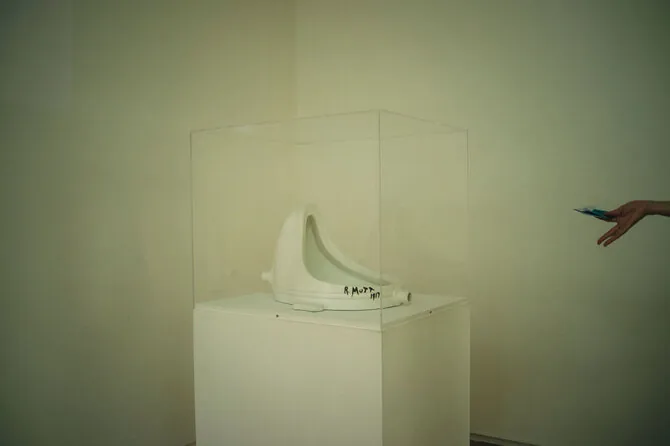
However, even Duchamp’s attempt to question the very principles of art as a category was not entirely new. According to BBC, this discussion dates back to ancient Greek philosophy, and one of the most famous thinkers who wrote about it was Plato.
Therefore, the choice of “ready-made” in M. Cattelan’s work seems more like a conscious and quite playful gesture, fitting perfectly into the tradition of art history.
“Comedian” was calculated from the start to cause a stir. At 61 years old, M. Cattelan was already an experienced provocateur, able to create global interest from a banana, a wall, and duct tape.
But beneath the surface lies much more: controversy, satire, a easily recognizable object, the tradition of still life, and the “ready-made” principle.
And although some people may be outraged by the price of “Comedian,” in 2019 it was not the most expensive work sold at Miami Art Basel, nor is it the most expensive “ready-made” work sold at auction.
As BBC states, the radical truth of “Comedian” is that there is actually nothing radical about this work.


