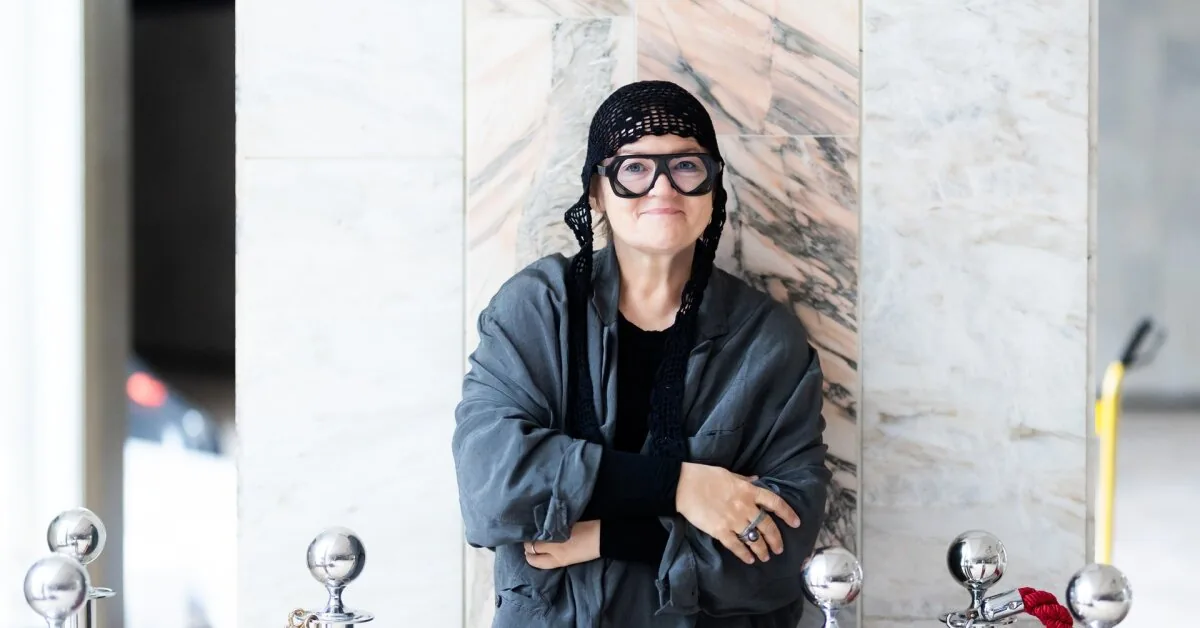
The artist was congratulated on her anniversary by Prime Minister Mindaugas Sinkevičius, President Gitanas Nausėda, and Minister of Culture Lukas Alsys, who highlighted E. Ridikaitė’s unique creative language and her contribution to Lithuanian culture in their greetings.
Read more ESO representative: 62 thousand consumers in Lithuania are still without electricity
“You transform seemingly insignificant things – floor patterns, carpets, scarves, furniture, fragments of homes – into signs of memory and culture. Your works beautifully combine everyday life and fantasy, self-irony, and a language close to advertising and multiplication,” M. Sinkevičius said, congratulating the artist.

M. Sinkevičius also drew attention to E. Ridikaitė’s use of aerosol paint technique, hand-made stencils, and the monumental scale of her works. According to him, this makes the paintings seem like a part of architecture or an installation.
Minister of Culture L. Alsys highlighted E. Ridikaitė’s ability to discern deeper layers of personal and collective memory in the details of everyday life.
“Your work testifies to an exceptional ability to perceive deep layers of personal and collective memory in simple everyday details. Employing a unique execution technique and bold spatial solutions, you masterfully transform the ordinary environment, giving it a new conceptual charge,” the minister stated in his greeting.
He also emphasized the self-irony revealed in E. Ridikaitė’s works, her attention to material identity and the signs of time.
“Thank you for your artistic courage, authentic visual language, and intellectual contribution to our culture,” said L. Alsys.
Read more Confirmed – second largest sports club sale in history to take place
The head of state, G. Nausėda, thanked the painter for her exceptional contribution to Lithuanian art and culture, her creative consistency, her sensitive relationship with our heritage, and her ability to find universal meanings in fragments of everyday life and share them with the viewer.
“Your creative path is an exceptional phenomenon in contemporary Lithuanian art, testifying to artistic courage, consistency, and the ability to look at the world around us in a unique way. In your work, you have developed a distinctive and recognizable artistic language, where everyday details, architectural fragments, and signs left by time acquire new meanings, and spaces that at first glance seem ordinary or even empty become sensitive testimonies of human and societal memory,” reads G. Nausėda’s greeting.
According to the President, in E. Ridikaitė’s painting, what often goes unnoticed gains special significance: floor ornaments, wall fragments, architectural details, or fading traces of the past. All of this allows our cultural history to speak anew.
“Your works invite us not only to look but also to notice the layers of time and feel the fragile connection between what was, what remains, and what we choose to remember today. Your artistic gaze at the legacy of the Great Synagogue of Vilnius opens up painful, yet important historical layers for our society and reminds us of the Jewish community that built the Lithuanian capital for centuries. The ability to bring back into the present, through the language of art, what was destroyed or hidden by time, becomes not only a creative act but also a meaningful cultivation of our shared memory,” the President’s greeting states.
The President wished that the jubilarian would continue to be accompanied by unfading inspiration in the future, and that new works would uniquely reveal the signs of human existence, the memory of the city, and the experiences of different generations – all that art is capable of preserving longer than the physical environment itself.
Read more A Klaipėda resident trusted Russian-speaking WhatsApp interlocutors – lost 20 thousand euros