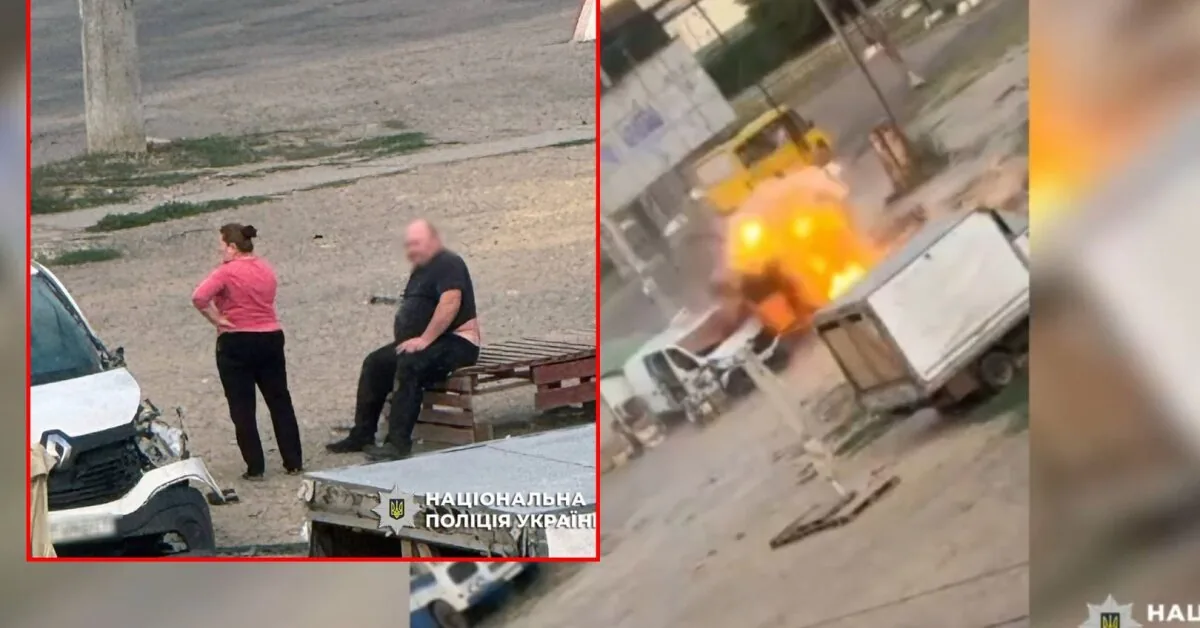
Jurij is 52 years old, he trades at a market stall in Kherson, near the front line. Recently, he was sorting vegetables when he heard a sound characteristic of a Russian drone buzzing. Later, Jurij told journalist Zarina Zabriska that he only had a few heads of garlic in his hands – no weapon: “I didn’t even have a phone.”
Read more “Luminor” profit fell by a fifth in the second quarter to 37.4 million euros
He began pointing at the tomatoes and peppers so that the drone operator – whoever and wherever they were – would understand: there was a peaceful person in front of him, not a soldier.
But the drone continued to pursue him. Police camera footage shows the drone flying around Jurij’s truck, preventing him from moving away. Jurij hides under an umbrella covering the stall, runs from one side to the other, points at the vegetables. Then the drone suddenly descends next to him and explodes. By some miracle, Jurij survived – he only suffered scratches and a concussion. Zarina Zabriska met him in the hospital: he was conscious, thinking clearly and, what is especially surprising, maintained his composure.
Composure
Perhaps the word “composure” is key here, says journalist Anne Applebaum. It is hard for a person to fully grasp what it is like when you are pursued by a deadly kamikaze drone, a flying machine that behaves as if it were alive.
In the pre-industrial era, religious fanatics saw flying devils in their visions. But modern peaceful residents almost never had to save themselves from a mechanical flying machine hunting them.
Read more “Nonsense” and “dogfights” – waves of emotions of Lithuanian swimmers after mutual races
Except those living in Kherson and its surroundings.
Since 2024, Russian drones have been conducting a real “human safari” in Kherson and other southern and eastern Ukrainian regions, tracking peaceful residents to kill them.

“When I wrote about the events in Kherson in 2023, no one approached the Dnipro – the Russian army was on the other bank. Now rapid technological development has made practically the entire city and its surroundings reachable by strikes from Putin’s army,” notes the commentator.
Peaceful residents became targets
Last year, the United Nations commission documented hundreds of drone attacks against people in eastern Ukraine. The targets were peaceful residents walking on sidewalks, working in gardens, riding ambulances, or simply going to work.
Sometimes drones hovered over burning buildings waiting for firefighters to arrive so they could attack them. Such actions can only be explained by the desire to intimidate people – or perhaps by a thirst for revenge, says the text in “The Atlantic.”