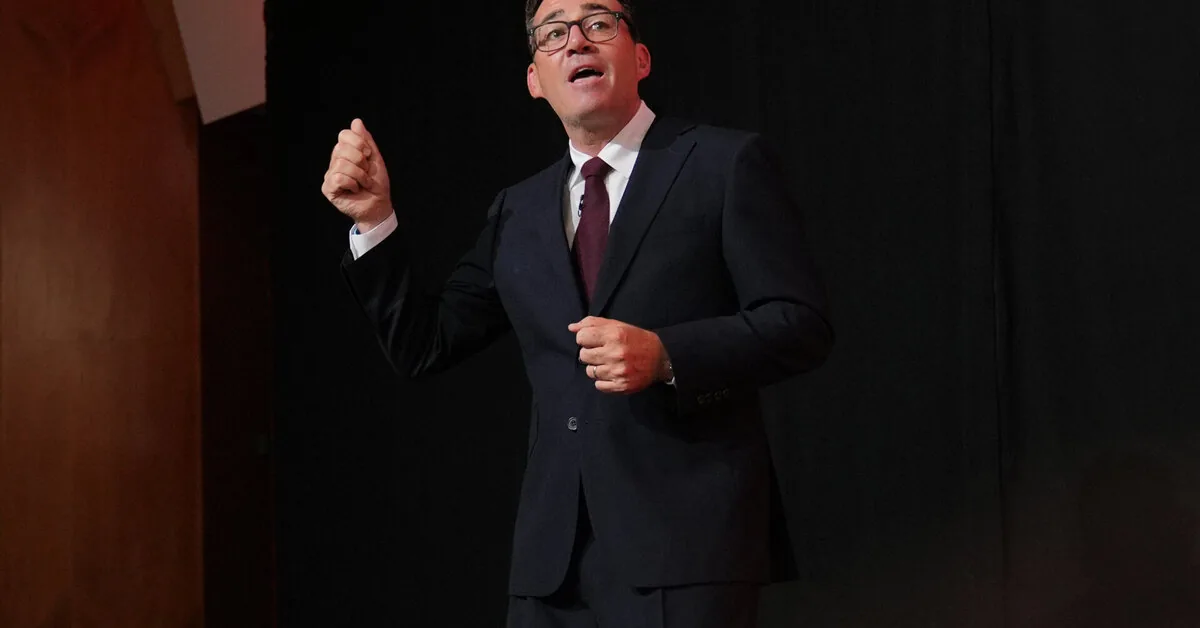
The new leader will have to solve many problems that defeated his predecessors, and he has little time to prove his abilities.
Read more The golden boot of the World Cup – in Kylian Mbappe’s hands
A. Burnham takes over from the unpopular Keir Starmer. This happened just two years after the latter led the Labour Party to a landslide victory in the elections following 14 years of Conservative Party rule.
At the request of King Charles III, 56-year-old A. Burnham is expected to deliver his first speech at 10 Downing Street on Monday shortly after K. Starmer bids farewell to his duties.
According to his team, he will outline “priorities aimed at restoring trust in the government and giving the UK more room to breathe” in the face of the cost of living crisis. Economic growth and devolution of powers to the regions are also expected to be pursued.
On Monday, announcements about appointments to the highest cabinet posts are also expected, with all eyes on who will replace Rachel Reeves as Chancellor of the Exchequer.
The former Mayor of Greater Manchester, nicknamed the “King of the North,” was elevated to this position by the Labour Party when K. Starmer resigned last month. MPs consider him the party’s best chance to control Nigel Farage’s anti-immigration party, Reform UK.
“Bigger and bolder measures”
Labour Party deputy leader Lucy Powell said on Sunday that A. Burnham’s experience working as a mayor outside the London power center means he understands what “bigger and bolder measures” are needed to fulfill the party’s election promises.
Among A. Burnham’s most urgent challenges will be a sluggish economy, high government borrowing costs, rising social expenses, and illegal migrants arriving in small boats, which is increasing support for Reform UK.
His premiership may also be shaken by unpredictable energy prices due to the war in the Middle East and the volatile American president Donald Trump.
L. Powell told BBC television that the new prime minister wants to “fundamentally” rewrite the “overly centralized” political system and economic model, where personal interests were placed above the welfare of ordinary people.
“It’s about giving security to ordinary people at work, at home, the ability to afford housing and live in a community they can be proud of, knowing their children will have future opportunities,” she said.
K. Starmer announced at the end of June that he was resigning from the positions of prime minister and Labour Party leader, his leadership overshadowed by scandals, mistakes, and political shifts.
Read more Three individual awards in the Spanish football team
However, A. Burnham, who returned to parliament only four weeks ago, has little room to maneuver due to slow economic growth, high national debt, and strict financial rules requiring government spending to be balanced with tax revenues.
Monday’s transfer of power will begin with K. Starmer’s visit to Buckingham Palace, where he will officially submit his resignation to the king, followed by a brief statement at 10 Downing Street.
Then A. Burnham will go to Buckingham Palace and afterwards deliver his first speech as prime minister. He says it will be a moment of “reflection and determination,” emphasizing that the UK must honestly assess the challenges it faces.
“Last chance”
A. Burnham was a member of parliament from 2001 to 2017 and served as a minister in the governments of Tony Blair and Gordon Brown.
He now positions himself as a “man of the people,” combining a relaxed, simple style with professional videos on social media.
But he has only three years to change the situation, as polls show that Reform UK could win the next general election scheduled for 2029.
On Friday, A. Burnham told supporters that his coming to power is the “last chance” for the Labour Party to get everything right.
Critics accused K. Starmer’s government of being unprepared to govern when he was elected in July 2024.
A. Burnham claims to have a plan.
However, his rapid “crowning” as party leader raised questions about how he will achieve his goals.
His first political statement came on Saturday when he canceled K. Starmer’s initiated national digital identity system, which would have cost £1.8 billion (about €2.12 billion) to implement over three years.
A spokesperson said that time and resources will be redirected “to where they are most needed, such as helping to address the cost of living problem.”
Read more The weather will cool down in the new week, rain will fall more often