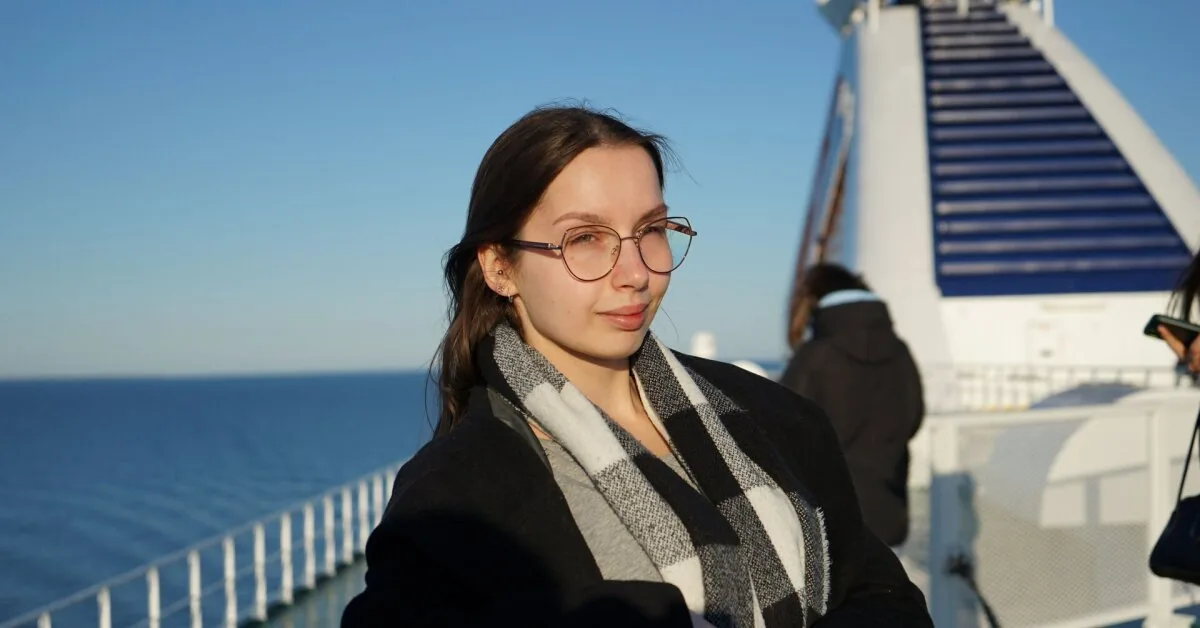
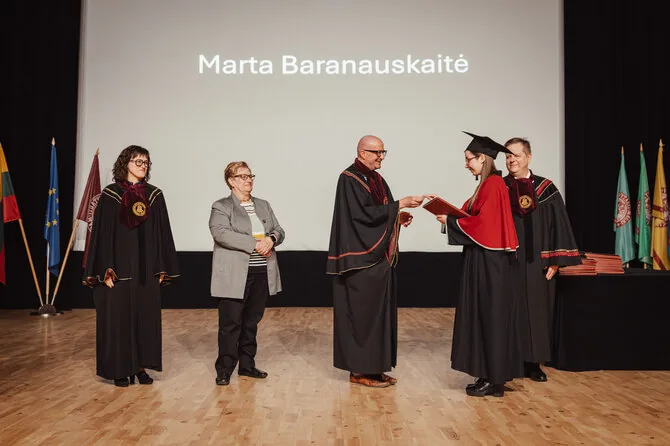
This award is given annually to young teachers who create a modern Lithuanian school through their work, according to a press release.
Read more Crimea defense – impossible: how Ukraine mixed up all of Russia’s cards step by step
The teacher herself says that the prize became not only a professional recognition but also a reminder of the responsibility to continue meaningful work. “At that moment, I was completely unprepared – I didn’t even have a thank you speech. At the ministry, I met many young teachers who have already accomplished a lot, so just the opportunity to be among them seemed like a great recognition. Only later did I begin to realize that this prize is a commitment. You feel responsibility and understand that what you do every day in the classroom has meaning not only for your students or school but also in a broader educational context,” says M. Baranauskaitė.
According to her, such recognition is especially important for young teachers because it confirms that their efforts are noticed: “Like all teachers, we have days when we get tired or doubt our work. Therefore, such recognition becomes a strong encouragement to move forward and not limit ourselves to just our class or school.”
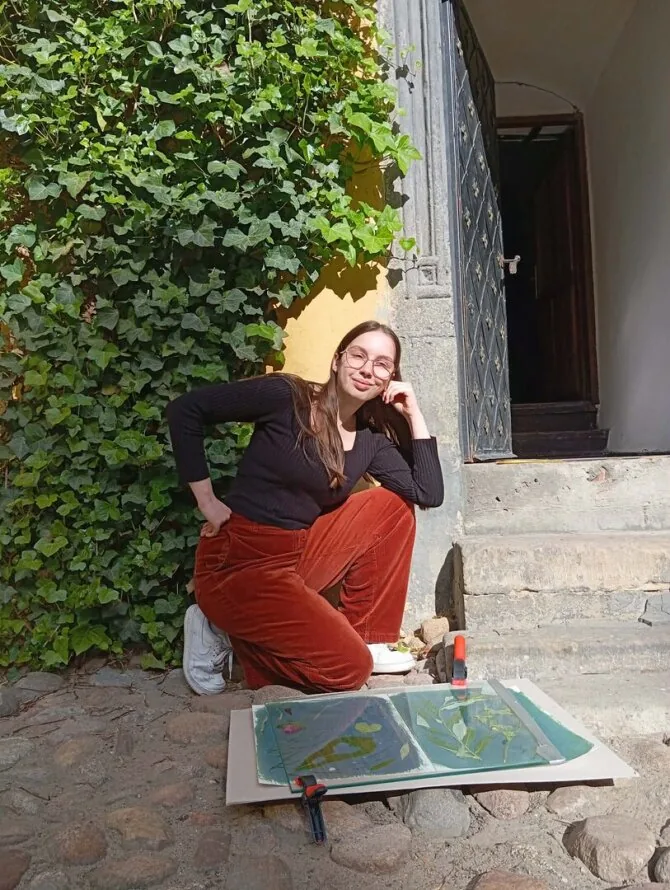
She became a teacher because of her teachers
Although many around M. Baranauskaitė expected her to choose medical studies, the final decision was influenced by something completely different – inspiring teachers. She still remembers the turning point.
“In the eleventh grade chemistry class, I caught myself thinking that I wanted to be like my teacher. I wanted to have as much knowledge, to be able to share it interestingly and engage students. At that moment, I realized that I wanted to be a teacher,” she recalls.
Today, Marta openly admits to being a teacher shaped by her own teachers: “I am absolutely a product of my teachers. I took a piece of myself from each of them. Sometimes I catch myself saying phrases or applying methods used by my math or Lithuanian language teachers.”
The greatest lesson they passed on, according to the teacher, was the attitude towards the child. She was shown that every child wants to learn and that every child has goodness inside. Sometimes they just need the right conditions, time, and a person who believes in them.
Had to develop professional backbone quite early
M. Baranauskaitė started her career as a math teacher while still studying at VDU Education Academy. She was brought back to the school by a former math teacher who offered her to substitute for a sick colleague and take over one math module lesson for tenth graders per week.
It seemed it would be just one weekly lesson for one semester, but the next year she got her own class and started working full-time.
The biggest challenge, according to her, was not teaching the subject.
“Since I had recently graduated from the same gymnasium, some older students still remembered me as a student. Naturally, I had to prove that I was the teacher in the classroom. Children quickly test boundaries – what is allowed, what is not, so I had to develop a professional backbone quite early,” emphasizes the interviewee.
However, she says, the support of colleagues helped her establish herself much more easily in the profession: “I have heard various stories where young teachers returning to their school are long regarded only as former students. I was very lucky – colleagues accepted me as an equal member of the community, shared methodological materials, advice, and support.”
In school, the person is more important than the grade
The teacher is convinced that today’s school should not be limited to just imparting academic knowledge. Studies at VDU Education Academy, she says, helped her understand the broader meaning of education. “From the first years of study, it was talked about not only teaching the subject but also about 21st-century competencies – collaboration, communication, problem-solving. I realized that we teach not so that the student repeats learned information in a test but so that they can apply it in life,” says Marta.
Today she develops these ideas while working at the VDU STEAM Didactics Center, where she leads activities for students, organizes seminars for teachers, and contributes to STEAM education research.
“I still have to discuss with teachers who see STEAM as an additional burden. But in reality, it is not another job – it is a different approach to teaching that helps students better understand why they are learning,” the interviewee is convinced.
Students choose a profession by seeing a happy teacher
Speaking about how to attract more young people to schools, M. Baranauskaitė first mentions not salary or working conditions but the teacher’s well-being.
“It is very important that students see a happy teacher. They constantly hear talks about problems in education, about workloads, curricula, exams. If a teacher constantly shows disappointment with their work, it is hard to expect that students themselves will want to choose this profession,” the math teacher is convinced.
She says she already has two twelfth graders who are considering studying pedagogy: “One of the most important reasons they choose this path is that they see teachers who find meaning in their work.”
The most important thing is to find your ‘why’
Asked what helped her achieve high results at school and university, the teacher does not look for a magical recipe: “It is very important to find your ‘why.’ Studying just for a grade won’t last long. When you understand why you need it, motivation appears.”
Marta admits that in school she spent a lot of time on popular science books, video lectures, and exploring how the world works.
“I was simply curious. I saw the meaning in learning, so it never felt like just an obligation,” the interviewee says.
Wishes not to give in to stereotypes
To young people considering pedagogy studies, M. Baranauskaitė first wishes to believe in their choice.
“I still hear that those who didn’t get into other fields go into pedagogy, or that you will be ‘just a teacher.’ I would like to wish not to listen to such stereotypes. If you feel that you want to work with young people and create change, it is worth believing in it. A teacher can become a person who fundamentally changes a student’s life,” Marta advises.
According to the Meilė Lukšienė Prize laureate, it is precisely the belief in the meaning of one’s work that allows one to stay in the profession even in the most difficult moments: “When you see students’ curiosity, their growth, and feedback, you understand that you made the right choice.”
Read more An extraordinary day in the life of Egidijus Dragūnas and his wife Žaneta