






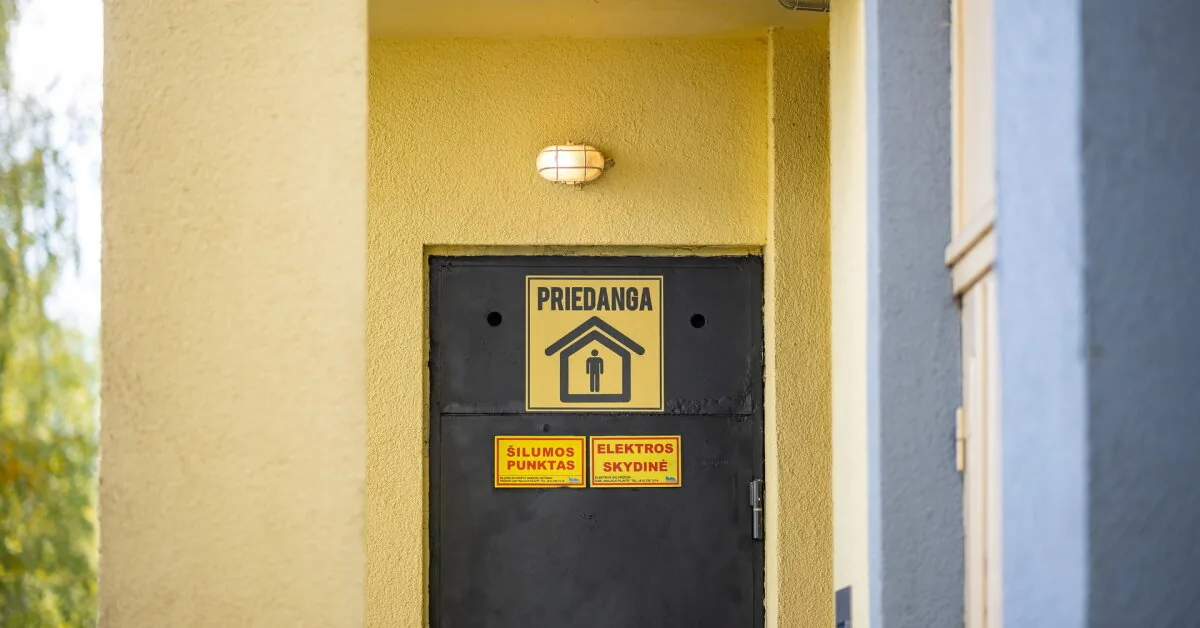
Some of the shelters designated for residents are located in the basements of apartment buildings, underground parking lots, and other common areas. Under normal conditions, such premises must be secured against unauthorized persons, so their doors are reasonably kept locked. However, upon receiving a danger warning, the same security measure can become an obstacle, according to a press release from the Lithuanian Housing Chamber.
The situation is even more complicated if the warning reaches residents at night. People wake up from sleep, must quickly assess the situation, take care of children or elderly family members, and reach a safe place as soon as possible. Under such circumstances, it cannot be expected that someone will timely find a responsible person, arrive with a key, or remember the specific door code.
According to Algis Čaplikas, president of the Lithuanian Housing Chamber, this practical issue must be resolved in the civil protection system before a real threat arises.
“We can have a very good shelter map, signs on buildings, and instructions for residents, but ultimately everything comes down to a very simple thing – the door. If during danger a person runs to it and it is locked, the entire system created up to that point stops at that point. And if the signal is received in the middle of the night, the situation is even more complicated. There cannot be such a last locked meter in civil protection,” says A. Čaplikas.
Doors could unlock together with the warning
The Housing Chamber proposes to evaluate technical solutions at the state level that would allow centralized or remote unlocking of access to shelter premises during emergencies or other dangers.
The principle would be simple: in everyday life, the building remains secure, and basements, underground parking lots, or other premises remain locked. However, upon receiving a designated civil protection signal, it would be possible to immediately open the necessary access routes for people.
According to A. Čaplikas, it should not be limited to one specific technological solution – the state should first define the outcome that must be ensured.
“We are not saying that every building must have the same lock or the same technology. However, there must be a clear principle: if a room is designated as a shelter, during danger a person must be able to access it immediately. How this is technically implemented in a specific building can be decided based on its structure and systems used,” says the Housing Chamber president.
Clear legal regulation is needed
Another problem the Housing Chamber proposes to solve at the state level is to clearly define how such technical measures should be legally evaluated and who has the right to decide on their installation.
If the installation of automatic or remote door unlocking is considered an improvement of the common property of an apartment building, in practice it may be necessary to organize a vote among apartment and other property owners.
Apartment administrators and associations know well that such procedures can take time: owners must be informed, a meeting or written vote organized, the required majority collected, and if not reached, procedures repeated.
According to A. Čaplikas, shelter accessibility should primarily be considered a civil protection issue, not a matter of building comfort or additional improvement.
“People can vote on what kind of stairwell finish they want or whether additional benches are needed in the yard. But when we talk about a measure that during an emergency can be directly related to people’s safety, a reasonable question arises whether its implementation should depend on voting at all. If the state says this is a shelter, the state must also set clear conditions on how it should operate,” says A. Čaplikas.
The Housing Chamber proposes to clearly establish that technical measures necessary for real and immediate access to the shelter be considered part of civil protection and mandatory safety requirements implementation.
Funding issues must also be resolved
Once the obligation to ensure access to shelters is established, it must also be clear who and with what funds implements such solutions.
According to the Housing Chamber, the state and municipalities should first assess the possibilities to contribute to the implementation of such systems, especially in buildings where the shelters are intended not only for the residents of a specific building but also for the wider community of surrounding areas.
“If an underground parking lot or basement of an apartment building becomes a place in the civil protection system where, during danger, not only the residents of that building but also those of surrounding buildings are directed, we must very clearly answer whose responsibility it is and who finances the preparation of such a place. We cannot automatically transfer all financial responsibility to the residents of one building,” emphasizes A. Čaplikas.
According to the Housing Chamber, one possible funding model would be to allow such measures to use the accumulated funds of apartment buildings. If these are insufficient and the measures are recognized as part of mandatory safety requirements, a clear mandatory work financing procedure should be established.
Such a model, according to the organization, would provide clarity to administrators and associations and prevent decisions important for residents’ safety from stalling due to unclear funding or decision-making procedures.
The civil protection standard cannot depend on the municipality
The Housing Chamber has addressed responsible institutions seeking not isolated solutions in individual buildings but a common model for all of Lithuania.
According to the organization, state institutions should prepare clear methodological recommendations for municipalities, apartment building administrators, and associations: how access to shelters should be ensured, what technical measures can be used, when owner decisions are required for their installation, who is responsible for system operation, and how such measures are financed.
“The civil protection standard cannot depend on the postal code. It cannot be that in one municipality an administrator can install a necessary safety measure, while in another, for the same decision, voting and legal discussions last for months. The nature of the danger does not change at the municipal boundary, so the main rules must be the same,” says A. Čaplikas.
Not only the shelter but the entire path to it must be checked
The Housing Chamber proposes to look at shelter preparedness practically – as if modeling a real emergency situation.
A resident receives a warning on the phone or hears sirens. Perhaps this happens in the middle of the night. They must get up, take care of family members, leave the apartment, go down to the first floor, basement, or underground parking lot, and move toward the designated shelter. There must be no place along this path where movement would stop due to technical or organizational reasons.
Therefore, according to A. Čaplikas, when assessing shelter preparedness, not only the room itself but the entire path to the safe place should be checked.
“We must check civil protection plans not on paper but through the eyes of a person. I received a warning. Where do I go? Through where do I enter? Will the door open? Will I know what to do? If we do not have a clear answer to at least one of these questions, it means we still have work to do,” says Algis Čaplikas, president of the Lithuanian Housing Chamber.
The Housing Chamber states it is ready, together with the Ministry of the Interior, Ministry of Environment, municipalities, and civil protection specialists, to assess problems arising in the practice of apartment building administrators and propose technical and legal solutions.
“The goal should not be another requirement for apartment buildings. The goal is that at the moment of real danger the entire system works: the person knows where to go, can get there, and finds a prepared place to hide. Only then can we say that a shelter is not just a sign on the wall but a real civil protection measure,” concludes A. Čaplikas.
Read more Will you answer 10 questions about the Supreme Court of Lithuania?