






So significantly that in 2006 at the Vilnius Congress Hall, his imagined Giacomo Puccini’s “La Bohème” Paris became the first home of the “bohemians,” and the troupe’s name, derived from the opera’s title, still resonates in Vilnius conversations today.
Read more „Prosperus“ requests the Competition Council’s permission to acquire „Ozą“
What were these two decades like creating with “Vilnius City Opera”? What makes this institution special in the context of D. Bird’s diverse and international career? Finally, how do you create scenography under conditions where until the very last minute many things seem simply impossible? The conversation with D. Bird is a journey through the history of “Vilnius City Opera” and its most striking productions and their design solutions.
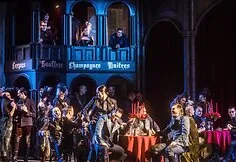
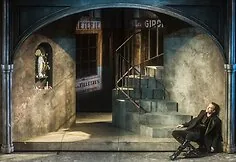
– Maybe let’s start with your acquaintance with Dalia Ibelhauptaitė. As far as I know, the first phone conversation about the upcoming Vilnius production happened under quite unusual circumstances – you stuck in London traffic, and Dalia waiting for you in the studio. How do you remember that call?
– Dalia and I had worked together before – we staged Prokofiev’s “The Gambler” in Maastricht. My agent then conveyed her thought: the relationship between director and scenographer is like a marriage – first, you have to fall in love. I’d say, a beautiful thought. True, we didn’t fall in love immediately, but over the years – definitely so.
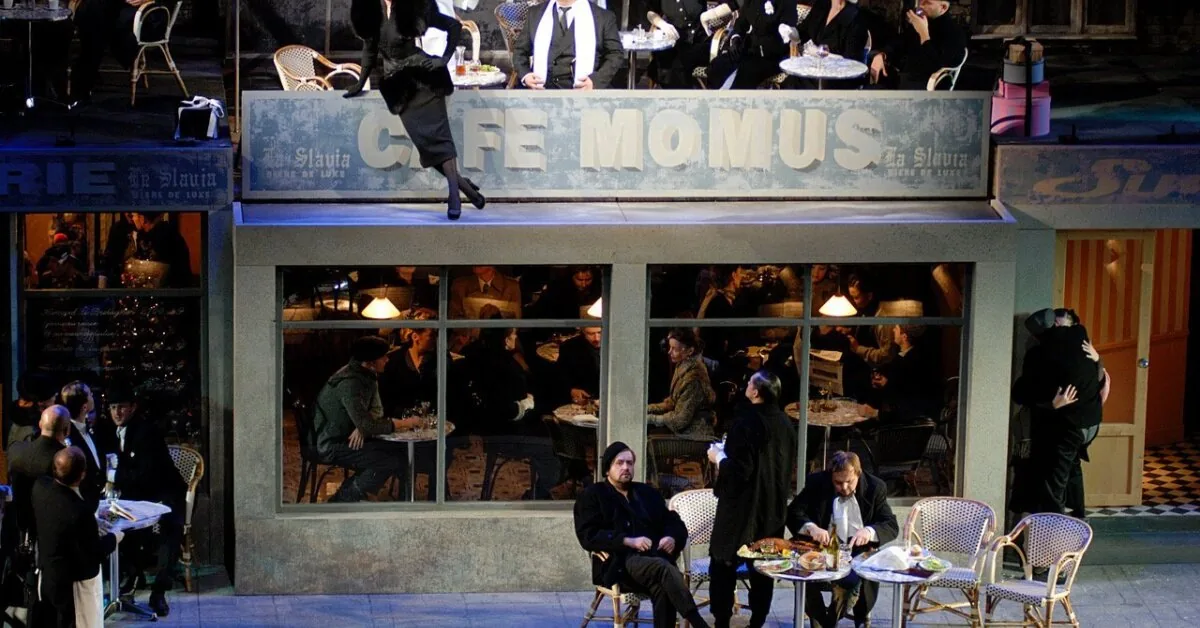
For “La Bohème,” we were supposed to meet in my studio in South London, but while driving from the other side of the city, I got stuck in a completely immobile traffic jam. Dalia was waiting in the studio, so eventually, we had to talk on the phone for a very long time. She explained why she wanted to move “La Bohème” to 1950s Paris and why the idea of time seemingly stolen from Lithuanians was important to her – about her parents, deportations to Siberia, lost decades. That moved me deeply: it was not nostalgia but an attempt to find the time that people here could not experience.
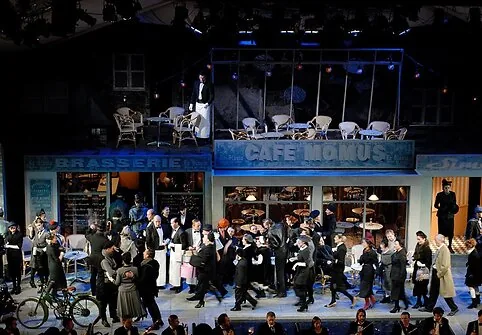
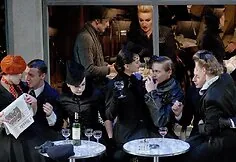
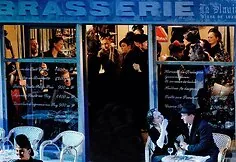
– Soon you saw the Congress Hall for the first time – almost the opposite of an opera theater. What was your first impression?
– No stage tower, no side spaces, everything bright, nowhere to hide anything, no orchestra pit. The first impression – a very challenging space, but… I like challenging spaces. In a regular theater, you accept the portal, curtain, and red velvet as a given and don’t think too much. But in the Congress Hall, you simply cannot not think about the space itself.
Since there was nowhere to hide or lower decorations, everything had to be part of the scenography itself. I made a model, came up with that crazy roof with a studio on top that could open. I wasn’t sure if it was a silly idea. I showed it to Dalia. She has a sound she makes when she is very excited about something – a kind of hum. She made that sound, and I understood: okay, let’s go this way.
The best thing about working with Dalia is that you bring her something extravagant, and she pushes you even further. She is a maximalist. I am a bit of a maximalist too, so not much encouragement is needed.
– D. Ibelhauptaitė wanted to move “La Bohème” to 1950s Paris and introduced you to that period in a very specific Lithuanian historical context – as a time that was, in a sense, taken away from Lithuanians. How did this idea change your view of the 1950s, and what did you immediately start imagining when creating the scenography?
– If someone in the UK said: “Let’s move ‘La Bohème’ to the 1950s,” you’d first think of shiny American cars, progress, post-war optimism, but Dalia spoke about this period completely differently.
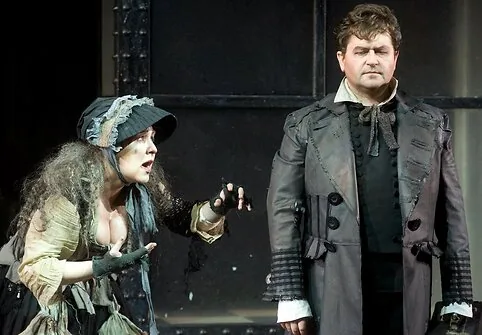
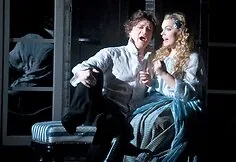
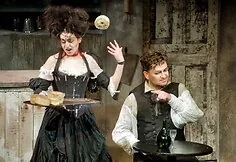
Paris at that time was also just recovering from the war. I was interested not in a shining, already modern city, but Paris that was just beginning to open – as if small patches of light gradually appeared in the darkness. I studied Eugène Atget’s photographs: old, dark streets, shadows, small spots of light. Therefore, the scenography even gained a 19th-century feel, and into the older city fabric, we introduced signs of the new era – shop signs, electric light. Then came Juozas Statkevičius’s costumes and a clear 1950s layer.
It was important to me that these were not decorative “fifties.” In “La Bohème,” we talk about poor young people who long to create a new life, and the city itself is just beginning to reveal itself to them.
– Colleagues remember the early “bohemians” years as quite chaotic. What stuck with you the most from that time, the first productions?
– Oh, many memories and even more chaos. Everything eventually works out, but at first, you don’t know it will. [Laughs.]
“The Magic Flute” required a lot of gold foil. In the UK, we use cheap imitation in scenography, but in Vilnius, you could only get real gold leaf because it was used for church decoration – and it cost maybe ten times more.
I also remember the women who painted the decorations. Instead of a compressor, they had a cylindrical vacuum cleaner with a hose connected to the other side: so it wouldn’t suck but blow the paint. Incredibly ingenious, although it made the work much harder.
The first time I went to the decoration workshops outside Vilnius, I felt almost like I was in a desert: a big old shed, terribly cold, an outdoor toilet – a hole in the ground, and inside, thickly dressed men welding structures. It seemed like we were all checking each other’s bluff: can we really make what we imagined?
The first time I went to the decoration workshops outside Vilnius, I felt almost like I was in a desert.
We did a lot of props and painting work ourselves. I brought my assistant James Cotterill, and my wife, who is a painter, also came. We laid plastic in the Congress Hall foyer and set up a kind of workshop. But everyone worked with incredible passion. And then you see those young singers – Edgaras Montvidas, Asmik Grigorian, and others – and there are no questions left. That was the first “La Bohème” I saw where the main characters really looked like young people just starting their life journey.
– You have worked in many major opera theaters. What made the “bohemians” different – and remain so – in the global context?
– People. Of course, people work with passion in theaters worldwide, but in Vilnius, everything had to be done despite many obstacles – in an unusual space, with small resources and a very small administrative system. It was necessary to practically grow an entire generation of specialists – stage managers, production managers, decoration masters. It was wonderful to watch their confidence and capabilities grow. Romas and his team were cautious at first, but after a few projects, it was clear: they could do anything.
Read more Everything you need to know about «GTA VI»: price, story, map, and key innovations
The same with the singers – they went to major world stages and then returned to Lithuania with new experience. We strongly felt the need to create something here. It may sound pompous, but it seemed important for the country.
– When staging “Eugene Onegin,” D. Ibelhauptaitė suggested moving the action to Soviet communal apartments – an environment you had not experienced yourself, but the audience remembered it well. How does a foreigner approach such historical experience?
– You research, research, research. You look at many photographs, but that’s only a superficial, visual understanding. One of the most interesting parts of the scenographer’s profession is that you constantly find yourself in different periods and have to delve into a world you know almost nothing about.
Dalia knew that world, so I knew she would stop me if I made a terrible mistake. I had spent time in Berlin soon after the wall fell, visited Hungary and Poland, and been in Dalia’s parents’ apartment. But I had never been in a real communal apartment.
A photo book about Havana was very helpful – about beautiful old houses divided into small living spaces. It’s a completely different story but helped understand what happens when elegant architecture starts serving the purpose of housing as many people as possible. So in “Onegin,” we started with a beautiful old house that could fit a traditional 19th-century building, and then we kind of broke it inside with partitions and new structures.
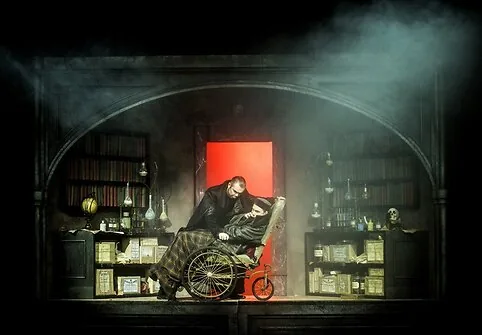
– “Faust” became one of your favorite Vilnius productions. What else did you discover placing the story in the Congress Hall space?
– After a few years, I returned already knowing well what could be done in that space. Then you can ask not “is it possible?” but “how else can we change it?”. I remember showing the model to Dalia and John Morrell in a café in central Vilnius. I demonstrated how one scene transitions to another, and they couldn’t understand for a while what was moving where. That was a great sign for me!
Scale was very important here. Scenography works not only intellectually but physically. A small space can cause claustrophobia, a huge one – a feeling of freedom. At the beginning of “Faust,” the man seems trapped at the end of life and opportunities. Outside the window, he hears young, singing, optimistic people, and then his world suddenly bursts outward. The most interesting thing is when such emotions don’t need to be explained – the viewer feels them through the space.
– How much freedom did you get working with Dalia and the long-time team?
– A lot. I deeply respect Peter Mumford and John Morrell, and every time I feel privileged to create with them. They could continue their careers anywhere in the world but returned to this crazy space not for the highest fees but because we liked being together and working with Dalia.
Of course, she controls everything very firmly but at the same time gives enormous creative freedom. She knows how to see what is strong in a person and then allows and encourages it to grow.
Of course, she controls everything very firmly but at the same time gives enormous creative freedom.
– When did you feel that the “bohemians” had already become a separate institution with its own distinctive style?
– Probably quite late. All those years, we looked at the Opera and Ballet Theater across the street – a large building with chandeliers in the foyer. I don’t want to say they were enemies, but they were respectable cultural houses, and we were rebels, troublemakers, bad kids.
When I came to work there many years later staging “Don Giovanni,” I saw that many theater people had started their path with the “bohemians.” Then you realize: everything really has changed.
But I always liked that punk feeling. We were not obedient, perfect kids who quietly do their homework. We worked against the current.
– Do you have a favorite story that best conveys the spirit of the “bohemians”?
– I don’t know if I should tell this. Maybe I should first show it to Dalia. [Laughs.] I myself give feedback to people very gently. Once I tried to explain to a props master that the chair he made was not quite what I expected. I put my computer on it, showed a photo, explained politely…
Then Dalia came in, looked at the chair, and I had to quickly grab my computer from it. Let’s say: her way of expressing dissatisfaction with the chair was much more straightforward than mine.
After the first performance, Romas, by the way, started filming my model presentations so that later I couldn’t sneak in new things after he had calculated the cost. [Laughs.]
I think we just fell in love with our shared creative process.
– To conclude the conversation: what does being a “bohemian” personally mean to you?
– Probably, in the end, I will say the word “family.” There is a real connection, a sense of kinship, something that approaches love.
We really cared about what we did together. We did it under difficult circumstances, without much money, because we liked it and felt its weight. I think we just fell in love with our shared creative process.
Read more Firefighters in Gargždai rescued a child stuck in the fountain grate