







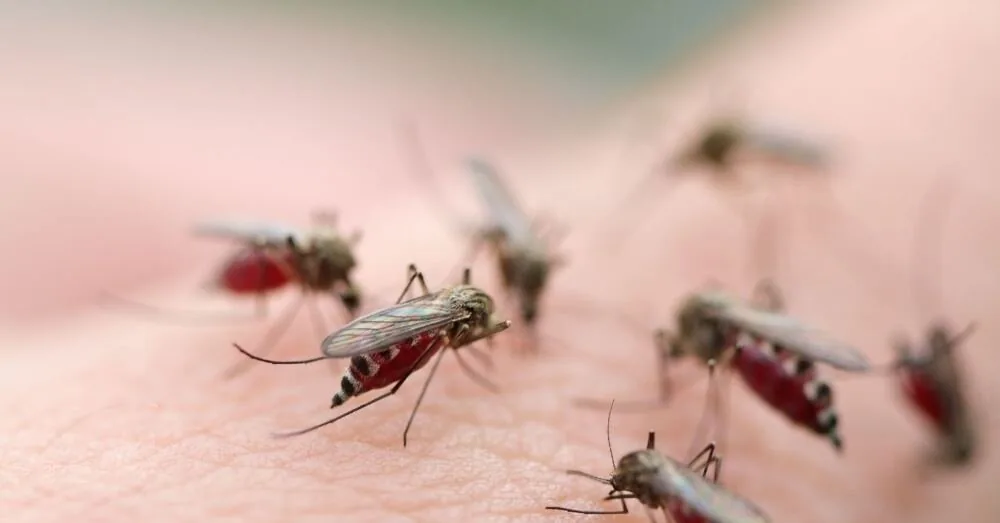
Mosquitoes are usually most active during the summer, but this year people have to defend themselves from them in the autumn.
Read more 18-year-old Ramzan Kadyrov’s son has assembled a personal «army»
Posts are spreading on social networks where residents share their observations about mosquito activity and ways to protect themselves from these bloodsuckers.
“They attack not only in the evening but also during the day. It’s impossible to work in the yard,” complains one woman.
“They are so small – some kind of mutants. Nets don’t really help. And they bite even through socks. But you still have to pick raspberries, so I march to the raspberry patch wearing a winter jacket, thick pants, and a scarf up to my eyes,” writes another commenter.
Why are mosquitoes so aggressive and when will this annoying phenomenon end? The news portal VE.lt asked biologist Antanas Kontautas to comment.
“Mosquitoes usually live and develop actively in the summer; I haven’t noticed such frequent activity in the autumn. There have been such years, but definitely not often. We haven’t seen any special weather or natural conditions that could explain the late mosquito activity this summer. Perhaps their abundance can be explained by the fact that we have not yet had frosts at night. Usually, at the end of August or beginning of September, a light frost would occur at night, which would simply freeze the insects. But for some time now, nights have been warm, the autumn is humid, with a lot of precipitation – favorable conditions for them to multiply,” shared A. Kontautas with his insights.
As the weather cools, male mosquitoes die, and fertilized female mosquitoes hide in basements, tree hollows, under bark, or other secluded places, where they enter a dormant state until the next spring.
Read more LTG leaves business resilience manager Gediminas Šečkus
President of the Lithuanian Entomologists Society Andrius Petrašiūnas told VE.lt that a large mosquito population in autumn is not something to be surprised about.
“It just fluctuates. The summer was quite uniform, not rich in heat, many unhatched eggs accumulated, and now they have reached a favorable time and temperature. No detailed studies are conducted in Lithuania, so it is unclear whether the abundance of bloodsuckers in autumn is due to climate change or, say, the fact that birds that catch mosquitoes hatched earlier this year and are already migrating to warmer regions. This can only be stated theoretically,” commented the entomologist.
There is no specific answer as to when the mosquito influx will end. The insects will remain active as long as conditions are favorable – sufficient moisture and warmth, experts say.
So far, the weather is still very favorable for mosquitoes, and they are most active in the morning and evening because at these times bloodsuckers easily avoid direct sunlight. Mosquitoes cannot tolerate direct sunlight because the surface area of their bodies heated by the sun’s rays during flight is quite large, causing the insects to quickly lose fluids and die.
More than 30 species of bloodsucking mosquitoes live in Lithuania. These insects react to sharp smells and essential oils. They strongly dislike tea tree, peppermint, lemongrass, cloves, lavender, rosemary, basil, and eucalyptus. The most effective natural remedy is clove essential oil.
Mosquitoes tend to fly towards dark clothes, so they “dislike” and less frequently land on light-colored clothing.
Read more New Zelensky proposal to Putin: put that list on the table