









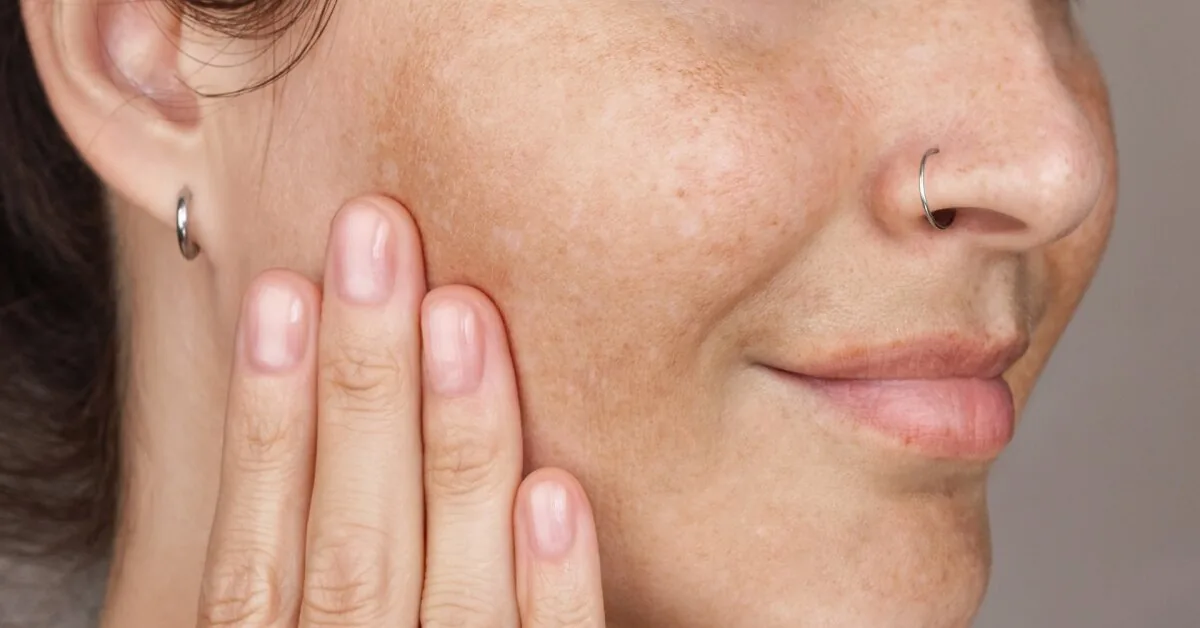
Specialists explained what types of pigmented spots can appear on the skin, revealed how to distinguish hyperpigmentation from freckles, which products are suitable for skin affected by pigmentation, and when skin changes should be shown to a doctor, according to a press release.
Read more Check your hands: what 1 subtle nail change reveals about your health?
Pigmented spots – not only due to the sun
Hyperpigmentation is a skin condition where more pigment melanin accumulates in certain areas, resulting in darker spots or uneven skin tone. According to Ramunė Uosienė, an expert at the BENU Pharmacy Healthy Skin Institute, melanin is a natural skin protection against ultraviolet sun rays, but when its production intensifies in certain areas, the skin unevenly develops pigmented spots.
“Many people notice that pigmented spots become especially pronounced after summer. This happens because ultraviolet rays act as a long-term stimulus to melanocytes, the pigment-producing cells. Interestingly, pigmentation is not always visible immediately. The skin has a kind of ‘memory’ – changes caused by UV rays during summer may become apparent only after a few weeks or even in autumn, when the tan starts to fade but the darker areas remain,” says R. Uosienė.
However, according to her, it is inaccurate to say that every pigmented spot is a direct result of sun exposure. The sun often acts as the main factor, but pigmentation can also be triggered by pregnancy and hormonal changes, skin inflammations, acne scars, certain medications, genetic predisposition, or natural aging processes.
Freckles and pigmented spots
Although freckles and pigmented spots are often confused, according to R. Uosienė, the difference lies not only in appearance but also in causes. Freckles are usually inherited, typically appearing in childhood, are small, light or slightly darker brown, symmetrically located on the nose, cheeks, shoulders, or hands.
In summer, under sun exposure, freckles become more pronounced, while in colder seasons they often lighten or almost disappear.
“Pigmented spots usually appear later – in adulthood, after prolonged sun exposure, hormonal changes, pregnancy, skin inflammations, or certain medications. They are generally larger than freckles, have clearer borders, and usually do not disappear with reduced sun exposure. On the contrary – over time, they may darken or enlarge,” explains R. Uosienė.
Spots, melasma, or post-inflammatory pigmentation?
REVÙ CLINIC dermatologist Jokūbas Liutkus notes that spots, or sun-induced pigmented spots, are usually flat, solitary, well-defined brown or dark brown spots. Meanwhile, melasma is a chronic, recurrent hyperpigmentation condition characterized by larger, irregularly shaped brown skin areas, often symmetrically located on the forehead, cheeks, and upper lip skin.
“Genetic predisposition, ultraviolet radiation, and hormonal factors – for example, pregnancy or hormonal contraceptive use – are important for the development of this disease. The condition often persists for a long time and tends to recur, so long-term management is required,” says J. Liutkus.
According to the dermatologist, there is also post-inflammatory pigmentation – skin darkening remaining after inflammation, such as acne, other rashes, or burns. The key sign is that spots appear exactly where there was previous skin damage.
When should you see a doctor?
J. Liutkus notes that most types of pigmentation are harmless to health, but precancerous skin changes or even skin cancer can look like a simple pigmented spot.
“Diagnosis requires dermatoscopy in a dermatologist’s office, and sometimes even histological examination,” says J. Liutkus. “It is especially worth showing a doctor a new unusual spot or one that is growing, changing shape or color, becoming asymmetrical, having uneven edges, or multiple shades. I call this the ‘ugly duckling’ sign, when one lesion differs and is unlike other lesions on the body.”
Read more Where to put tomato leaves and stems: 6 ways not everyone knows about
The dermatologist emphasizes that it is especially important to properly diagnose a spot or pigmentation before any aesthetic removal with laser or other procedures: “First, we need to know what we are treating, and only then decide how to reduce pigmentation. In practice, I often encounter cases where undiagnosed melasma was treated with aggressive laser procedures, after which pigmentation became even more pronounced over time.”
Different conditions – different procedures
According to J. Liutkus, there is no single best device or one procedure suitable for all skin spots, so treatment must be comprehensive.
“For treating spots, picosecond lasers, intense pulsed light procedures, and sometimes deeper chemical peels are most suitable. When treating post-inflammatory hyperpigmentation, it is first important to control its cause, such as acne, while the basis of melasma treatment is consistent sun protection and medication with topical or oral drugs,” says J. Liutkus.
The doctor adds that in the case of melasma, overly aggressive laser procedures can cause additional inflammation and eventually worsen pigmentation, so it is very important to visit a dermatologist and have treatment performed only by specialists who understand the disease course and select appropriate treatment methods.
Cosmetics designed to fight pigmentation
In the case of hyperpigmentation, according to R. Uosienė, it is important to choose skincare ingredients based on the cause of pigmentation and skin condition, as active ingredients in cosmetics can act differently: some inhibit melanin production, others reduce pigment transfer to skin cells, stimulate renewal, or help reduce inflammation.
“One well-known ingredient is vitamin C. It has antioxidant effects and can inhibit melanin formation processes, so the skin gradually becomes brighter. Niacinamide works somewhat differently – it helps reduce melanin transfer to skin cells, so it can be useful in reducing the visibility of pigmentation. It is worth including azelaic and tranexamic acids in skincare when dealing with pigmented spots,” advises R. Uosienė.
The expert also mentions retinoids and exfoliating acids but emphasizes that these products can irritate sensitive skin, so these active ingredients should be introduced into the skincare routine gradually.
R. Uosienė adds that among ingredients specifically designed for pigmentation, thiamidol stands out, which targets melanin production and is generally well tolerated.
Sun protection is needed all year round
According to the specialist, it is better to reduce pigmentation consistently rather than intensively – active ingredient “cocktails,” where all products are used at once, should be avoided, and pigmented spots should not be exfoliated as this can further irritate the skin. Another important rule is to use sun protection with SPF 30 or 50 not only in summer but every day.
“Although in autumn the sun seems less intense, UV rays reach the skin all year round and can affect pigmentation processes. For this reason, sun protection should not be a seasonal habit – it should be used daily,” advises the interviewee.