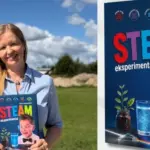






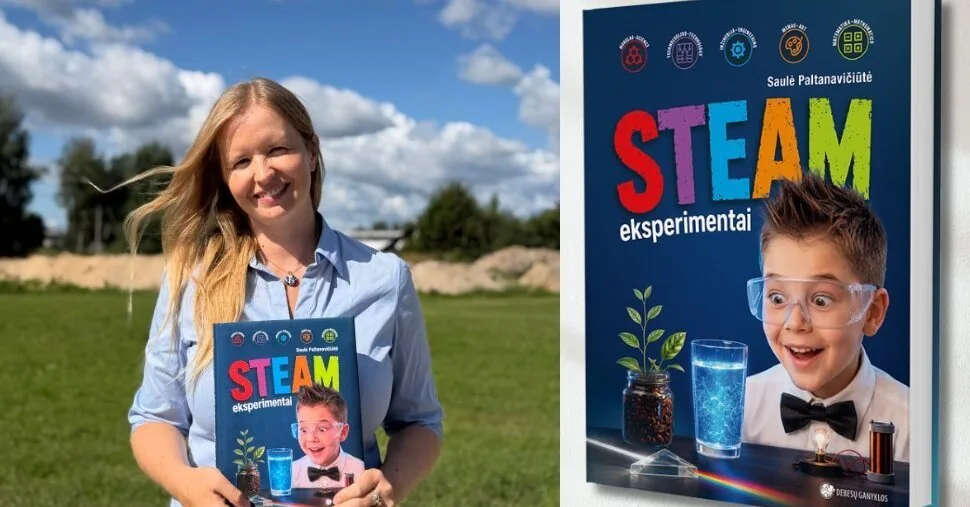
Third-generation biologist, naturalist, and author of children’s books Saulė teaches children natural sciences in Mexico, making compost with them, observing birds, conducting experiments, as well as photographing nature and writing books. She says that living in this country and working with children has helped her discover a different relationship with the world.
Read more EIB Director: this year funding for Lithuania is expected to increase 4 times to 2 billion euros
Unexpected questions from children, which are not always easy to answer, are part of S. Paltanavičiūtė’s daily life. However, she does not avoid such questions; on the contrary, she accepts them as a natural part of learning. “The most important thing is not always to know the correct answer, but not to be afraid to ask, search, try, and make mistakes,” says Saulė. This principle is exactly what her new book “STEAM Experiments,” published by the publisher “Terra Publica” with the children’s and youth brand “Debesų ganyklos,” is based on. In it, science is not just formulas or pre-known correct answers, but an opportunity to explore independently, obtain unexpected results, and start over if the first attempt fails.
In this interview, S. Paltanavičiūtė talks about working with children, their most surprising questions, the most astonishing experiments, and ways to support and nurture a child’s desire to explore the world.
– You are a biologist, teacher, nature photographer, and author of excellent educational books for children. How did writing come into your life?
– Writing came naturally and gradually. I enjoyed writing essays in school. Later, when I started traveling, it became very interesting to write about travels. About fifteen years ago, my first travel articles appeared in magazines and portals.
After settling in Mexico, I had the idea to write my first children’s book inspired by the culture of this country. At that time, I started working as an educator, discovered the joy of teaching, and all these areas merged very naturally.
– Is it still possible to surprise a biologist with something in nature? When was the last time you saw or learned something and thought: “Wow, I really didn’t know that”?
– Definitely. I constantly learn and discover something new – both about Lithuanian and world nature. A few days ago, I watched a show about Ireland’s nature. It showed razorbills pushing their fledglings, who cannot yet fly, off a 100-meter-high cliff into the rough sea. Nature can sometimes seem cruel, but everything is arranged there.
In Mexico, I am still amazed by agave flowers that can reach 10 meters high. Agaves sometimes prepare for blooming for 30 years. It turns out this is called the death bloom because most agaves wither after flowering. I found this very interesting.
Nature can sometimes seem cruel, but everything is arranged there.
– Children are especially curious. What is the most unexpected question about nature or science you have heard from a child?
– Children ask all kinds of questions, for example: “Will a swallowed apple seed really grow in the stomach?”, “Why does water taste different in different countries?” and so on. Sometimes I have to ask for time to look into it because I don’t have an exact answer at the moment. I think it’s good for children to know that we all are learning.
– What do children still notice in nature that we adults no longer see? Perhaps working with children has taught you to look at nature differently yourself?
– Yes. It’s fun to work with children because they have not yet lost their sense of wonder and desire to explore. In Mexico, children especially like digging in the compost box with little shovels. They find all sorts of things – we examine beetle larvae and huge earthworms – which they really want to take home and keep as pets. It’s fun to see how much joy a found earthworm gives a child. It allows you to look at everything differently, rediscover things.
– What experiments usually cause a “wow” effect for children? Or have any experiments completely failed and thus became the best lesson?
– Anything that erupts, explodes, amazes them, and even more so if there is fire. Also, if something changes color. For example, we did an experiment to determine the acidity (pH) of various drinks. You can see a whole rainbow of colors. It’s a fun way to learn and discover new things.
Not all experiments succeed. Sometimes the result disappoints because it is not impressive at all. I try to convince students that in science, the absence of a result is also a result. It’s not terrible if something doesn’t work the first time; you can always try again.
The experiments described in the book “STEAM Experiments” are ones I have personally tried and photographed. At the end of each experiment description, you will find a section “What to do if it didn’t work.” After reading it, I invite you to repeat the experiment until it succeeds.
Read more Village in England held an «independence» vote on asylum seekers
– What is more important for a child – to know the correct answer or not to be afraid to ask? How to preserve children’s natural curiosity as they grow?
– Nowadays, the focus is precisely on questions, the ability to search for answers independently, make mistakes, and try again. The modern world is very different from when I was growing up. It is no longer enough to know an answer or memorize it. When information is accessible with a few clicks, it is no longer so important to keep as much of it in your head. It is more important to develop the ability to search and ask, solve problems, and cultivate critical thinking.
As a teacher, I constantly observe what interests my students, and children show it very clearly. I think it is important to notice this and encourage them to continue exploring. I try to include as many practical activities as possible in the learning process.
– Today, children grow up among screens and technology. Is it harder for them to fall in love with nature? Or can technology become another way to discover it?
– I have seen examples of screen addiction. But when there is no screen, the same child in my class gladly digs in the compost and looks for earthworms.
Technology can be used in the teaching (learning) process. There are many games and apps on nature topics that provide children with knowledge about nature. For example, a waste sorting game or a farmer game. But nothing can replace being in nature.
In my lessons, I try to use technology less so that children can spend at least one lesson with nature, feel the earth, enjoy planting, notice insects and different plants. They like it.
– How to talk to children about climate change, pollution, or endangered species without scaring them? How to foster responsibility for nature while maintaining curiosity and belief that we can preserve it?
– Great question. Once, when starting the topic of climate change with my students, I chose a short introductory video. Later, one girl said it affected and scared her. Indeed, sometimes it seems that one of the most effective ways to make a person change something is to scare them a little. But that may work more with adults. Children now grow up in a very unstable and uncertain world. And most problems are the legacy of other generations.
I think it’s good to do experiments together, notice pollution, talk with the child about why it happens and who suffers from it. I have noticed that children really like to know they are doing a good deed for nature. My students enthusiastically made hummingbird feeders, seed pendants for birds, insect hotels. I aim to show that with small actions, everyone can make a difference.
– If “STEAM Experiments” fell into the hands of a child who today says “science is not for me,” what would you want them to think after closing the last page of the book?
– I would like them to think: “Science is not necessarily what I imagined, and I liked it.” In fact, STEAM covers a huge range of things – natural sciences, technology, engineering, mathematics, and art. The experiments in the book are divided by topics and suit children with various interests. From experiments in the kitchen and nature to art creation, meteorology, and applying the laws of physics.
There is no need to be afraid of the word “science.” Sometimes science can seem big and scary to children. But when they do fun experiments – build a maze for a plant, create a rocket with a balloon, make eco-friendly modeling clay, construct a kaleidoscope – they don’t even notice it’s science. They learn while having fun, and that is the goal of this book.
One thought repeats in Saulė Paltanavičiūtė’s answers – children’s curiosity should not be suppressed but nurtured. Questions, attempts, mistakes, and the desire to understand the world are an inseparable part of learning. Sometimes one interesting experiment is enough for science to become close to a child.
And those who have more questions after reading the interview are invited by the publisher “Terra Publica” to ask them live to the author. On September 18 from 12:00 to 12:45 at the Kaunas Book Fair, there will be a meeting with S. Paltanavičiūtė and a presentation of her new book “STEAM Experiments.”
During the event, visitors will not only learn more about the birth of the book but also see with their own eyes how science is applied practically – S. Paltanavičiūtė herself will perform experiments from the book “STEAM Experiments.”
Read more Eurostat: annual industrial growth in Lithuania in July – among the highest in the EU