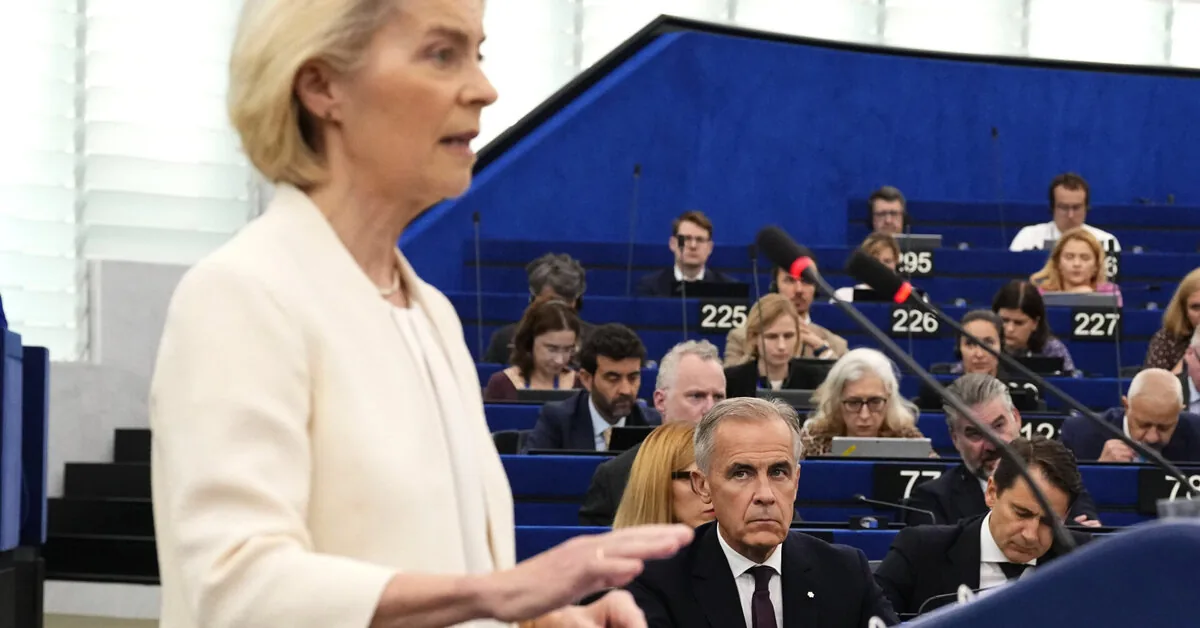









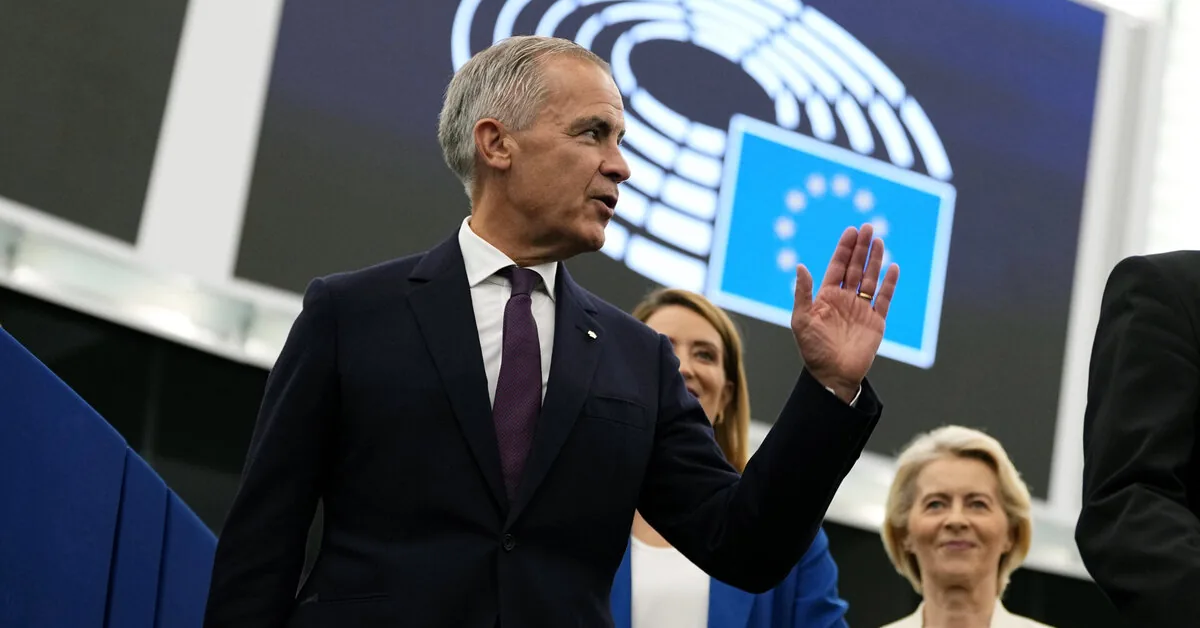
In Strasbourg, European Parliament member U. von der Leyen stated that Brussels and Ottawa, democracies facing the “breakdown of the international rules-based system,” must cooperate more closely.
“I would like to work with you to open the doors for Canada to become the first associate member of the EU,” said U. von der Leyen to the Canadian Prime Minister, who participated in her annual speech at the European Parliament, and received a standing ovation.
M. Carney seeks closer ties with the European Union, with both sides trying to distance themselves from the United States, led by President Donald Trump.
The Canadian Prime Minister aims to create a “unique alliance” with the 27-country bloc, both seeking ways to reduce dependence on the United States.
This is the first foreign government leader to participate in the annual “State of the European Union” speech. Next month, an EU-Canada summit will take place in Montreal.
U. von der Leyen stated that it is time to move from trade-based cooperation to a broader “alliance for the future” and to “raise relations with Canada to the highest possible level.”
“We will work in advanced manufacturing. We will create a technology alliance. We will integrate defense industry bases. We will make the Arctic a model joint project,” she said.
As another area of cooperation, she mentioned energy, key minerals, batteries, artificial intelligence, cyber and economic security.
“This partnership is not directed against anyone else, but aimed at our common strength,” she added.
Read more „Bolt Food“ introduces innovation
The EU treaties do not provide for the possibility of becoming an “associate member.” However, this idea was first raised this year regarding Ukraine by German Chancellor Friedrich Merz.
Under this plan, which Kyiv, seeking full membership status, received coldly, Ukraine would have been allowed to participate in the bloc’s summit meetings and have its representative in the European Commission.
It would also have benefited from some parts of the EU budget but would not have full voting rights.
Pressed by US tariffs and Chinese competition, Brussels and Ottawa are already cooperating closely.
The free trade agreement (CETA), which eliminated almost all tariffs, helped increase trade in goods and services by more than 80% since 2016.
And this year Canada became the first non-EU country to join the defense loan program.
“We believe that power belongs not to the strongest, richest, or loudest, but to all of us. That democracies have the freedom to choose whom to work with,” said U. von der Leyen. “Therefore, we unite forces voluntarily.”