






Ukrainian President Volodymyr Zelensky accused Russia of attempting to “cripple the economy and destroy people’s lives” with increasing strikes on civilian infrastructure, including railways.
The country’s airspace has been closed since the beginning of the Russian invasion.
The railway has become a vital link helping to transport people, including visiting foreign leaders, diplomats, and aid workers, as well as cargo and supplies for the war.
“There has been an almost continuous campaign of strikes against the railway,” AFP quoted Ukrainian Railways head Oleksandr Peretsovskyi as saying. “It is growing exponentially. Every month, every week is usually worse than the previous one.”
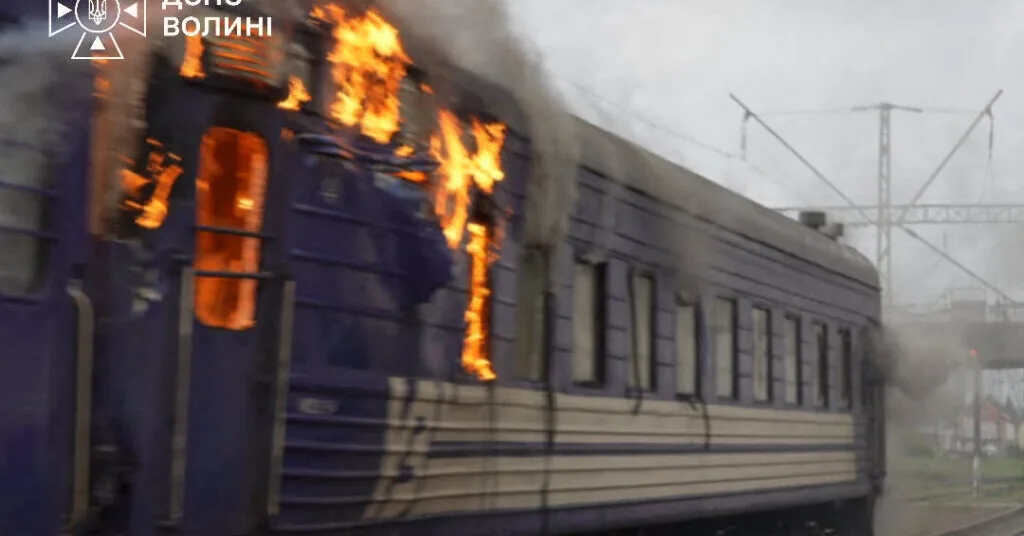
NATO member Poland reported on Sunday that Russia struck a railway locomotive on Ukrainian territory, about two kilometers from the shared border.
A few days earlier, Kyiv officials stated that Russian targets included border crossing points on the border with Moldova.
In August alone, about 40 locomotives were attacked across Ukraine, Peretsovskyi told AFP in an interview.
About 400 locomotives have been damaged during the war in total.
He described a new escalation as Russia now starting to strike parts of the network in the west, far from the front line, as happened during the weekend attack on a train near the Polish border.
According to him, this attack was the closest to the EU border so far.
“They are trying and continuing to test everyone’s nerves (…) The message being sent is that there are no safe zones on Ukrainian territory,” Peretsovskyi said.
Asked about this strike, Kremlin spokesman Dmitry Peskov said on Monday that Russia will continue to strike targets across Ukraine.
With the threat of a larger attack, Ukrainian trains are stopped and evacuated, and passengers stand for hours in fields and forests along the tracks until the danger passes.
During the attack on the train waiting to cross the Polish border, no one was injured because passengers were evacuated just before the strike.
Peretsovskyi warned that Russian capabilities are increasing.
“Their ability to accurately strike rolling stock and similar targets is clearly expanding,” he said.
“Everyone feels that their technical capabilities are growing in terms of autonomy, overcoming electronic warfare systems, and the range from which they can fire,” he added.
Since the start of the invasion, 62 railway workers have died performing their duties due to Russian strikes.
Kyiv now fears that these strikes are only part of a campaign aimed at Ukraine’s economy.
The intensified attacks on railways come after months of strikes on shipping in the Black Sea, as well as attacks on warehouses, agriculture, transport hubs, and logistics centers around Kyiv and across the country.
“On one hand, it is related to the economy – this whole complex of strikes against us, our clients, the metallurgical sector, ports, infrastructure,” Peretsovskyi said.
“On the other hand, it aims to break people’s spirit: to instill the idea that they are forgotten, that transport links are cut off, that they are no longer part of a larger country,” he added.
Read more Dalia Ibelhauptaitė: «The Bohemians» formed in my mind as Dalia Tamulevičiūtė’s «top ten»