






In this interview, we talk about her poetic world, where a glass on the table or an ancient dog’s grave gains mythical weight. Discussing this year’s festival theme “Poetry Rituals,” the author’s perspective on the flow of time, the nature of translation, and the power of repetition emerged, turning our everyday actions and poetry itself into an unchanging yet transformative ritual.
Read more Scientists fed people tomatoes for three months: what happened to their brains afterwards?
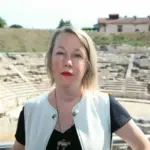
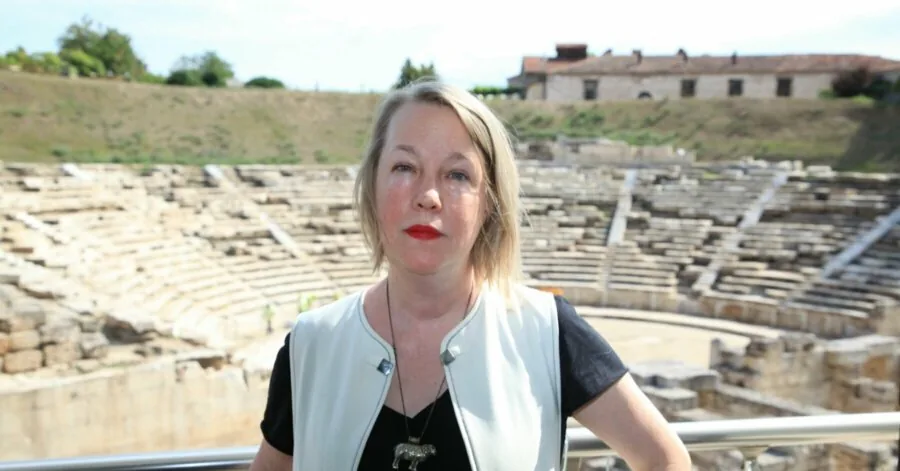
Alicia E. Stallings, born in Decatur, USA, in 1968, studied classical philology at the University of Georgia and Lady Margaret Hall College, Oxford University (UK). She worked as an editor for the Atlanta Review newspaper. Since 1999, she has lived in Athens. Director of poetry programs at The Athens Centre.
Author of five poetry collections: Archaic Smile (1999), Hapax (2006), Olives (2012), Like (2018), This Afterlife (2022). She translated Lucretius’s epic On the Nature of Things, Hesiod’s Works and Days, and the parody epic The War of the Frogs and Mice. Awarded the Willis Barnstone Prize for translations, fellowships from the Guggenheim and MacArthur foundations, a finalist for the Pulitzer Prize for poetry, and also received the National Book Critics Circle Award.
– You were born in Decatur, Georgia (USA), studied classics at the University of Georgia and Oxford. You will come to the “Poetic Druskininkai Autumn” festival from Athens – a city that has been your home for more than two decades. You have said: “You walk down a street named after Heraclitus, and your child plays in the playground with Xenophon. Their names and stories still linger in the air here.” But later you mentioned that living in Greece made myths less mythological for you. Does life in Athens really break the mythological veil from Antiquity?
– I would say that now I understand diachrony much better – the various layers of the past and the present existing simultaneously. I also notice how mythology and history overlap in unexpected ways. As if between interwar and neoclassical buildings and scaffolding of new hotels, you constantly glimpse the Parthenon.
– Your literary biography spans several cultural spaces: America, Great Britain, and Greece. You are a Poetry Professor at Oxford, but you emphasize the importance of speaking not only about English-language poetry but also about translations, classical and contemporary Greek poetry, and other literary traditions. Recently, more attention has been paid in Europe to the visibility of smaller languages and literatures. Has living among different literary cultures changed your understanding of what constitutes a “poetry tradition” in general?
– Undoubtedly. In fact, the English-language poetry tradition has long developed through translations. Without translations, there would be no iambic pentameter, no sonnets, no blank verse, no prose poetry. Probably no other poet at the end of the 20th century and the beginning of the 21st century in English-language poetry has had such an influence and so many followers as Cavafy.
When I think about the readership and smaller languages, I remember Sappho. She wrote for an audience of… well, how many? A few thousand people on an island? And now her work is read in languages that did not even exist in her time. So English-language poetry, isolated from translations, other traditions, and other languages, would be doomed to stagnation.
– You yourself are not only a well-known poet but also a translator. You translated Lucretius’s epic “On the Nature of Things,” Hesiod’s “Works and Days,” and “The War of the Frogs and Mice.” Speaking about Hesiod, you said that his world seems surprisingly close to you because seasonal work, community festivals, hunger, or bird migration are still in our “living memory; some of it still happens now.” You mentioned that rhyme in translation helps not only to maintain poetic quality but also to polish lines, and some rhyme pairs themselves suggest the poem’s theme. When translating a text written before our era, do you feel more like a translator who must preserve the author’s voice or a poet who inevitably reshapes that voice?
– This is an extremely interesting and broad topic. I think one aspect of translation is how many times the work has already been translated before you. If it already has several translations (I would say – the more, the better), various solutions are possible.
But if, say, you are the first person to translate a poem into a new language, you have to take greater responsibility not to distort the original. On the other hand, fidelity can be different: not only literal but also formal. A poem written in strict meter, translated in free style, can be rendered literally, word for word, but on a broader scale, completely distort the original.
I agree with Kenneth Rexroth, who said that translation frees us from our contemporaries. It also frees us from our own personality. Sometimes I compare translation to sexual reproduction: the translation contains both the translator’s DNA and the original’s DNA. Translation is not a clone – rather a new work that must operate according to its own laws.
Sometimes I compare translation to sexual reproduction: the translation contains both the translator’s DNA and the original’s DNA.
– In the “Poetic Druskininkai Autumn” almanac, your poem “First Love: Quiz” turns the story of Persephone into a quiz. Alongside what seems like a usual ride, dinner, a glass of wine, and dirty knives in the sink, there unfolds the loss of innocence, violence, abduction, a mother’s grief, and the last answer: “e. all of the above” (translated by Kornelijus Platelis). Back in 2002, you said: “there is no single version of a myth” and that classical authors understood myths not only as “carved in stone.” Does such flexibility of myth allow us to speak about experiences for which the current perspective does not yet provide proper distance?
– Myths are not Scripture; they are flexible and changing. Yes, they can be one way to look at a certain experience from a distance. Ancient myths, by the way, are often quite domestic, telling about families. Therefore, I think they can be very useful when talking about tensions in contemporary families.
I am also a big fan of canons and traditional forms – including standard mythical stories – because a certain form allows us to trample on established expectations. But simply rewriting a myth without feeling it or “renewing” it, in my opinion, is the least interesting thing you can do with it.
– In your poetry, humor often exists alongside horror. The poem “First Love: Quiz” is playful just by its quiz format, yet violence emerges. In the poem “Hades Meets His Bride,” this method is even more pronounced: Hades politely shows Persephone around her new home, talks about the seriousness befitting a queen, and notices death signs almost as household details. Finally, his observation that “something still pulses too strongly” in Persephone’s hand reveals the true meaning of the situation. Does humor serve you as a way to make tragedy even more disturbing and obvious?
– Interestingly, poems that I find funny are sometimes described by others as disturbing, and vice versa. I think humor and horror have much more in common than might appear at first glance. This again relates to canons, expectations, and how they are fulfilled or subverted. Both humor and horror are truly disruptive of usual norms (subversive).
Interestingly, poems that I find funny are sometimes described by others as disturbing, and vice versa.
Therefore, I think the most accurate answer would also be: “all of the above.” It is both a way to approach tragedy and a way to make it even more disturbing and visible.
In the mentioned poem, Hades is portrayed as a caring man, especially trying to make his bride feel comfortable. But his hospitality and care eventually become frightening. When writing this poem, did you think about how the boundaries between love, care, and control can sometimes be unnoticed? This is a very old poem. I wrote it when I was just in my early twenties. I think it was partly inspired by Robert Browning’s chilling poem “My Last Duchess.” On the other hand, it was born from the desire to write a poem from the perspective of an abuser/violent person who does not realize he is the “bad guy.” So it was partly an experiment in point of view. In a way, writing from Persephone’s perspective seemed easier to me, so I wanted to challenge myself. Moreover, at that time, I had just escaped destructive relationships – so I have no doubt that this also underlies the poem.
Read more Sinkevičius has an artificial intelligence advisor: who is he and what does he promise?
– In one interview, speaking about the form of your poems, you said: “Free verse is problematic. I can’t get a grip on it.” You described form as a surface where you can find “supports for hands and feet.” You mentioned that sometimes a poem begins to “write itself” in one form, but later it turns out it needs a completely different one. In the poem “Dužena,” the philosophical thought about the nature of glass gradually becomes a poem about indifference: “It breaks because / It is dropped and falls and hits the hard / Bottom because no one catches it” (translated by K. Platelis). Is form a necessity for you, important for the thought to gain momentum? Perhaps complete freedom in writing is not necessarily what a poem needs to find its “true” direction?
– Complete freedom paralyzes me. Therefore, I need some structure or canon to lean on. I think limitations, paradoxically, liberate. When certain decisions are made as if by themselves (as happens in strict forms), opportunities for new choices open up.
For example, in my “Presto manifesto” on rhyme, I wrote that rhyme frees the poet from what he wants to say. I care more about what the poem itself wants to say. I would choose to listen to it rather than shout over it.
– The subject of the poem “Empathy” says: “Empathy is not noble-hearted, / It looks after itself.” (translated by K. Platelis). You mentioned that this work was born from nightmares caused by reports of migrants dying in the Aegean Sea, and that it was important for you not to speak in others’ words because you were not a participant in their experience. Is poetry generally an ethical way to depict another person’s suffering?
– I think imagining others’ experiences can be important, but we must acknowledge what we truly cannot know. That distance must be realized.
– In the poem “Ancient Dog’s Grave Found During Athens Metro Construction,” the dog’s grave found during metro construction becomes a story of a journey to the afterlife. The dog follows the same path that people, wars, and misfortunes marched, and at the end of the journey meets Cerberus: “And then the last moment of tension – noses touch / One, two, three times with the loose Cerberus.” (translated by K. Platelis) In this poem, myth is revealed not through a human but through an animal. Do you think animals can become intermediaries between the material world and what we call the mythical or afterlife world?
– Animals and their otherness (and at the same time – their individuality) are very important to me. I think poetic imagination – often based on sensations, very empirical and somewhat disrupting the usual order (unlike the human mind) – has much in common with how, in my imagination, a dog, cat, bird, or snake experiences the world.
That tangible, bodily afterlife world, which appears in many of my poems, begins from my childhood fascination with underground, afterlife, and other worlds from fairy tales, myths, and stories (e.g., from “Alice in Wonderland”). I remember the first time I read Virgil’s description of Aeneas entering Charon’s ferry and how the mud starts to seep into the boat because Aeneas, unlike shadows, has weight, and I remember the excitement I felt then.
Animals and their otherness (and at the same time – their individuality) are very important to me.
– The poem “Machines Mourn Dead People” is impressive. Death is experienced from the perspective of machines. But they mourn not abstract humanity, but the presence of a specific person nearby: “the rough warmth of their hands,” oily fingers, curses, repairs, and work assigned to them by people. Even rough treatment here becomes a sign of closeness: “When we broke down, they kicked us like dogs, / But we didn’t complain. We kept silent with clenched teeth – / We considered it an honor to feel like dogs then, / The curses, roughly uttered through teeth, warmed us.” (translated by K. Platelis) Is this shift in perspective for you a way to question our habit of considering humans the center of the world, to doubt the very idea of anthropocentrism?
– This poem is also from my earlier works, but it seems to resonate very well with today’s context – the theme of artificial intelligence, robots, and the threats they may pose to humanity. But machines are also our own creations, so inevitably our humanity is “imprinted” in them. I like trying to look at the world beyond human vision, although I understand that this is probably impossible.
– In your poetry, everyday, even mundane elements unexpectedly gain mythical weight. In 2023, speaking about everyday life, you said: “since we are mortal, since ultimately everything hangs by a thread, [and our lives] manifest against something universal and important.” You also mentioned that even a simple play on words can act as “a kind of responsive magic.” Is it precisely mortality that turns everyday life into a ritual?
– Sometimes I talk about what I call “mythodomestic” – the cosmological scale of even the smallest, most everyday actions. Poetry is a way to touch that. Domesticity is a repetitive process: waking up, making breakfast, doing laundry, washing dishes. But it is precisely from this that our unique and unrepeatable life consists.
I think yes – the most everyday, repetitive parts of our lives can become a ritual if we acknowledge that they are simply full of importance and meaning.
– The subject of the poem “Burning Embers” repeats: “It won’t come back. You will have to understand,” and the work ends with the line “What burned is already embers.” This repetition resembles not persuasion but a kind of incantation: repeated even knowing it will change nothing. Interestingly, in 2025, you gave a lecture at Oxford University titled “Repetition is a Form of Change: An Oblique Strategy in Poetry.” This year’s “Poetic Druskininkai Autumn” theme is “Poetry Rituals.” Perhaps the ritual of poetry is not an attempt to change something but rather a way to come to terms with our own limitations – with what cannot be changed?
– Simply put, “Burning Embers” is a villanelle with some deviations, so repetitions are an integral part of its form. Repetition, of course, is also a very important element of ritual.
My mother used to say: if you do something twice with a child, it already becomes a tradition. For example, baking cookies at Christmas once is just a special event; twice in a row – already a tradition. Repetition is not meaningless.
Ritual often requires special language, and poetry’s roots probably lie in ritual.
I really like Brian Eno’s Heraclitean aphorism: “Repetition is a form of change.” A line literally repeated later in a poem is no longer the same line because time has passed, because you yourself are no longer the same person, because the context has changed. But it is precisely repetition that makes that change visible and tangible.
Ritual often requires special language, and poetry’s roots probably lie in ritual. Limitations, paradoxically, can liberate. Ritual is partly related to being fully here and now in the repeating moment (because “now” repeats constantly). I think poetry is about the same.