KnyguKurejai.lt – a project telling about children’s and youth books and their authors. The theme of 2019 is the anatomy of books. Writers and illustrators open the doors to the backstage of their works, sharing special stories never published before.
Read more Four people died in nightly Russian attacks in Ukraine
Text anatomy according to Benas Bėrantas
Beginning
It all started in the summer three years ago. Less than a year had passed since the release of the last book “Pirmokykla,” so it seemed too early for Vilija and me to think about something new. Suddenly, the “Book Start” competition for books for 2-4-year-old children was announced, which turned everything upside down. In July, we were celebrating Vilija’s birthday, and in a good mood, we decided to seize this opportunity. So, during the anniversary at the cottage, we shook hands to start the jubilee – the fifth – joint picture book.
There was little time, and since illustrating for readers of this age takes much longer than writing, I had to act quickly. I realized I could no longer come up with new ideas, so I opened my creative notes and pulled out one of the older ones that seemed most suitable for the competition. I wanted the book to be like a wish to children – don’t be afraid to try and believe that you will eventually succeed.
Every creator has their own style, and when a writer and illustrator work as a duo, it becomes even more pronounced. Although many know us for books about the squirrel Tiklis and the crow Kirnis, I did not think about them while writing this story. The competition rules required a separate story, not a series continuation. “Catch the Wind” is thematically closer to the book “Bambukas is slooow,” as both the woodpecker Viržis and the panda Bambukas learn to accept themselves and solve the situations they find themselves in.

Vilija and I did not win the competition. But it must be said that no one won – the winner was simply not chosen. However, despite this, we believed in our woodpecker and decided that the book still had to tame the wind.
Preparation
My biggest problem is probably that I prepare too much and for too long. In this case, the deadline helped and generally helps a lot. Then you just do it and see how it turned out. Just like the woodpecker Viržis in the book keeps trying and trying, which is much better than just accumulating and not daring.
I flew a kite as a child and remember it as a very fun activity. Maybe that’s why subconsciously I wanted to write this story? It’s no secret that I draw inspiration for creativity from my own experiences, from childhood.
Interestingly, creativity often encourages trying or remembering something, not the other way around. At the very beginning of summer, the book participated in the kite festival “Winds of Winds” in Klaipėda. Many impressive kites were raised there. I myself could not attend because I was not in Lithuania at the time, but I promised myself that I would definitely go to the festival next year, and then the book would have flown me after itself.
Since time was pressing, the initial manuscript appeared quite quickly. And while preparing, I spent most of the time reading about the kite as a mythological creature, as well as Lithuanian animals, especially birds. This is how the book’s characters were born.
Characters
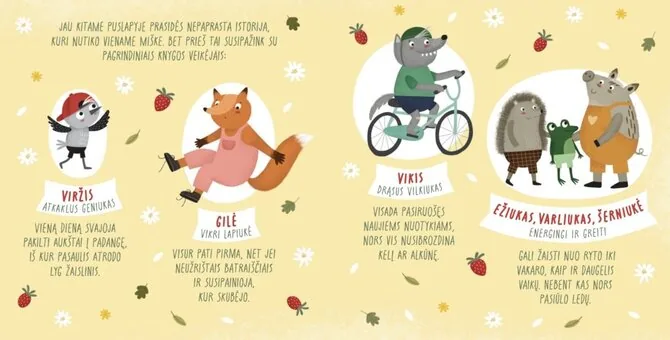
Among birds, the woodpecker appeared expressive and recognizable. Of course, a stork or a titmouse could also learn to fly, and they would also be very characteristic and convenient to illustrate, but symbolism was also important. The woodpecker pecks the tree, and to me, this is a beautiful metaphor for persistence because the main character of the book never stops trying. I seriously considered the cuckoo and the owl, but I rejected the first because of the name (sorry, cuckoo), and the latter is already merged with literary classics.
The story is intended for the youngest readers, so I did not want to overload it with characters. And although various characters bustle in the forest clearing, only four have names for this reason. Of course, first the woodpecker Viržis, as the main character, also his two best friends – the fox Gilė and the wolf Vikis. And the firefly Debesylas, who, together with the woodpecker’s parents, has an important mission – to encourage. I really wanted such a dreamy character alongside the parents to show that inspiration or support can come quite unexpectedly.
Those who follow my books closely probably know that I like to give names thematically. In the Tiklis and Kirnis trilogy, all are named after Baltic deities, and “Catch the Wind” continues the idea from the book “Bambukas is slooow” to name characters after plants.
Probably for the first time in my book, there is an incorporeal character. The wind, although invisible, is very important to the story and can be seen in the illustrations by observant eyes. It’s funny that at the book presentations at the Vilnius Book Fair and the “Adventures Continue” festival, I embodied the wind. Such a whimsical wind, causing chaos but also pushing forward and lifting up. It somewhat resembles the role of the writer, at least as I imagine it.
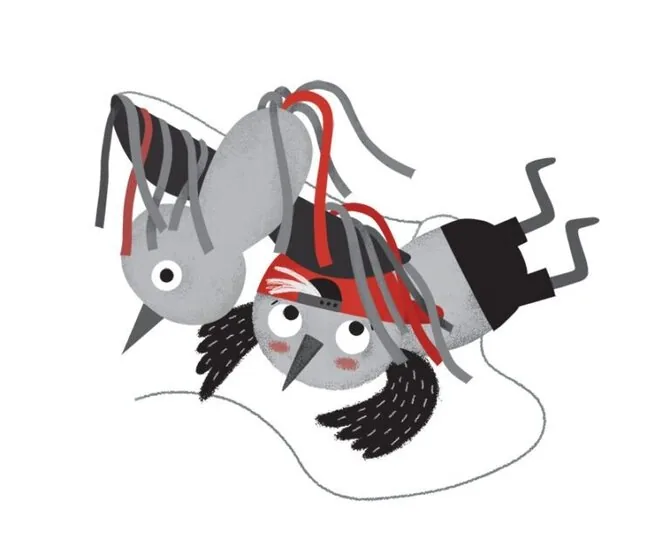
I would say the kite is also a character. It is like the woodpecker’s avatar; no wonder he first wants to teach the kite to fly so he can too. The kite conveys the woodpecker’s emotions and is always with him as a talisman bringing success.
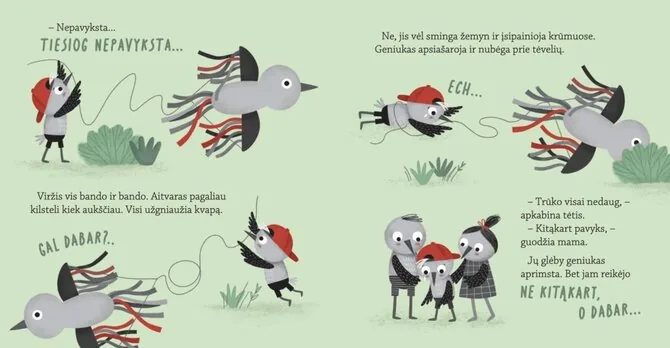
Secondary characters are no less important; they participate in parallel stories. Vilija and I have decided that this is an important part of our joint creation, so we discuss who could do what in the illustrations, even if one or another character is not mentioned in the text. For example, you can see how many animals fail at something in the first forest clearing, but towards the end, there are more successful attempts, meaning the lessons are not in vain.
I would like to mention separately the scene with the parents. It was not in the original manuscript, but in the late stage of the book’s creation, I decided that not only children but also parents should learn. After all, we adults are constantly learning something, and it is important that children notice this. I find it charming that modern parents do not try to have answers to all questions.
Environment
The environment is created by Vilija; I can only share the vision or observations. Visual perception helps me; I often already see the work in illustrations or even film frames.
Is it the same forest where the squirrel Tiklis and the crow Kirnis live? Although the action of these books takes place in Lithuanian forests, the location in my mind was not the same. The forest is like a city, and in every city, we meet similar and different children and adults, just like with animals. Perhaps the woodpecker Viržis has already learned to fly and, having risen above the fir tops, can look down at other forest clearings from above.
I am convinced that details are very important; they enrich the picture book because the plot itself is often simple. Perhaps that is why I try to think through as much as possible throughout the creative process and also draw Vilija’s attention to things that may not be so noticeable at first glance.
Plot
Although the book is about learning, I did not want to focus on how the woodpecker technically raises the kite into the air, the fox ties its shoes, or the wolf tries to ride a bike. I pay the most attention to the emotional side; this book is probably the most philosophical of all I have written for children. From this comes parental support, the firefly’s advice, the woodpecker’s help to friends, then everyone’s help to the woodpecker.
The plot’s axis is illuminated by the firefly Debesylas – catching the wind, like playing tag. The wind is the connection between different parts of the plot because when it blows, the woodpecker and other characters move to the next scene until they reach the climax.
Community became a cornerstone for me. There is a saying that it takes a whole village to raise a child. In this book, the woodpecker needs the whole forest to rise into the air. In the final scene, everyone holds their breath watching the woodpecker glide in the air for the first time, and then when he falls onto the moss, they gather to congratulate him. After all, the event is so significant, one of those remembered for a lifetime. It has become a tradition for Vilija and me to share our experiences with readers at the end of the book.
Sensoriality and interactivity were important to me. Therefore, the text contains many emoticons, interjections, and reactions. The narrator is not just a passive observer; he sincerely supports the woodpecker, emotionally reacts to his attempts. I hope that reading the book aloud helps parents keep children’s attention and engage them in the story.
Read more Police: «Kaunas Pride» passed peacefully, no casualties reported
Creative process
It’s funny, or maybe a little worrying, that our first joint book with Vilija was probably created the fastest, and the fifth – the slowest. If this trend does not change, the tenth will probably appear when we are already seniors.
The last three years in my life have been insanely intense. I directed all my time and energy to the work of a literary agent because I feel responsible not only to myself but also to writers, illustrators, translators, publishers I work with. I traveled a lot to foreign book fairs, talked about Lithuanian authors’ books, and communicated with people worldwide. I jumped into the book between work, trips, meetings. It was not easy, but every time I could look at the text and illustrations as if for the first time, and that helps a lot in the creative process.
During this period, Vilija and I went to present our books in Denmark, Luxembourg, Turkey, and the upcoming book was one of the main topics of conversation during the trips. We also met in Vilnius and often corresponded.
We were supposed to send the book to print this January when I was traveling in India and hoped to rest for a week on the Andaman Islands. But we kept finding things to fix or improve, and updated layouts downloaded very slowly due to poor internet connection. I held my laptop high in the air to speed up the internet a bit. That’s how that week of vacation passed, but the most important thing is that the book finally saw the light of day. And maybe it’s good that I didn’t spend too much time on the beach because I might have met a water snake, which you have to watch out for there.
Now it seems that I could rewrite every book already published, including “Catch the Wind,” better, but maybe that just means I am gradually moving forward, learning, and hopefully improving.
Illustration anatomy according to Vilija Kvieskaitė
Style
My illustration style has gradually formed by creating one book after another and trying to find a balance between simplicity, coziness, and humor. At first, I experimented more and searched for what interests me, now I feel a bit braver – I know which color, shape, line, or character expression is close to me. The principle of shaping a drawing is important to me: you first need to tame the character, find its form and character, and only then build the whole scene around it. Therefore, my sketchbook contains many individual characters, details, and abstract backgrounds, which I combine, cut, and arrange using digital graphic programs.

Characters
As Benas mentioned, we prepared this story for the “Book Start” competition. The main character – the woodpecker, which I had drawn in that version, did not please me; I was still looking for its execution. He is a bit like my nephew Dominykas – restless, stubborn, emotional. It so happened that while we were creating the book, Dominykas was learning to ride a bike without training wheels, just like the story’s wolf character Vikis. Both Dominykas and Vikis learned to ride a bike, but it took persistence.
I struggled the most with depicting the wind. At first, it was supposed to be a separate visual character, but later we decided not to depict it directly, revealing its presence through details – fluttering laundry, a blown-off hat, rustling grass.
It was important to me that the characters be easily recognizable, expressive, but not overloaded with details.
Environment
Benas brings the main characters with the story, and I invent additional ones while shaping the scenes. I really wanted to create forest scenes dense with action, details, and humor. I also paid a lot of attention to what might not be said at all in the text – when some characters or a small incident appear in the background, which is not necessary to understand the story, it enriches it and can be a fun discovery for the child.
Plot
After reading Benas’s text, several scenes immediately came to mind; I started with them and later supplemented with other compositions. I illustrated and designed all the books I worked on, so while laying out the text, I could more freely divide it according to the illustrations and suggest typographic solutions. Small flap sketches helped maintain the layout’s dynamics – then it was clearer where larger plans fit and where more small details were needed.
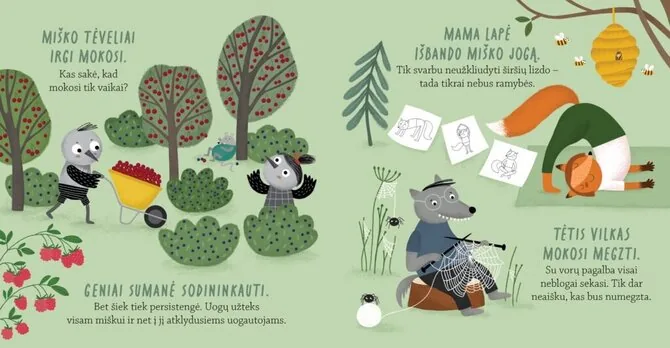
This is already the fifth book that Benas and I create together; I think we are a well-coordinated duo. Benas was involved in the illustration process, had his suggestions, but left me space to interpret the story in my own way.
Creative process
I created this book on weekends and evenings after work hours, probably why it took longer than I wanted. During the book’s creation rush, my friend and I lived in a small studio-type apartment – the same table for dinner and work. I really missed more space and looked for opportunities where I could work quietly. I became a frequent visitor to the MO Museum reading room. A routine formed – after work, I rushed to the museum, sat in the reading room, briefly flipped through some book for inspiration, and worked until the museum’s closing time. I left last; the security guard let me out through the side doors. I stuck museum visit stickers on the back cover of my sketchbook – a nice collection has accumulated.
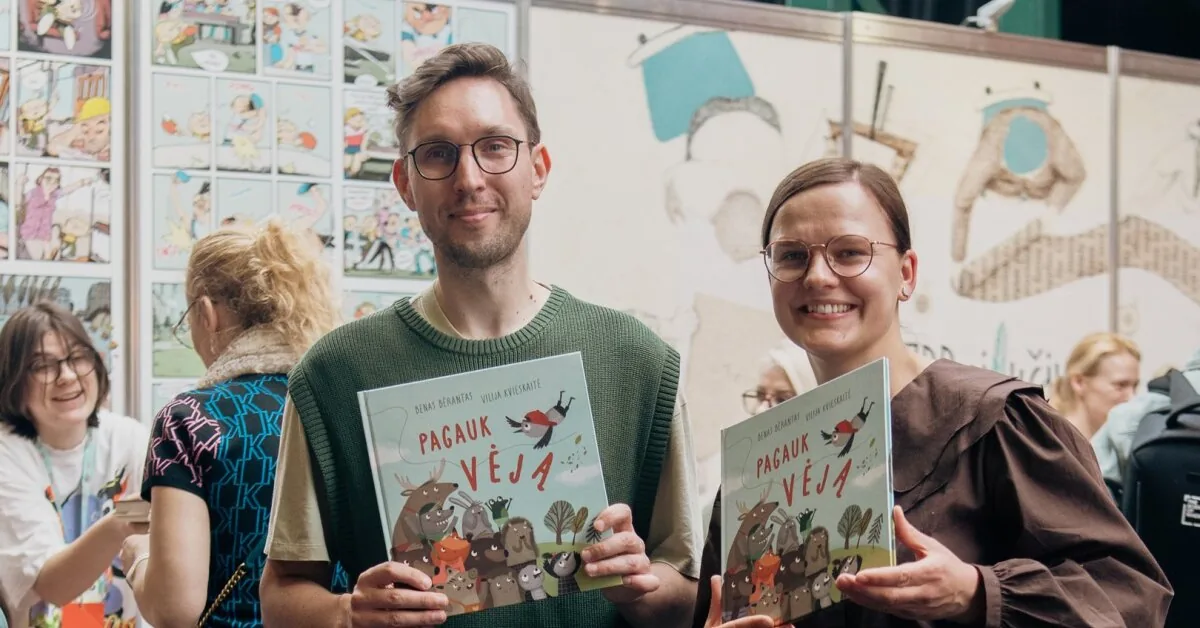
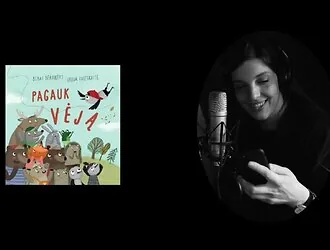
When it seemed that everything was almost finished, Benas suggested adding a little more to the story – additional illustrations were needed. Later, we got a bit stuck in the final stage – we published the book ourselves, looked for the most suitable publishing brand name, its visual design, and coordinated other organizational matters. But I am very glad that we were persistent like the woodpecker and did not give up, so at the 2026 Book Fair, we could already present our work. The woodpecker came to life with the help of actress Justė Liaugaudė, and since then, the book has lived its own life.
Authors’ biographies
Benas Bėrantas
I was born on June 13, 1989. It was a sunny and warm summer afternoon.
In childhood, my mother read to me a lot, so I loved books from an early age. I started creating stories at nine and, with my aunt’s help, even published a collection of my short stories in a single copy. Back then, it was just a game, and I never dreamed it would one day become my profession.
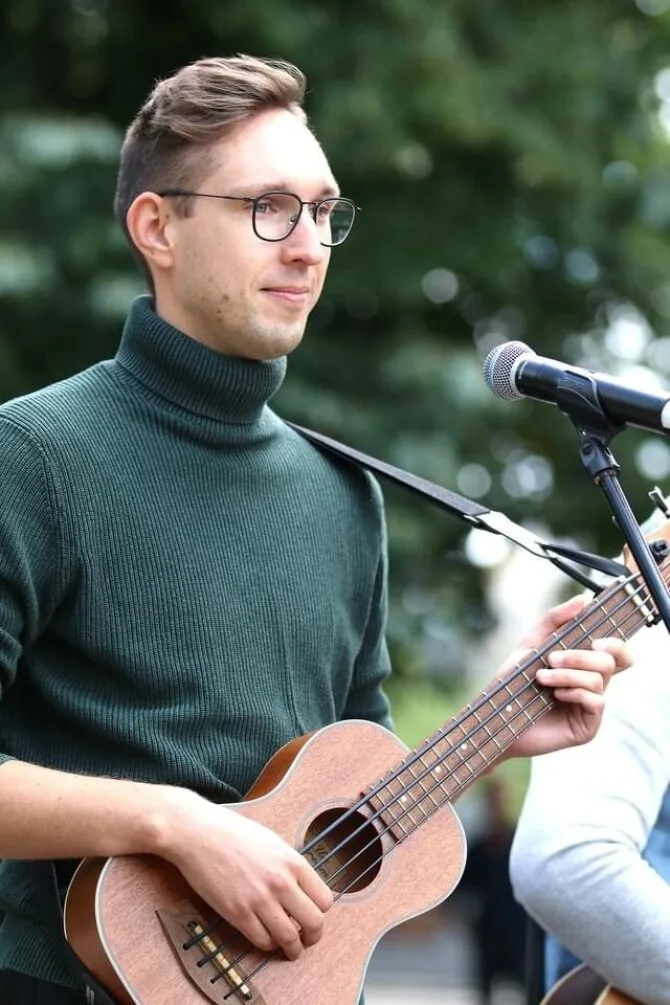
Currently, I can call myself the author of 13 children’s books and 1 book for adults. My work is translated into 20 world languages, including not only Spanish, French, or German but also more distant ones – Arabic, Sinhala, or Chinese. I have received the Vincas Aurylas award for promoting Lithuanian children’s literature abroad.
My entire professional life revolves around books. I graduated in publishing studies at Vilnius University, spent five years after graduation at a children’s literature publishing house. Now, for nine years, I have been an independent publishing agent and, with my agency “Book Smugglers Agency,” help Lithuanian authors’ books travel around the world. They help me travel too – I have visited more than 50 countries and hope to visit many more.
I started writing for little readers nine years ago, during which thousands of children have read my books. Those who took my first book at seven are now teenagers. If my latest picture book “Catch the Wind” becomes a memorable childhood book for even one child, I will be a very happy author.
Some of the dearest books I have written for children:
- “Nut Cake” with illustrator Vilija Kvieskaitė (Nieko rimto, 2017)
- “Mr. Kampas” with illustrator Tania Rex (Nieko rimto, 2019)
- “Bambukas is slooow” with illustrator Vilija Kvieskaitė (Nieko rimto, 2021)
- “Čiūčia and Pirate. Lost Sleep” with illustrator Olga Degtiarova (Alma littera, 2025)
- “Catch the Wind” with illustrator Vilija Kvieskaitė (Vaivorai, 2026)
Vilija Kvieskaitė
I was born in 1988 in Jonava.
In 2010, I graduated in graphic design from the Faculty of Arts at Kaunas College. More than 10 years later, I decided I wanted to study more, completed preparatory studies, and earned a bachelor’s degree at the Vilnius Academy of Arts.
I started my career at a publishing house, later worked at an advertising agency, and for several years worked independently – creating books, various graphic design projects, and conducting workshops.
During school and studies, I worked in vegetable greenhouses and an ice cream production workshop (a childhood dream to eat as much ice cream as possible came true). Currently, I work as a graphic designer.
I have illustrated 15 children’s books, some of the dearest:
- Benas Bėrantas “Nut Cake” (Nieko rimto, 2017)
- Benas Bėrantas “Baubaimė” (Nieko rimto, 2018)
- Selemonas Paltanavičius “Winter of Snowmen” (Alma littera, 2019)
- Vytautas V. Landsbergis “How the little mouse Zita turned into a human” (Dominicus Lituanus, 2020)
- Benas Bėrantas “Bambukas is slooow” (Nieko rimto, 2021)
- Benas Bėrantas “Pirmokykla” (Nieko rimto, 2022)
- Tomas Dirgėla “Iceland is not working today” (Tyto alba, 2022)
- Benas Bėrantas “Catch the Wind” (Vaivorai, 2026)