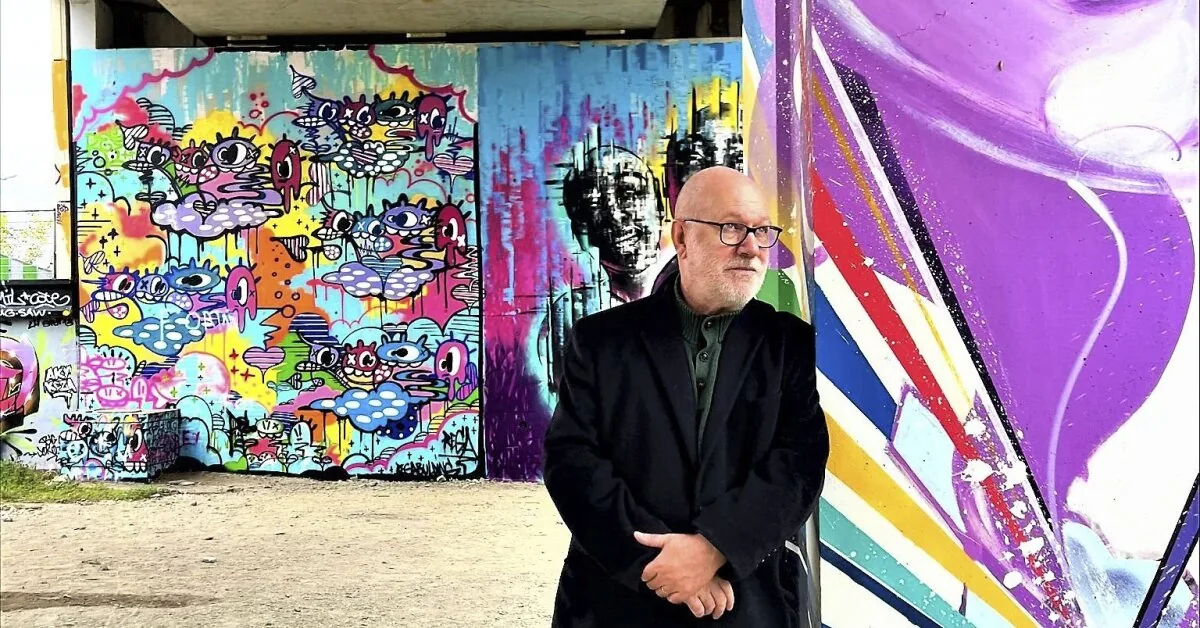
Like a classic of Western philosophy, this book is also based on dialogue – these are conversations about life and philosophy. Death and fear, freedom and totalitarianism, choices and limitations – the questions raised in the book are sought for answers not only by contemporary thinkers but also by many of us.
Read more Test-game: one thing does not fit with the others. Will you understand which one?
“There is no more politics,” says A. Šliogeris. He calls the modern man the Mole of the Screen, the excess of language a garbage dump, and links the boundless desire to have, consume, and create ever new artificial worlds with an unquenchable lust. Sharp, probing an open nerve and therefore sometimes uncomfortable – that is A. Šliogeris in this book.
We invite you to read an excerpt from the book “Conversations about essences”.
Information garbage dumps and politics
We live in a time of complete linguistic abandonment, or linguistic prostitution. The word “prostitute” has never had such a broad meaning as it does now. You see, at least for me, the main problem of language is precisely the catastrophic excess of language that has drowned our souls and turned us into blind Moles of the Screen. Our times are the triumph of the language garbage dump, even having its magical name – postmodernism. Garbage in general can be considered the unsurpassed symbol of our era. Excessive language (information) garbage dumps – too. Garbage dumps are expanding uncontrollably, and soon the whole planet, including man himself, will turn into a garbage dump.
We live in a time of complete linguistic abandonment, or linguistic prostitution. The word “prostitute” has never had such a broad meaning as it does now.
These language garbage dumps turn language into a whore. Having become a pile of information garbage, language increasingly loses its nuclear meaning – to be a bridge to the speechless Reality. Naturally, the same happens to individual words. The same with the word “politics” – I wrote in “The Fate of Philosophy,” and now I will clearly say that there is no more politics. What is called politics, in Orwell’s words, is merely the management of a global farm of human pigs; politicians are ephemeral overseers of this global pigsty, not autonomous individuals expressing the autonomy of a community of free people by their decisions, as was the case in ancient republics.
In politics, experience is the most important, let’s say – direct experience. And not just any, but what we could call acquaintance, in other words, maximally individual experience. So again, eyes – they are the most important even in politics… Let’s call it this way – the main tool of politics… Or no, let’s say – politics happens in the eyes. It is no coincidence that agoras, forums are where people see each other best. There was no such thing as pseudo-politics in Greece – bureaucratic-cabinet politics or, as proudly said, diplomacy, where everything is decided in offices.
Such politics arises in the modern ages in Europe because the scope of the state changes. Otherwise, it seems it was impossible if the state consists of fifty million or even let three million. Politics is no longer possible here; in such a gathering of people, only despotism is possible. You might say there is so-called representative democracy, but in reality, it is nothing but despotism. Only that there are many varieties of despotism: cruel, stupid, rough, bandit-like, and there is gentle or intelligent despotism. Take current countries, whether the so-called European Union, America, or even Lithuania – they are all despotic. Despotic because there is a governing subject, the so-called power, and there is a governing object, which power does not see at all.

What does it mean, for example, to some Uspaschius or Kubilius, you or me? They don’t care about the so-called nation because such an invisible nation is an abstraction existing only in the word “nation.” In general, where bureaucracy rules, true politics, as a direct meeting or junction of specific people, cannot exist. These are the epochs of empires – abstract and therefore already collapsed pseudo-community formations. Just as politics disappeared in antiquity with the rise of Macedonian and later Roman imperial despotism, so it disappears in non-Greek European countries, again in imperial formations, regardless of what that empire calls itself – democratic, socialist, liberal, or autocratic.
Take current countries, whether the so-called European Union, America, or even Lithuania – they are all despotic. Despotic because there is a governing subject, the so-called power, and there is a governing object, which power does not see at all.
All empires can only be bureaucratic, and calling a bureaucrat a politician is inaccurate: he should be called an overseer supervising a huge shadow economy. He doesn’t care about a specific individual, just like the chief overseer – the king, despot, president, prime minister, or speaker of the parliament. Those characters are interested only in words, not living people, with whom they cannot meet even if they want to very much, because there are too many serfs in the current states, and the so-called politicians, that is bureaucrat-overseers, care only about the citizen’s passport data.
So in today’s world, there is no politics and cannot be – only the uncompromising struggle for existence of huge superstates remains, and each of those states can be called in Orwell’s words – a farm of animals. The empire animates not only the individual but also interpersonal relations, so now on the Screen we primarily see a hominid-animal concerned only with animal needs: sex, food, economy, living standards, and similar quasi-human things. Thus bureaucratic abstractions turn into personal code slavery. The equivalent of a bureaucrat is always a hominid as a statistical unit, thus a hominid as a biological abstraction, an abstract unarticulated shadow marked by a number – a personal code.
We should not have nuclear bombs
I came to the conclusion that man is governed not by needs but by desire. Needs govern the animal, not man. If man were governed only by needs, we would not now have a super-monstrous civilization with all the hadron colliders and the Screen.
I will say it very simply, because I have said and written it many times: a need is connected with a specific thing, a specific object. It can be satisfied, for example, by eating a cutlet or buying a suit. Desire has no object, moreover, it cannot be satisfied or calmed – of course, for a high-ranking hominid, not a pig-man. Desire has no end; it is infinite. Infinite not in the extensive but in the intensive sense, although, frankly, for example, the tourist type or “space conquest” shows that the intensity of desire unconsciously turns into extensiveness. Moreover, desire embodies absolute negativity.
Desire has no object, moreover, it cannot be satisfied or calmed – of course, for a high-ranking hominid, not a pig-man. Desire has no end; it is infinite.
Just don’t get lost in the labyrinth of thoughts: I am not talking about that negativity in which I live by eating and wearing out – thus destroying – things related to our bodily needs. Desire is ideal destruction; it seems to sweep away any finite state, finite thing, or being. Only because of desire can man not achieve the state of Paradise in this world, that is, root himself in complete presence, and constantly hangs on the gallows of the future or the past. In short, desire is directed towards Nothingness, more precisely – desire itself is a moving Nothingness, as the power of nihilistic destruction.
Read more At the border with Belarus, 21 illegal migrants were turned back
Plato perfectly illustrates this by saying that Eros, or desire, is the child of Poros, the god of excess, and Penia, the goddess of poverty. So, according to Plato, desire is both excess and poverty – the poverty of excess and the excess of poverty – because whatever man achieves, everything goes to nothing, there is no such finite state in which I could say: here, that’s all, I have enough.
In general, in no area of life is there a blissful state of calmed desire. So again, I have to conclude: if man were governed only by needs, we would now have neither nuclear bombs, nor computers, nor churches, nor works of art, nor gigantic buildings, nor books, because all this arises not from need but from that strange fundamental existential given of man, which not only does not coincide with need but also begins where need ends, where it is satisfied.
Building the Milan Cathedral or pyramids is not a need. On the contrary, to build a pyramid, Cheops had to severely limit the needs of his people and those slaves who built it. Why the hell did he build it? Who needs this gigantic stone sack? Everyone rejoices, everyone worships those magnificent buildings, is proud, but I find it funny: to build a gigantic stone sack just so that in its microscopic corner rats gnaw the soul of some decrepit old man – well, as Ostap Bender says, this feat alone can make one lose faith in human intelligence.
Unfortunately, humanity is relentlessly becoming more stupid, and this stupidity is caused precisely by nihilistic, uncontrollable desire.
But such megalomaniac monsters have been presented so many that it even becomes unpleasant. Well, for example, the Celtic-Germanic Romanesque or Gothic monsters, current stadiums, skyscrapers, insanely large bridges, factories, and other idiotic beauties. Where does all this come from? Certainly not from need. What need can be satisfied by a Dubai skyscraper invented by a complete fool? I am not even talking about all kinds of Hubble pipes, trips to Mars, and searches for intelligent beings in the crazy distances of the universe.
Unfortunately, humanity is relentlessly becoming more stupid, and this stupidity is caused precisely by nihilistic, uncontrollable desire. All “high” human culture – I mean what rises above a simple tool satisfying a simple need – arises from desire; it is precisely the slavery to desire that will soon destroy both the planet and the desire’s slave himself. After all, are there simple tools? There are none. When a savage makes a spear, he immediately decorates it with the most intricate ornaments. And a decorated spear is no longer a simple tool; it is a Staff embodying meaningless desire, from which gods eventually arise – witnesses of hominid stupidity, clots of nihilistic excess. Let’s ask – what excess? The answer: the excess of nihilistic destruction – by the way, solemnly called creation – excess.
Desire best embodies the absolute negativity peculiar only to hominids, and it must be especially emphasized that such negativity does not arise from natural necessity. Animals do not build pyramids, churches, skyscrapers, do not sacrifice, do not produce A-bombs, spaceships that should fly the “builder Solnesas” somewhere to Mars, the Crab Nebula, or who knows where else. Animals have only needs. But if the existence of a hominid is governed by nihilistic destruction, there must be some source of it? I am forced to conclude that there is some strange metaphysical place where there is nothing and from which this desire arises: that place is precisely Nothingness.
Man always lacks reality
The third, crucial thing, I consider probably my greatest discovery, since much has been said about desire and Nothingness, but about an even more crucial source of nihilism – none. It is characteristic of the hominid, and only the hominid, as a slave of Nothingness, to lack Reality. Man always lacks Reality; he is fatally doomed to anesthesia, a lack of Reality intensity. Reality is never enough for man. I can even say that all human culture arises from the lack of Reality.

How does the artificial world arise? If you tried to explain it only by natural necessity, the artificial world would be elementary. In fact, even a monkey has an artificial world. It takes a stone and breaks a nut or takes a stick and knocks down a banana. But the center of the human artificial world consists of, or at least its center is considered, unnecessary things, for example, temples, libraries, museums, universities, hadron colliders, nuclear bombs, and everything else whose necessity cannot be explained at all. Where does all this come from? I think that man in this respect is simply a cosmic patient because he constantly lacks Reality as the simplest natural given, a gift of non-humanity. He always needs to somehow compensate for the terrible lack of Reality because it is not very pleasant to feel like a ghost and deal only with ghosts.
What does he try to compensate for that lack? First of all – by creating an artificial world. A world of luxury artifacts. Why does a woman need a diamond necklace? Or why does a man need to drive not an Opel but a bulldozer-type jeep? Why must he wear a watch with diamonds? After all, this is not only unnecessary but also tasteless or even dangerous.
They tell you, man is free, he must transcend the limits of necessity. But this transcendence is a huge misfortune because is there anything worse than constant dissatisfaction with oneself and the directly visible world.
The pinnacle of absurdity is, of course, the Americans. In the United States, there is a private cosmodrome, and for two years ahead, there is a queue of billionaires and millionaires eager to fly into space. What the hell, what will you do there? Or look at the tourist. Why the hell travel around the world if you are not forced by any necessity? Besides, the best things are always close, right here, in front of your eyes. I understand the classic nomad, driven by a need arising from necessity – a herd of cattle eats the grass and must move to another place. But why the hell should I now get on a Boeing or a train and go somewhere, for example, to Spain, Alaska, Antarctica, or somewhere else? There is no need; it is just pure loss.
Even decrepit old men now wander all over the globe. Why? This can mean only one thing – lack of Reality. If you had enough Reality, you would be like that cat who ate, lay down next to you, purrs, you pet him, and that’s it, he is happy. Or lazy lions, who sleep ninety percent of their lives because lionesses work for them. They kill antelopes, the lion chases them away, fills up, and then sleeps for a week. He does only two jobs: makes lion cubs and protects them from another lion. He is satisfied, happy, lacks nothing. A true sage. Tell a full lion: why are you lying here in this bleak savannah, go to Paris, to the Louvre, you will see the “Mona Lisa” there, go to a private cosmodrome, there is one in America, you can fly into space, you will see a blue-white pancake, and the guide will tell you that antelopes graze on that pancake. Admit it, it sounds absurd. But for man, it has become necessary; he even calls it a need. It is no need; it is desire.
In other words, the lack of Reality characteristic of man forces him to transcend the limits of necessity or, as the Greeks say, moderation. And such a simply crazy transcendence of moderation is even heroized. You see, they tell you, man is free, he must transcend the limits of necessity. But this transcendence is a huge misfortune because is there anything worse than constant dissatisfaction with oneself and the directly visible world in which fate forced you to take root? That is why such “freedom” can only be described negatively. It is simply the possibility to move in the space of Nothingness along the curve of nihilistic destruction.
Read more Want to fly? Research revealed an unexpected truth about travel safety