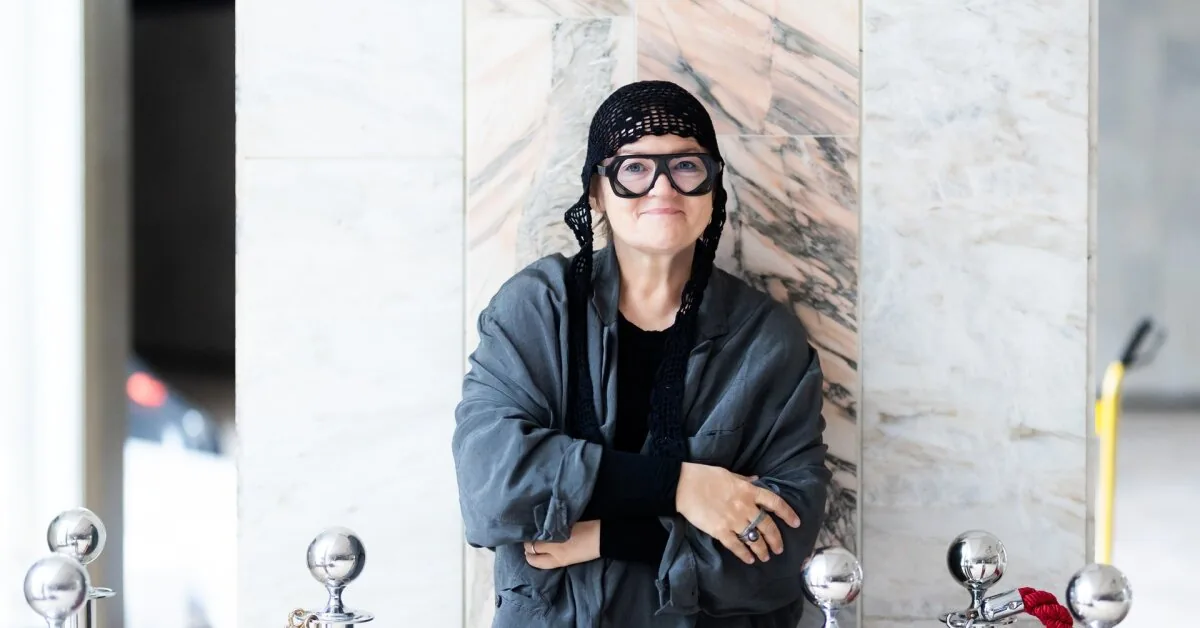
Interview with 15min where she talks about the cultural attaché network and its development plans, her personal decision to participate in the culture protest, the planned Lithuanian years in Germany, and the Lithuanian pavilion competition at the Venice Art Biennale.
Julija Reklaitė was interviewed by Monika Gimbutaitė.
Cultural Attaché Network and Expansion
– Let’s start with current affairs. The Prime Minister’s cultural advisor Darius Kuolys announced that a new cultural attaché position will be established in Latvia. How does the institute view this idea?
– The decision is essentially political. I lead the implementing institution. It is not my job to evaluate political decisions or politicians’ statements.
– Was this idea coordinated with the institute? Do I understand correctly that you learned about the decision after it was made?
The cultural attaché is one, but not the only tool to operate abroad.
– To be fair, as the minister has also mentioned, discussions about expanding the cultural attaché network have already taken place. We have a list of priority countries, which we compiled based on where the cultural field sees greater cooperation opportunities. Another part is our foreign policy directions. Where various interests intersect, we consider whether a cultural attaché is needed as reinforcement for embassies.
Latvia was not on this list. But that does not mean there is no need to strengthen cooperation, visibility, etc., among the Baltic countries. The cultural attaché is one, but not the only tool to operate abroad. If there is a need to work more closely with the Baltic countries, we are ready and could offer various ways of operation.
– Which countries are on the mentioned list? What are the institute’s priority directions if there is an opportunity to expand the attaché network?
– Besides the already operating 11 cultural attachés in 14 countries, we see a need to strengthen the Benelux countries. Currently, during the European Union presidency period, we have a cultural attaché in Belgium, but we would like to extend this position. We consider that a cultural attaché is very much needed in Spain, also thinking about South America, as it is a huge Spanish-speaking market. The issue of a cultural attaché in South Korea remains relevant, left over from the times when attachés operated in China and South Korea.

– Culture Minister Lukas Alsys, in an interview with LRT Klasika, also mentioned the idea that the new attaché’s area of responsibility could expand, including Estonia alongside Latvia, or perhaps the Scandinavian countries, although we already have attachés for Denmark, Finland, and Sweden. How much does this proposal reflect the existing need? And how effective is the model in general when one attaché oversees more than one country?
– To answer how effective it is – countries are not equal. It depends not only on geography but also on the intensity of connections. For example, in the Benelux case, the network is very developed, so I certainly don’t think it would be a problem. We have attachés in three Scandinavian countries. But movement between them – both of artists and cultural attachés – is quite complicated because travel between countries is expensive and distances are very large. Physically it is difficult, but the work goes well. However, several countries are covered because of a lack of resources, which are optimized.
The most important thing is to have a reasoned discussion with the field and professionals: what connections we already have, what needs strengthening.
Returning to the Latvia question, it could definitely be Latvia, Estonia plus someone else, possibly Finland. If this is our political direction, and it seems it is – both because of NATO expansion and our identity, regional security issues – it would certainly be possible to redistribute geography a bit. The most important thing is to have a reasoned discussion with the field and professionals: what connections we already have, what needs strengthening. I think looking to the future, it is worth thinking geographically broader, not about covering just one country.
– Last year, the institute took over the cultural attaché functions from the Ministry of Culture, although it had previously worked with the cultural attaché network. What fundamental change occurred? How much does taking over the functions mean a stronger voice in the development and review of the attaché network when discussing with the political field?
– The institute has always overseen the cultural attaché activities. But, as emphasized in the 2018 audit, it is not good when you are responsible for the budget and activities of a person who is not your employee. This was one of the key arguments for transferring cultural attachés as employees to the Cultural Institute. Everything else remained the same, only now the administrative connection is direct: it is easier to set tasks, priorities, and record activities.
We put more and more effort into analysis so that we can have answers for ourselves, politicians, and the field about the impact of one or another decision and the direction we are moving. How much does this strengthen us politically?
We maintain close relations with the Ministry of Culture, which we have greatly strengthened, and with the Ministry of Foreign Affairs.
Again, we are an agency, an executor of political decisions. Greater influence in the long run can only come through reputation and building authority. We maintain close relations with the Ministry of Culture, which we have greatly strengthened, and with the Ministry of Foreign Affairs.
The cultural attaché, it should be emphasized, works in embassies, and their second, no less important, leader is the ambassador. Attachés are diplomatic corps employees, and how they get along with diplomats greatly affects the result. But our work is not directly related to influencing political decisions.
– One could argue that the institute’s voice should have influence on these issues because the institute best senses the temperature and develops cultural ties abroad. Are there positive signals that the priority cultural attaché directions you mentioned might appear?
– In principle, yes. But until decisions are made, it is very difficult to say firmly. Because it is not only political will but also a budget issue. We would very boldly expand the attaché network if we were not limited by resources.
We are not only talking about maintaining the attaché as a person in that country. It is a whole cultural package issue. If the Culture Council’s budget does not increase, the opportunities for cultural organizations to operate abroad decrease. When facing financial difficulties, international activities are often reduced first because they are more expensive and complicated, and most organizations’ main audience and mission are in Lithuania. Therefore, we are directly connected to the overall situation in the cultural field.
The institute was granted public administration rights in 2022, which also allowed it to allocate the state budget, i.e., organize competitions. Strengthening the institute has always been listed among priorities in government programs. But in reality, we have minimally increased the number of competitions during that time because each competition requires additional money. Without increasing resources, the status itself does not provide anything extra.

“You have to find a way to serve the state, not a political force”: culture protest and the institute
– We want to discuss political moods in the cultural field. It is no secret that the past cultural season had a very high political temperature. You yourself participated in Cultural Assemblies and spoke there. The sign of the culture protest still hangs on the doors of the Cultural Institute. You refused to participate in the State Progress Council when members of the assembly’s initiative group – Gintarė Masteikaitė and Arūnas Gelūnas, as well as the president of the Lithuanian Youth Organizations Council Umberto Masi – were removed from it. Did these decisions pose professional or political risks for you as the head of the institution?
– I would not have made certain decisions if I had not weighed those risks. But I certainly cannot speak about any consequences – communication with the entire leadership is normal and constructive.
The image of Lithuania that we form abroad is not an artificially created positive narrative. It must speak about what is currently relevant in Lithuanian culture.
Why did I participate in the assembly and feel I had to be there? That summer, before the protests began, we talked a lot about values and directions at the institute. One of the main conclusions was that reputation is very important to us both internationally and in Lithuania. Our main audience or, if you will, client is the artist and cultural organization in Lithuania. If we have nothing to export, we can create whatever programs we want – we are nobody. This means that we operate according to the cultural field’s line and support it at all stages.
The image of Lithuania that we form abroad is not an artificially created positive narrative. It must speak about what is currently relevant in Lithuanian culture. Institutes we cooperate with operate on a similar principle – both Goethe’s and the French Institute.
In this sense, the protests that took place in Lithuania seem to me a very positive sign. With threats coming from the radical left, the right, and unfriendly states, all countries without exception face them. But their reactions differ. In Lithuania, the cultural field managed to defend itself from radical forces. These threats have not disappeared. But the first step and creative approach, a very flux approach – a wild, creative, democratic movement – were received absolutely positively by colleagues.
The cultural field identified that it is first important to protect the state itself. And then everything else – money or duties. I had discussions about what a civil servant can and cannot do. But my conclusion is very simple. I serve the state. If there are higher goals, you have to find a way to serve the state, not a political force or an inappropriate instruction.
In Lithuania, the cultural field managed to defend itself from radical forces. These threats have not disappeared.
Will the season’s success in France be repeated?
– Another question that received much attention in the political field is the Lithuanian years in Germany. According to President Gitanas Nausėda, this was even one of the reasons why the then Minister of Culture Šarūnas Birutis was removed from office – allegedly due to a lack of ministerial initiative, although it would seem that the project’s organizational work is primarily under the institute’s umbrella. How much basis did the president’s statement have in your eyes?
– This would be commenting on political activity, so I would like to refrain. But in our view, attention to Germany and international cultural cooperation is significant, as all recent culture ministers have said: Birutis, Adomavičius, Aleknavičienė, and now Alsys. The president also contributes to this. It is no secret that the Lithuanian season in France took place at his initiative. They want to replicate that success in other countries and formats.

Germany resonates strongly because this is not just a cultural project – it is primarily about security, the brigade issue, and then the cultural dimension appears. I think cooperation with Germany is very natural: if you come to defend, you have to understand what you are defending. With greater attention to culture come certain obligations. We become more visible in the political field – we did not talk so much about such things before.
– Does additional pressure come with the attention? It seems that a kind of cultural “seasonality” has taken hold in part of the political field. But it is no secret that the successful season in France happened thanks to huge mobilization by the institute and the cultural field. Is there an expectation that such sprints will now be run every year or every two years?
– In international formats, we have often been called victims of our own success. When you do something well, you attract attention, and everyone expects you to repeat it.
We do not represent individual artists and do not create programs ourselves – our strength is the strength of cultural organizations. If they do not feel safe, they cannot create and have to constantly run a marathon at sprint pace, we will very quickly burn out the entire cultural field. New productions must appear, young artists must have a place to experiment – we cannot always rely on the same stars with the same production.
If we do not create a sustainable funding system focused not only on results and their export but also on strengthening organizations, sooner or later we will end up in a dead end.
We are trying to create an algorithm for international focuses: how often they could take place and how much preparation they need. Everyone sees the result, but up to three months of programming is three years of work.
If we do not create a sustainable funding system focused not only on results and their export but also on strengthening organizations, sooner or later we will end up in a dead end. And political orders will always be more focused on short terms and quick results. They do not interfere with each other if the management and funding system is regulated. Because if only resources were sufficient, the cultural field would certainly not be against working with Germany, Sweden, Poland, or other countries. But all this takes time and money.
– Speaking of money – how much does the funding allocated for the Lithuanian years in Germany reflect the real need of such a large-scale project?
– It depends on how the goal is presented. If we want to surprise Germany with one million euros, it is certainly not a country of that scale – I sometimes joke that if our goal is to introduce Germans to Lithuania, it is better to spend that million on an advertising campaign rather than transporting cultural production. But if we want Germans to really get to know Lithuania, our history, and relevant topics, it requires long-term work – it costs, it is not a one-time shot.
We see the program in Germany as long-term. Resources are limited, one million euros per year, so it seems important to us to put a lot of effort into getting to know each other: organizing visits to Germany, showing already created products, i.e., investing in mobility. I believe this will lead to a need for larger projects. And good ideas can find other funding sources – European Union funds, lands, municipalities.
I do not want to compare seasons: their timing, circumstances, and countries differ. But expecting the kind of success that happened in France in three months under current conditions would be unrealistic. However, seeing the result of what we are doing now after five years is entirely possible.

Three ideas received in the Venice Art Biennale competition
– Another change – this year the institute took over the organization of the Lithuanian pavilion competition at the Venice Art Biennale from the Lithuanian Council for Culture. The competition consists of two stages, the first of which is the currently ongoing ideas competition. How many ideas did you receive?
– Three.
– Probably your expectation was different? As I understand, the two-stage competition was organized hoping to encourage more active participation?
– We introduced two stages responding to artists’ expectations to ease participation conditions. We based it on the Estonian example, where in the first stage an international commission meets with artists, gets acquainted with their portfolios, and for the artists themselves, it is an opportunity to increase competencies by gaining such experience.
To represent Lithuania at the Venice Biennale, a very strong organization with large financial and human resources is needed.
The eased conditions did not yield the expected result – we did not receive the dozen or so applications that could be expected. This partly shows that the field is small: there is a kind of silent agreement – if he participates, maybe now it is his turn, I will wait. At the same time, to represent Lithuania at the Venice Biennale, a very strong organization with large financial and human resources is needed. In this sense, the field has not expanded – there are still only a few organizations of such caliber.
I think we will reconsider whether two stages are really needed in the future: the effort is great, but the result is not. On the other hand, we will see if conclusions can be drawn after one attempt because all processes need time to get going.
The reputation of the Venice Biennale itself may also have an impact. If the biennale’s position does not change, the question is how much prestige it will have in the future. In Lithuania and countries with a similar view of the situation, this may have an impact because huge efforts are needed for the pavilion, and after them, it may end up next to the Russian pavilion.
Huge efforts are needed for the Venice pavilion, and after them, it may end up next to the Russian pavilion.
Again, there have been competitions in the Culture Council with one or two applications, so in this sense, three applications are not so bad. All three applications are very strong, so I have no doubt that the winner will be worthy of attention. Candidates should be announced soon, and the winner will be revealed at the end of the year.
– Will the international selection committee be made public?
– It will inevitably be public because it will meet with the candidates.
International network and culture as part of security infrastructure
– Among the duties themselves is the role of vice president of the board of directors of the European Union National Institutes for Culture (EUNIC) network. How does Lithuania and its institute structure, financial resources compare to colleagues in this network?
– It is very difficult to comment because the structure and affiliation of cultural institutes vary. Some belong to Ministries of Foreign Affairs, others to Ministries of Culture, and others to both. For example, the Czechs have several physical institutes abroad whose employees are diplomats, Latvians do not have such an institute at all, Estonians have six cultural attachés without an institute.
What I definitely see is that in terms of the number of people and resources we have, we far exceed our capabilities. Colleagues often ask how many people work in our communications in Italy or Germany. Hearing the answer, many raise an eyebrow. For example, the Mickevičius Institute is about ten times larger in terms of staff and budget, but we sit equally at the same table, and in terms of implementing seasons – the number of events – the difference is certainly not one to ten.
Overall, our artists are also known for doing many seemingly impossible things. This is good news, but in terms of sustainability, it is also a big risk. In a country like Germany, the conditions under which our artists sometimes represent Lithuania at prestigious events would be considered exploitation. This is probably also our cultural internal issue.
At EUNIC, we can openly talk about common challenges and see that much larger countries face similar problems. We advise each other, coach each other, although institutes and their leaders are different. Ukraine is also an associate EUNIC member – network countries finance separate programs to help the Ukrainian institute navigate this difficult time.
In terms of the number of people and resources we have, we far exceed our capabilities.
I would see the difference mostly not through budgets or the number of employees but through political dependence, place in the state structure, programs. Maybe most of all – with what topics, challenges, and geographical directions are worked on. Most countries today see Africa as their main priority because some European issues are also decided there. Among countries, the approach to operating in the USA differs radically. Therefore, when reviewing the attaché network, it is important to consider not only our geographical directions but also see how other countries move.
– How much has cultural diplomacy in Lithuania already become part of foreign policy? How much is it understood in the political field that this is not an isolated issue relevant only to the cultural sector but an integral part of policy?
– I think cultural seasons also contribute to the common understanding. It is important to distinguish cultural diplomacy from cultural ties. Cultural diplomacy is more related to implementing foreign policy goals through culture, soft power. And cultural ties are when the field works with the field, connections are made between organizations, and later between societies. The Lithuanian Cultural Institute operates more in this area.
Another understanding is coming – that culture is not only part of diplomacy but also part of security infrastructure. We talk about reputational security.
– But the institute has a cultural diplomacy department.
– Yes. We named it that because of cultural attachés, who are embassy employees and also engage in cultural diplomacy. At the same time, we wanted to get closer to the Ministry of Foreign Affairs. We cooperate very closely with it, but our way of operating still comes more from the cultural field and its current issues.
The fact that diplomacy begins to see culture as an opportunity is also a consequence of the French season. Diplomats see how many doors open in France thanks to culture. And in Italy, we saw that cultural dialogue also starts to move economic and other issues.
I think another understanding is coming – that culture is not only part of diplomacy but also part of security infrastructure. We talk about reputational security. The idea that you treat those you know more carefully and gently. One of the goals of the German program we set for ourselves is to bring German society closer to our geopolitical situation.
Where connections arise naturally, where our artists are well seen, we should not interfere – just rejoice and tell their success stories in Lithuania.
Ten years ago, I probably would not have questioned the idea “let’s separate culture from politics,” which is actually one of the Russian propaganda narratives. But it was so ingrained that we really kept our distance, trying to be apolitical. And now we understand that we are an integral part of the same politics, diplomacy, and security infrastructure.
Only here remains the danger of instrumentalization. Culture must maintain autonomy and decide content-wise what, where, and how it does things. I listened to Saulius Šaltenis, former Minister of Culture, interview on “Pas Nemirą.” I really liked the phrase that culture needs two things – money and autonomy. I understand how this sounds to people who do not work in this field. But you cannot tell an artist where to go and what to do.
We follow Mirga, not Mirga us. And that is wonderful, it should be so. Where connections arise naturally, where our artists are well seen, we should not interfere – just rejoice and tell their success stories in Lithuania, because “you will not be a prophet in your own land.”
Read more Air threat declared in Romania due to incoming drone: F-18s scrambled