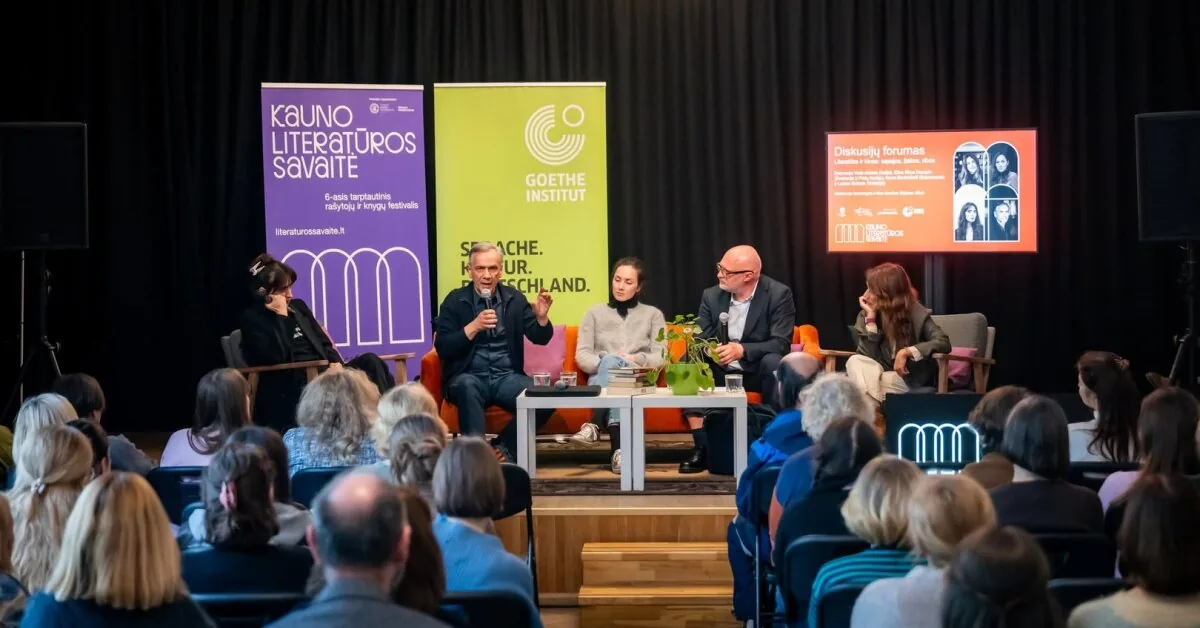
The symposium theme is “Writing in Dark Times: Central European Literature Today.” Participants will discuss how literature bears witness to war and other historical ruptures, preserves memory, helps build community, and maintains a sense of normalcy and freedom.
Read more Emmanuel Macron calls on the EC leader to ban social networks for children under 15 years old
At the same time, the current state of Central European literatures will be examined – new authors, generations, trends, similarities, and differences of these literatures.
“Every year, organizing the Kaunas Literature Week, we noticed a lack of events in our literary life that would encourage the exchange of ideas between Lithuanian and world writers, where professional acquaintances and future joint projects would be formed. Of course, translation workshops are organized, but it seems to me that we have not had a symposium with a broad and intensive international program for at least a decade.
The idea to expand the “Šeteniai Readings” and invite Ukrainian and Polish authors simply floated in the air. Of course, the first time is the first time: finding partners, coordinating organizational matters, securing funding involved overcoming many difficulties. It is gratifying that not only institutions but also private individuals responded to our request for support; we are very grateful to all of them.
Now I can proudly say that the path has been traveled, and invite all literature lovers to the symposium. We offer them not only new texts by authors, mostly sounding in Lithuanian for the first time, but also a rare opportunity to look into the creative and intellectual kitchen of writers, to hear how they assess the dramatic present of our literatures and countries,” says Laurynas Katkus, artistic director of the Kaunas Literature Week.
Šeteniai was chosen not by chance. In 2026, the 115th anniversary of Czesław Miłosz’s birth will be commemorated, and his work and the idea of Central Europe remain an important reference point when talking about memory, identity, and the complex history of the region.
The symposium will highlight the poet’s legacy and turn his homeland into a living place of literary dialogue. The event will also complement the program of Kėdainiai – the Lithuanian Capital of Culture in 2026 – with an international accent.
The organizers see the Šeteniai symposium as a continuing initiative that can strengthen the ties between Lithuanian, Ukrainian, and Polish literatures in the future.
When words lose meaning
One of the most important topics of the symposium discussions is the impact of war on language, literature, and the entire human existence.
Well-known and beloved in Lithuania, Krzysztof Czyżewski, a poet and one of Poland’s most prominent public intellectuals, will speak about “survival poetry” from Miłosz to Viktoria Amelina.
The famous Ukrainian writer Ostap Slyvynskyi will consider how catastrophes change the concept of truth in literature, how a fictional work differs from testimony, and what an “emotional document” is.
Poet Kateryna Michalitsyna will talk about the emptiness that opens beyond words: how words lose meaning, whether it is still possible to regain it, and what new dialogue is needed when usual forms of speech no longer work.
Read more In Tauragė – the European champion who just played in Russia
Poet Marius Burokas will raise the question of whether a premonition of war is possible in literature and how it manifests. He will also examine the growing war fatigue in society, the emptiness of talking about war, and the moral boundary faced by an author who writes about war but does not experience it directly.
Can literature still change society?
Writer and philosopher Mantas Adomėnas will consider whether literature can defend freedom and democracy, whether the free world needs a new grand narrative, and how to turn historical memory into a unifying rather than divisive force.
Poet and literary researcher Halyna Kruk will speak about Eastern Europe as a distinct, full-fledged part of European identity, which Western Europe often does not understand or notice. Her presentation will reveal the complex identity of a borderland person, a living and traumatizing force of history, and the memory of landscape and childhood as a foundation of inner freedom.
Essayist Danylo Ilnytskyi will view poetry as a chronicle, a repository of memory, and a way of healing. Is documentation merely a temporary function of wartime poetry, or does it become a new characteristic? How does the memory of totalitarianism and war operate in Ukrainian literature?
Prose writer Sandra Bernotaitė will consider how much historical events determine the unexpected relevance of literary works, and also whether literature can help develop inner resilience.
A detailed symposium program can be found at this link.
Living dialogue not only in Miłosz’s homeland
The main symposium program in Šeteniai will begin on September 23. For three days, presentations will be read, discussions and conversations will take place (in English). The symposium is open to the public and free of charge. Those wishing to participate are invited to register here by September 13.
No registration is required for those wishing to attend the readings of the symposium participants’ works in Kėdainiai, Kaunas, and Krasnagruda (Poland), where the manor belonging to Miłosz’s family remains and the “Pogranicze” foundation operates.
The readings will take place at the Kėdainiai Regional Museum Multicultural Center (Paeismilgio St. 12B) on September 24 at 6 p.m. The literary evening at the Kaunas Artists’ House (V. Putvinskio St. 56) will be held on September 25 at 7 p.m.
Readings will be in the authors’ native languages with Lithuanian translations, and conversations will be in English with translation into Lithuanian.
Read more Nerijus Mačiulis. Do not urge to give birth, there are more serious problems and better solutions